


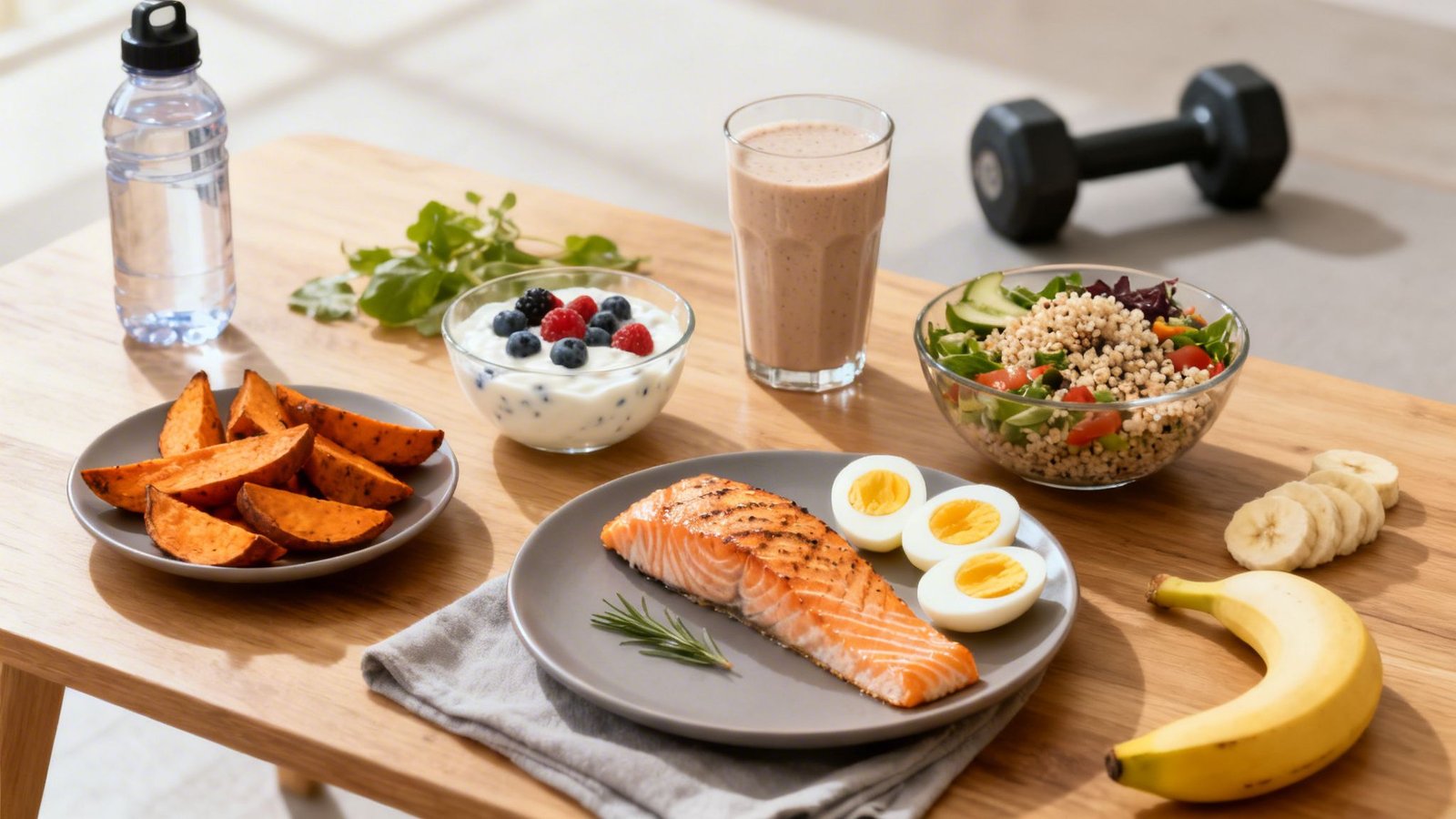
Once you've racked the weight on your final set, your body is ready for one thing: recovery. The two most crucial nutrients you can give it right now are a combination of fast-digesting carbohydrates and high-quality protein. This powerful duo works together to restock the energy you just burned and deliver the raw materials your muscles need to repair themselves and grow stronger.
Your Immediate Post-Workout Nutrition Blueprint
You just gave that workout everything you had, and now your body is practically screaming for nutrients. Think of the hours immediately after you train as a critical window to kickstart the recovery process and maximize the results from all your hard work. Nailing your nutrition here can make a huge difference in how quickly you bounce back, how sore you feel tomorrow, and how strong you are for your next session.
The Anabolic Window of Opportunity
You’ve probably heard people talk about the "anabolic window," that supposedly magical 30-minute timeframe after a workout where your gains are made or lost. The reality is a bit more forgiving than that. While it’s not a window that slams shut, the concept is rooted in truth: your muscles are significantly more receptive to nutrients for a few hours after you lift.
This heightened sensitivity is why your first post-workout meal is so important. Your goals are simple but powerful:
- Replenish Glycogen: Lifting weights uses up your muscles' main fuel source. Topping those stores back up with carbohydrates is non-negotiable for having enough energy for your next workout.
- Kickstart Muscle Repair: Strength training creates tiny micro-tears in your muscle fibers (which is a good thing!). Protein provides the amino acids needed to patch up that damage, building the muscle back bigger and stronger than before.
Research from the International Society of Sports Nutrition (ISSN) points to a clear target: consuming 20 to 40 grams of high-quality protein within a few hours of your workout is a game-changer for sparking muscle protein synthesis—the very process that drives muscle growth. If you want to dive deeper, you can learn more about optimizing your protein timing after a workout.
The real goal isn't just to eat, but to eat with purpose. Your post-workout meal is the first step in preparing your body for its next challenge. It’s not about perfection but consistency in providing the right fuel at the right time.
The infographic below breaks down these core nutritional targets, showing how protein and carbs work together to refuel and rebuild.

This visual guide reinforces the fundamental principle of smart recovery: hit a solid protein target to support muscle growth and match it with a healthy dose of carbohydrates to restore your energy levels.
The Real Reason Protein and Carbs Are Your Post-Workout Lifeline

Ever wondered what’s actually happening inside your body after a tough lifting session? It’s a bit like a construction site. Pushing your limits creates tiny, microscopic tears in your muscle fibers. This isn't a bad thing; it’s the necessary first step for growth. But to rebuild that muscle stronger than before, you need the right materials and a crew to do the work.
That's precisely where protein and carbohydrates come in. Right after a workout, your body is in a breakdown, or catabolic state. Your post-workout meal is the signal that flips the switch from breaking down to building up—an anabolic state. This whole rebuilding process is what we call muscle protein synthesis (MPS), and it's the secret to turning gym effort into real-world strength.
Protein: The Bricks for Building Stronger Muscle
Let's start with the most important building material: protein. It supplies the amino acids your body desperately needs to patch up those muscle fibers.
Think of amino acids as the individual bricks for your muscle wall. When you eat protein after training, you're essentially rushing a delivery of fresh bricks straight to the construction site. This allows your body to not only repair the damage but to add a few extra layers, making the muscle bigger and more resilient for next time.
For most people, a target of 20-40 grams of high-quality protein after a workout is the sweet spot. This dose is proven to kickstart that muscle repair response and make sure none of your hard work goes to waste. If you're new to this and looking for a convenient way to hit that target, our guide to the best protein powder for beginners can help you sort through the options.
Protein’s main job after training is to stop the breakdown and kickstart the repair. It’s the raw material that transforms the stress of your workout into actual muscle gains.
That quick influx of amino acids basically tells your body, "Okay, demolition is over. It's time to build."
Carbohydrates: The Fuel for the Construction Crew
So, protein provides the bricks. But what about the crew that has to lay them? They need energy, and that’s where carbohydrates come in.
Strength training burns through your muscles' primary fuel source, a stored sugar called glycogen. After a tough workout, those fuel tanks are running on empty. Ignoring this is like asking your construction crew to work a double shift with no power tools—they’ll be slow, sloppy, and quit before the job is done. The result for you is that heavy-legged, sluggish feeling and a much slower recovery.
Here’s why restocking those carbs is non-negotiable:
- Restores Your Energy: Eating carbs quickly refills your muscle glycogen, getting you ready to go for your next session. No more dragging yourself through your next workout.
- Keeps Fatigue at Bay: Topping off your energy stores helps you sidestep that post-workout crash and keeps you feeling sharp.
- Protects Your Muscle: Carbs are so important that they have a "protein-sparing" effect. By providing a quick energy source, they allow all that protein you just ate to be used for muscle repair, instead of being burned for fuel.
Think of it this way: your body's number one priority is energy. If you don't give it carbs, it might start converting that valuable protein into fuel, completely derailing your muscle-building goals. Combining carbs and protein is the ultimate one-two punch that lets each nutrient do its job, speeding up your recovery and maximizing your results.
A Lifter’s Grocery List: 21 of the Best Foods for Post-Workout Recovery
It’s one thing to know you need protein and carbs after a tough workout. It’s another thing entirely to figure out what to eat that isn't the same old plain chicken and rice. Let's be honest, your post-workout meal should be something you actually look forward to.
Think of this as your go-to grocery list for real, whole foods that speed up muscle repair and get you ready for your next session. Each food here is picked for its powerful mix of nutrients that specifically support recovery.
Protein Powerhouses for Muscle Repair
After you lift, your muscles are screaming for protein. It provides the amino acids—the literal building blocks—your body needs to patch up the micro-tears in your muscle fibers and rebuild them stronger. Making high-quality protein the star of your post-workout meal is non-negotiable.
Here are some of the best choices out there.
- Eggs: Many people call eggs the perfect protein for a reason. They pack all nine essential amino acids your body needs to kickstart muscle repair. Plus, the yolk delivers healthy fats and vitamins that are crucial for hormone health. Quick meal: Whip up a two-egg omelet with a handful of spinach and serve with whole-wheat toast.
- Greek Yogurt: This is an absolute champ for protein, especially casein. Because casein digests slowly, it feeds your muscles a steady stream of amino acids over several hours. Just be sure to grab the plain kind to dodge unnecessary sugar. Quick meal: A bowl of plain Greek yogurt topped with fresh berries and a small handful of almonds.
- Salmon: Not only is salmon loaded with top-tier protein, but it’s also one of the best natural sources of omega-3 fatty acids. These healthy fats are fantastic for taming post-workout inflammation and can help take the edge off muscle soreness. Quick meal: A grilled salmon fillet with a side of roasted sweet potatoes.
- Chicken Breast: It's a classic for a reason. Chicken breast is lean, incredibly versatile, and won't break the bank. You can easily cook up a big batch to have on hand for quick meals all week. Quick meal: Toss some pre-cooked, shredded chicken into a quinoa salad.
- Cottage Cheese: Just like Greek yogurt, cottage cheese is swimming in muscle-building casein protein. This makes it an amazing recovery food, especially if you eat it before bed. It's also high in leucine, the single most important amino acid for firing up muscle growth. Quick meal: A scoop of cottage cheese mixed with sliced peaches and a dash of cinnamon.
- Tuna: For a fast and affordable protein hit, you can't beat canned tuna. A single can gives you a serious dose of protein to get the recovery process started immediately. Quick meal: A classic tuna salad sandwich on whole-grain bread.
- Tofu: A fantastic option for plant-based athletes, tofu is a complete protein that's easy on the stomach. It's a blank canvas, soaking up the flavor of whatever you cook it with. Quick meal: A quick tofu scramble with chopped bell peppers and onions.
Carbohydrate Champions for Topping Off the Tank
Carbs are your body's preferred energy source. After a workout, your muscle glycogen—the fuel stored in your muscles—is running on empty. Eating carbs helps you restock those stores so you’re powered up for your next workout. Carbs also play a key role in helping shuttle protein into your muscle cells where it can get to work.
- Sweet Potatoes: These are a go-to source of complex carbohydrates, meaning they provide long-lasting, steady energy. They’re also full of antioxidants like beta-carotene. Quick meal: A simple baked sweet potato topped with a spoonful of Greek yogurt.
- Quinoa: A true nutritional all-star, quinoa is both a complex carb and a complete protein. It has a great nutty flavor and texture that works well in almost any meal. Quick meal: Use it as a base for a recovery bowl with black beans, corn, and avocado.
- Oats: You can't go wrong with a bowl of oatmeal. It’s a simple, comforting, and incredibly effective way to get quality complex carbs and fiber to refuel your system. Quick meal: A warm bowl of oatmeal made with milk (for extra protein!) and topped with a sliced banana.
- Bananas: When you need carbs fast, grab a banana. They're super easy to digest and are packed with potassium, a key electrolyte you lose through sweat that helps keep your body’s fluids balanced. Quick meal: Slice one into your protein shake or just eat it with a big spoonful of peanut butter.
- Tart Cherries: This one might surprise you, but research has shown that tart cherries and their juice can noticeably dial down muscle soreness and inflammation after exercise. Quick meal: Drink a small glass of pure tart cherry juice or mix some dried tart cherries into your yogurt.
Recovery Tip: The magic happens when you combine these foods. The best post-workout meals pair a great protein source with a quality carb source to tackle both muscle repair and energy replenishment at once. A plate of grilled chicken (protein) and sweet potato (carbs) is a classic for a very good reason.
How To Time Your Nutrients For Optimal Results

For years, the gym world has been obsessed with the "anabolic window." You've probably seen it—the frantic rush to slam a protein shake within 30 minutes of the last rep, fearing that any delay means lost gains.
While that idea is rooted in some real science, the panic is completely overblown. The good news is that your body is much more forgiving than that. Think of it less as a tiny window that slams shut and more as a wide-open "opportunity garage." After a tough workout, your muscles are primed and ready to soak up nutrients, but this heightened sensitivity lasts for several hours, not just a few minutes.
This gives you a ton of flexibility. You don't need to stress about racing the clock. The single most important thing is consistently hitting your total daily protein and carbohydrate targets. Perfect timing is just the cherry on top that helps optimize the process.
Translating Targets Into Real Food
Knowing what to eat is just as crucial as knowing when. Vague advice is useless when you're tired, hungry, and staring into your fridge. So, let's nail down some specific numbers you can actually use.
Here are some practical guidelines for your post-workout meal:
- Protein: Aim for 0.14–0.23 grams of protein per pound of your body weight (0.3–0.5 grams per kilogram). For a 180-pound person, that’s a solid 25–41 grams of protein.
- Carbohydrates: You’ll need quite a bit more here. Shoot for 0.5–0.7 grams of carbs per pound of body weight (1.1–1.5 grams per kilogram). For that same 180-pound person, this works out to 90–126 grams of carbs.
Following these guidelines ensures you're giving your body plenty of amino acids to repair muscle and enough glucose to restock your energy stores. This is what sets you up to come back even stronger for your next session.
Your post-workout meal's primary job is to kickstart recovery by supplying protein for muscle repair and carbs for energy replenishment. Hitting these targets within a few hours of training is far more important than hitting a 30-minute deadline.
Putting it all together, a meal could look like a large chicken breast (about 40g of protein) served with a big sweet potato (roughly 40g of carbs) and a side of broccoli. Simple and effective. If you want to go deeper on how protein fuels your efforts, see our expert advice on whether you should take protein during a workout.
When Faster Timing Matters More
Even though the anabolic window is flexible for most of us, there are a couple of situations where timing becomes more critical. The urgency really depends on your training schedule.
You should make it a priority to eat sooner rather than later if:
- You Train Twice a Day: If you have another workout coming up in less than eight hours, getting a meal in quickly is key. A fast-digesting combination of protein and carbs will accelerate glycogen replenishment so you're ready for round two.
- You Trained in a Fasted State: Working out on an empty stomach means your body is already in a state of breakdown. A post-workout meal becomes much more urgent to flip the switch from breaking down muscle to building it back up.
But for the vast majority of people who lift once a day and ate a meal a few hours beforehand, a balanced meal within two to three hours is a perfect strategy. It takes the stress out of nutrient timing and lets you focus on what really drives results: quality and consistency.
A Look at Key Supplements for Better Recovery
Let's be clear: a solid diet built on whole foods is always your foundation. Nothing replaces that. However, certain supplements can give you a real, convenient edge in your recovery. Think of them not as magic pills, but as strategic tools to fill nutritional gaps and speed up your body's repair process, especially when life gets busy.
Knowing what these supplements do helps you figure out what to eat after strength training to get the best results. We'll focus on two of the most proven and effective options out there: whey protein and creatine monohydrate. These aren't just for pro bodybuilders; they're for anyone serious about recovering faster and getting stronger.
Whey Protein: Concentrate vs. Isolate
Whey protein is the go-to post-workout supplement for a reason. It's a high-quality, fast-digesting protein from milk, loaded with all the essential amino acids your muscles are crying out for after a tough session. Downing a whey shake is like sending a rapid-response repair crew directly to your tired muscle tissues.
You'll generally see two main types on the shelf, and knowing the difference can help you pick the right one for your goals and budget.
- Whey Concentrate: This is the most common and budget-friendly option. It's less processed, which means it keeps a little more of the natural fat and carbs (lactose) from milk. For most people, concentrate is a fantastic and effective choice.
- Whey Isolate: This is the more refined version. Extra processing removes nearly all the fat and lactose, bumping the protein content up to over 90%. This makes it the perfect pick if you're lactose intolerant or watching your macros like a hawk. That purity also means it gets absorbed just a little bit faster.
A simple dose of 20-30 grams of whey mixed with water or milk within an hour of your workout is a great way to kickstart that muscle repair process.
Demystifying Creatine Monohydrate
If protein is the building block for repair, creatine is the power source. Think of it as a battery recharger for your muscle cells. Your muscles run on a high-energy molecule called ATP (adenosine triphosphate) to fuel every single contraction.
When you're training hard, you burn through your ATP supply fast. Creatine is the superstar that helps your body rapidly regenerate that ATP. This allows you to squeeze out that extra rep or two, maintain your strength throughout your workout, and ultimately drive greater long-term gains in strength and size.
Creatine doesn't build muscle fibers directly the way protein does. Instead, it supercharges your performance in the gym, which is the stimulus that tells your body to build more muscle.
It's one of the most heavily researched supplements on the planet, with decades of data confirming its safety and effectiveness. If you're interested in exploring other recovery aids, check out our complete guide on the best supplements for workout recovery.
The most effective approach is simple: take 3-5 grams of creatine monohydrate every day. There's no need to cycle on and off. While timing isn't crucial, many people find it easiest to just mix it into their post-workout shake so they never forget.
Post-Workout Supplement Comparison
To help you choose the right tools for your recovery, here’s a quick comparison of some popular supplements you might consider adding to your post-workout routine.
| Supplement | Primary Benefit | Optimal Timing | Pros | Cons |
|---|---|---|---|---|
| Whey Protein | Fast muscle repair and growth | Within 60-90 minutes post-workout | Rapidly digested, complete amino acid profile, convenient | Can cause digestive issues for those with lactose intolerance |
| Creatine | Increased strength & power output | Daily (timing not critical) | Highly effective, well-researched, inexpensive | Can cause minor water retention (in the muscle) |
| Casein Protein | Slow, sustained muscle repair | Before bed or between long meals | Provides a steady release of amino acids, promotes satiety | Slower digestion makes it less ideal for immediate post-workout needs |
| BCAAs | Reduces muscle soreness & fatigue | Intra-workout or post-workout | May decrease muscle breakdown, easy to drink during training | Benefits are minimal if you already consume enough protein |
Each supplement offers unique benefits, but for most people starting out, a combination of whey protein and creatine provides the most significant and scientifically-backed advantages for post-strength training recovery.
Your Path to Smarter Recovery and Stronger Results

So, let's pull all of this together. The goal isn't perfection; it’s building a simple, sustainable habit around your post-workout nutrition that actually works for you. Getting this right is how you amplify the hard work you just put in at the gym.
The core idea is refreshingly simple. After you train, your priority is a meal that delivers a solid one-two punch of protein and carbohydrates. Aim to get this meal in within a couple of hours after your session. This gives your tired muscles the exact fuel they need to start repairing and restocking their energy reserves.
Building Your Recovery Meal
Think of your post-workout plate as a construction site. Protein provides the bricks to rebuild and strengthen muscle fibers, while carbs are the energy source that gets the whole crew back to work.
- Protein: This is your non-negotiable for kickstarting muscle protein synthesis—the scientific term for the muscle-building process.
- Carbohydrates: These are essential for refilling the glycogen stores you burned through, ensuring you’re ready for your next workout.
We’ve already walked through plenty of great food choices. Whether it's a plate of salmon and sweet potatoes or a quick bowl of Greek yogurt and berries, you have tons of delicious ways to nail your recovery nutrition.
Your goal is to build a nutrition framework that fits your lifestyle. Consistency with good choices is far more powerful than occasional perfect meals.
Finally, remember where supplements fit in. Things like whey protein or creatine are fantastic tools, but they are not magic. Think of them as convenient gap-fillers, perfect for when you're in a rush, but they should never replace real, whole foods.
By putting these simple strategies into practice, you create a powerful blueprint for getting stronger, recovering faster, and truly making your training count.
Conclusion
Mastering what to eat after strength training is less about a single "perfect" meal and more about consistently applying core principles. The foundation of effective recovery is simple: combine high-quality protein with sufficient carbohydrates within a few hours of finishing your workout. Protein provides the building blocks for muscle repair, while carbohydrates replenish the energy stores you've depleted.
Whether you opt for whole foods like chicken and sweet potatoes, a convenient protein shake, or plant-based options like tofu and quinoa, the key is to fuel your body intentionally. This guide has provided 21 excellent food choices to get you started. Remember that supplements can be powerful allies, but they should complement, not replace, a solid nutritional base. By making smart, consistent post-workout choices, you ensure that every rep you perform in the gym translates into tangible strength, growth, and faster recovery.
Frequently Asked Questions
When it comes to post-workout nutrition, a lot of questions pop up. Getting clear, straightforward answers is the key to building a strategy that works for you, without all the guesswork. Let’s tackle some of the most common questions people have about what to eat after hitting the weights.
What Should I Eat After a Late-Night Workout?
Training late at night throws a wrench in the usual post-workout meal plan. The last thing you want is a heavy meal sitting in your stomach while you're trying to sleep. The trick is to choose something that kickstarts muscle repair but is also light and easy to digest.
A protein shake made with water is often the perfect solution. It gets those crucial amino acids to your muscles fast without weighing you down. Other great options are a bowl of plain Greek yogurt with a handful of berries or a small serving of cottage cheese. They give you the protein you need to start the recovery process without disrupting your rest.
Do I Need to Eat Fat After Strength Training?
While protein and carbs should be your main focus right after a workout, healthy fats are absolutely essential for your overall health and long-term recovery. They play a huge role in hormone production and managing inflammation, both of which are critical for building muscle.
That said, you probably want to limit the fat in your immediate post-workout meal. Fat slows down digestion, which can delay how quickly your muscles get the protein and carbs they’re screaming for. A much better approach is to include healthy fats—from sources like avocado, nuts, seeds, and olive oil—in your other meals throughout the day, a few hours removed from your training session.
Think of it this way: protein and carbs are your rapid-response team, rushed to the scene immediately. Healthy fats are the long-term support crew, coming in later to handle systemic repairs and maintenance.
What Are the Best Plant-Based Options After a Workout?
If you’re on a plant-based diet, you have plenty of fantastic options for refueling after a workout. The main goal is the same: combine a complete protein source with a quality carbohydrate to cover all your recovery bases.
Here are a few powerful plant-based combos:
- Tofu Scramble: A simple scramble with firm tofu gives you a complete protein profile. Pair it with a side of roasted sweet potato for that perfect carb-protein punch.
- Lentils and Quinoa: A bowl of seasoned lentils served over quinoa is a classic for a reason. It delivers complex carbs for energy and a solid dose of plant-powered protein.
- Plant-Based Smoothie: When you're short on time, a smoothie is your best friend. Blend a scoop of pea or soy protein powder with soy milk, a banana, and a handful of spinach for an all-in-one recovery drink.
Is It Okay to Only Have a Protein Shake After Working Out?
A protein shake is incredibly convenient and a fantastic way to deliver high-quality protein to your muscles quickly. But here's the catch: it’s only half of the recovery equation. If you focus only on protein, you're ignoring the other critical piece of the puzzle—refilling your energy tank.
During a tough strength session, your muscles burn through their stored carbohydrate fuel, called glycogen. If you don't replace it, you’ll feel sluggish in your next workout, and your body might even resort to breaking down muscle tissue for energy—the exact opposite of what you want.
For the best results, either add a fast-digesting carb source like a banana or some powdered oats right into your shake, or make sure you follow it up with a solid food meal containing carbs within the next hour or two.
At Energy Supplement Reviews, we provide the insights and reviews you need to make informed choices about your fitness and nutrition. Explore our expert guides to find the best strategies and products for your goals at https://energysupplementreviews.com.
