


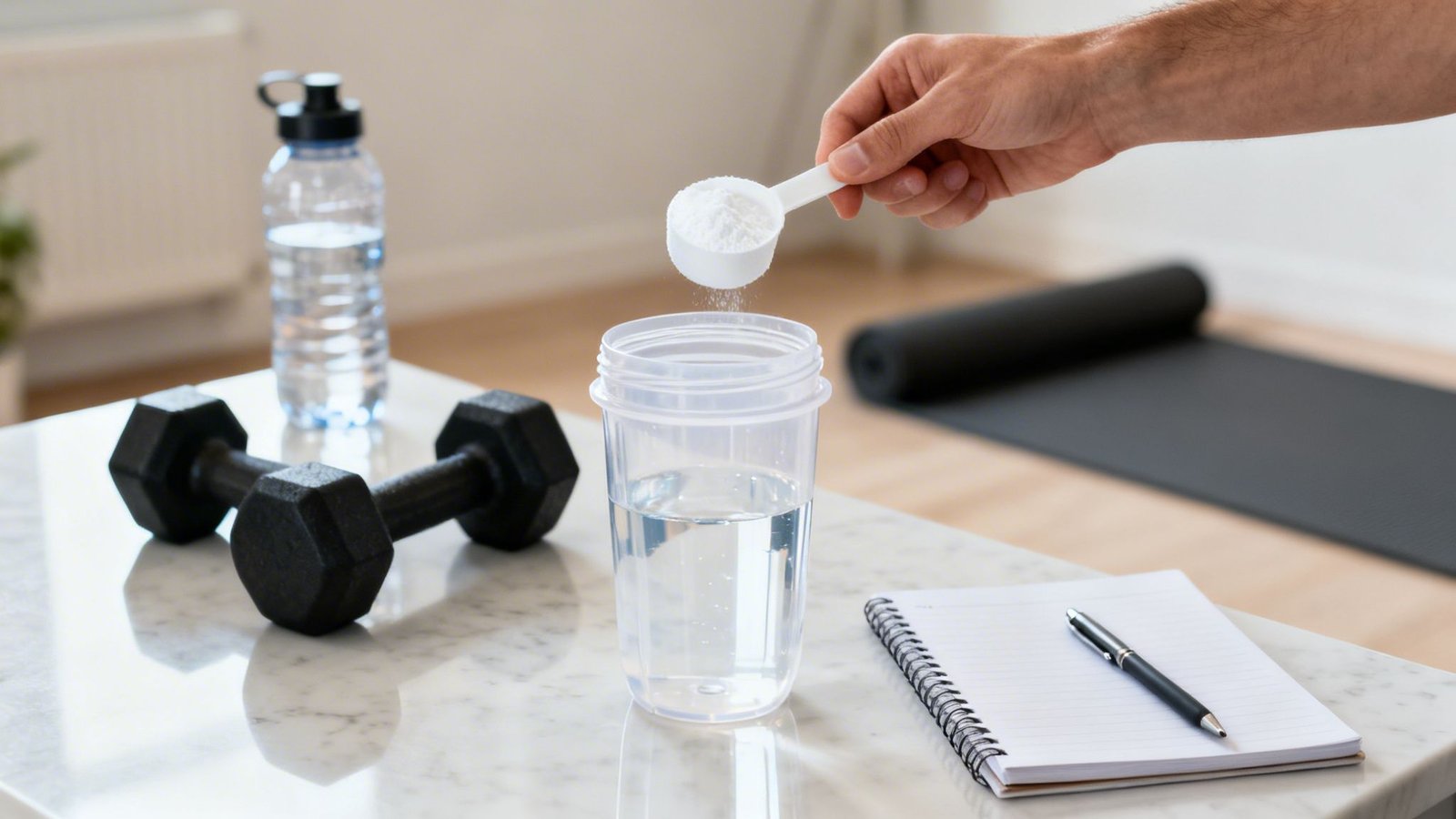
You’re probably here because your home workouts are consistent, but your progress feels slower than it should. You’re doing push-ups, goblet squats, split squats, rows, maybe some resistance band work, and you want a simple supplement that helps.
Creatine is one of the few that earns that trust. For beginners, it does not need to be complicated, expensive, or tied to a gym-only routine. If your goal is to get stronger, recover well enough to train again, and make your reps count at home, this is one of the clearest places to start.
The short version is simple. Buy creatine monohydrate from a reputable Amazon listing, choose either a loading phase or a steady daily dose, take it consistently, drink enough water, and keep training hard. The details matter, though, because the right method makes the difference between “this is easy” and “why does this feel bloated and messy?”
What Is Creatine and Is It Right for Your Home Workouts
If your workouts rely on short bursts of effort, creatine makes sense. That includes push-up sets near failure, dumbbell presses, lunges, jump squats, hill sprints, and bodyweight circuits where you’re working hard for brief efforts and then repeating them.
Creatine is a compound your body already uses to help produce quick energy. Supplementing it helps your muscles keep more of that high-output fuel available, which is why it’s useful even if you never touch a barbell.

Why beginners usually do best with monohydrate
The version I recommend first is creatine monohydrate. It is the form with the deepest research base and the simplest use case.
According to the University of Rochester Medical Center, creatine monohydrate at 3 to 5 grams daily is supported by over 700 studies since 1992, with 5 to 20% performance boosts in beginners by increasing phosphocreatine stores that fuel 10 to 30 second anaerobic bursts used in home strength training and bodyweight circuits (University of Rochester Medical Center creatine for beginners guide).
That matters because many beginners do not fail from a lack of motivation. They fail from not getting enough quality work out of each session. An extra rep here, a stronger set there, or slightly better repeat effort across a week adds up.
When creatine fits your situation
Creatine is a good fit if you:
- Train at home consistently and want better strength progress
- Use dumbbells, bands, or bodyweight circuits where repeat effort matters
- Want a supplement with a simple routine instead of a complicated stack
- Prefer value over hype and would rather buy one proven product than five trendy ones
It is not a magic shortcut. If your training is random and your protein intake is poor, creatine will not rescue the program.
Practical takeaway: For many beginners, the best “review winner” is plain creatine monohydrate powder from a reputable Amazon brand. Fancy forms are rarely the right starting point.
What works and what does not
A few beginner mistakes show up constantly.
| Choice | Better option |
|---|---|
| Buying a flashy proprietary blend | Buy plain creatine monohydrate |
| Taking it only on workout days | Take it daily |
| Expecting a stimulant-like feeling | Expect a gradual training benefit |
| Switching products every week | Stay with one simple product and be consistent |
If you’re learning how to take creatine for beginners, think of it as a daily saturation habit, not a pre-workout buzz.
The First Decision Loading Phase vs Maintenance-Only
This is the first fork in the road. You can either saturate your muscles faster with a loading phase, or take a slower route that is easier on the stomach for many beginners.
Neither path is wrong. The better option depends on whether you care more about speed or comfort.

Option one loading phase
The standard beginner loading method is approximately 20 grams per day, split into four 5-gram doses, for 5 to 7 days, followed by 3 to 5 grams daily for maintenance. This approach can raise muscle creatine stores by 20 to 30% beyond baseline (Herbalife creatine guide).
This is the fast-track approach. If you want to get saturated quickly and you tolerate supplements well, it’s effective.
Pros
- Faster saturation: You get to a fully loaded state more quickly.
- Simple short-term plan: One week of structure, then a smaller daily dose.
- Good for impatient beginners: Some people prefer doing the work up front.
Cons
- More chances for stomach discomfort: Bigger total intake means more room for bloating or digestive issues.
- More planning: Four doses a day is less convenient than one.
- Easy to do sloppily: Missing doses turns a “fast” method into an annoying one.
Option two maintenance-only
The other route is straightforward. Take 3 to 5 grams every day from the start and keep doing it.
This method takes longer to fully saturate your muscles, but it is usually easier to stick with. If you’re a beginner who already struggles to remember supplements, this is often the better call.
Pros
- Simpler routine: One daily serving is hard to mess up.
- Usually more comfortable: Lower intake tends to feel easier for sensitive users.
- Better for home trainees with busy schedules: You can attach it to breakfast or your post-workout shake.
Cons
- Slower payoff: You need patience.
- Less structure for some people: If you like aggressive plans, it may feel too relaxed.
Which path I’d recommend to many beginners
For the average new user training at home, maintenance-only is usually the smarter starting point. It gives you fewer chances to quit because your stomach feels off or because the routine is too fussy.
Choose loading if all three of these are true:
- You want faster saturation
- You tolerate supplements well
- You can stick to multiple doses for a week
Choose maintenance-only if even one of these sounds familiar:
- You get bloated easily
- You want the easiest possible routine
- You know consistency matters more than intensity for you
Decision rule: If you are unsure, start with maintenance-only. The “best” method is the one you will still be following a month from now.
Your Daily Protocol Mixing Timing and Stacking Tips
Most creatine problems are not really creatine problems. They are routine problems. Poor mixing, random timing, skipping rest days, and trying to build a complicated stack too early create most of the confusion.

Mixing it so you will drink it
For practical use, mix 3 to 5 grams in 8 to 12 oz (240 to 350 mL) of liquid. Pairing it with 50 to 100 g of carbs or protein can enhance muscle uptake by up to 60%. Post-workout timing may offer a slight edge, but daily consistency is the main driver (Jinfiniti creatine starter guide on loading timing and mixing).
That gives you a few easy options:
- Water: Fast and simple
- Juice: Often improves taste
- Protein shake: Convenient after training
- Smoothie: Good if you already use one daily
Micronized monohydrate is often the easiest beginner pick because it tends to mix better. If your powder settles at the bottom and feels gritty, the issue may be your mixing habit, not the product itself.
Timing that works in real life
You do not need a perfect 30-minute anabolic window mindset here. The best time is the time you can repeat.
A few workable habits:
- After your workout: Easy if you already make a shake
- With breakfast: Great on rest days
- With lunch: Fine if mornings are chaotic
For readers also comparing energy support products for harder training sessions, this guide to the best rapid ATP support supplement for speed training helps separate performance categories so you do not confuse creatine with stimulant-based pre-workouts.
Here’s a quick visual breakdown of practical use:
Stacking without overcomplicating it
Beginners do not need a giant supplement stack. A simple base is enough:
| Goal | Simple pairing |
|---|---|
| Convenience | Creatine + water |
| Post-workout routine | Creatine + protein shake |
| Meal-based habit | Creatine + carb/protein meal |
Keep the routine boring. Boring routines survive busy weeks.
A Review of the Pros and Cons Benefits vs Side Effects
A good creatine review should not pretend there are no trade-offs. The benefits are real, but so are the early annoyances some beginners notice.
The key is knowing which effects are normal, which are manageable, and which changes are a sign the supplement is doing what it should.
The pros that matter most to beginners
The biggest practical benefit is better training output. For a home trainee, that often means your sets hold up better, your reps stay cleaner longer, and you can create more overload with limited equipment.
That matters more than people think. If all you have is adjustable dumbbells, a bench, and floor space, getting more quality from each set is how you keep progressing without adding machines.
A few benefits beginners usually care about most:
- More productive hard sets: Useful for presses, rows, squats, lunges, and push-ups
- Better repeat effort: Helpful when circuits or density training are part of your plan
- A straightforward routine: No cycling complexity for many users
- Strong value: Plain monohydrate is usually one of the cheaper supplements per serving
The cons beginners should know before starting
The common side effects are usually not dangerous, but they can be annoying if you were not expecting them. According to Wellversed, loading phases can cause 2 to 5 lbs of temporary weight gain from intramuscular water retention, and newer findings suggest creatine HCl may reduce GI issues by 60% in new users who are sensitive to bloating (Wellversed ultimate creatine guide for beginners).
That first point matters emotionally. Some beginners see the scale jump and assume they are gaining fat. That is not what this is describing. The change is tied to water held inside muscle tissue.
Pros and cons summary
| Pros | Cons |
|---|---|
| Can improve workout quality | Can cause temporary water weight changes |
| Easy daily habit once established | Loading can feel rough for sensitive users |
| Good fit for home strength routines | Some powders mix poorly if rushed |
| Monohydrate is widely available on Amazon | Bloating worries can scare beginners off too early |
How to reduce side effects without quitting
The best fixes are simple.
- Skip loading if you’re sensitive: The slower route is often more comfortable.
- Mix it fully: Gritty sludge at the bottom is not a pleasant daily ritual.
- Take it with food or a shake: Many beginners tolerate it better this way.
- Consider HCl only if monohydrate bothers you: Monohydrate is still the standard first choice, but a more soluble form can make sense for some users.
If recovery is part of your bigger supplement plan, this breakdown of the best supplements for workout recovery helps place creatine in context instead of expecting it to do every job.
Key point: Early water retention is a trade-off, not a failure. Judge creatine by your training log and workout quality, not by one week of scale noise.
Sample Weekly Creatine Plans for Home Trainees
Many beginners do better when they can see the routine in calendar form. A supplement plan becomes easier when it looks like part of normal life instead of a separate fitness project.

Plan one for the beginner using loading
Here’s what a week can look like if you choose the faster route.
Monday to Sunday for the loading week
- Morning: 5 g
- Midday: 5 g
- Afternoon: 5 g
- Evening: 5 g
On training days, one of those servings can go into your post-workout shake. On rest days, the same four servings still apply. After the loading week, drop to your regular maintenance intake.
This approach suits the person who likes structure and does not mind multiple reminders.
Plan two for the beginner using maintenance-only
This is the routine I’d hand to many first-time home trainees.
Every day
- Take one daily serving
- Attach it to one existing habit
- Do not change the dose based on whether you trained
That last point matters. Creatine works through consistent saturation, so rest days count.
How to personalize the dose
Generic advice works, but body size matters. Kaged notes that a more precise maintenance intake is 0.03 to 0.1 g per kg of body weight daily, with examples such as 3 g for a 60 kg person and 5 to 7 g for a 90 kg person (Kaged creatine for beginners dosing guide).
A simple version:
| Body weight | Practical maintenance range |
|---|---|
| 60 kg (132 lb) | 3 g daily |
| 90 kg (198 lb) | 5 to 7 g daily |
If you are smaller, you do not need to force a bigger dose just because the tub scoop says so. If you are larger, blindly staying at the low end may not be ideal.
For better results from your meals alongside creatine, this guide on what to eat after strength training can help you build a more complete recovery routine.
Practical rule: Pick one dose, pick one time of day, and keep it steady for weeks. The best plan is the one that survives weekends, travel, and busy workdays.
Conclusion Our Final Review and Summary
If you want the simplest answer to how to take creatine for beginners, it comes down to three decisions.
First, buy creatine monohydrate from a reputable Amazon product listing. It remains an excellent starting point because it is well researched, practical, and easy to use.
Second, choose your dosing path. If you want speed and tolerate supplements well, a loading phase can work. If you want comfort and simplicity, use a steady daily maintenance dose from day one.
Third, make it part of your routine instead of treating it like a special event. Take it daily, mix it well, stay hydrated, and judge results by better training performance, not by whether you “feel” something dramatic.
The best creatine plan is rarely the most aggressive one. It is the one you can repeat without friction while you keep applying progressive overload in your workouts at home.
This verdict reflects effective use. Creatine works best when the method is simple.
Frequently Asked Questions About Creatine
Should beginners take creatine every day
Yes. Daily use is the point. Creatine works by building and maintaining muscle saturation over time, so taking it only on workout days is a common mistake.
Is creatine only for bodybuilders
No. It fits anyone doing repeated hard efforts, including home trainees using bodyweight work, dumbbells, or resistance bands. If your training includes short, intense efforts, creatine can be relevant.
Is powder better than capsules
Powder is usually the easiest place to start because it lets you adjust your serving more easily. Capsules can work, but many beginners find powder more practical for matching their preferred daily amount.
Should I take creatine before or after a workout
Either can work. What matters most is consistency. If post-workout makes it easier to remember, do that. If breakfast is more reliable, do that instead.
What if creatine makes me feel bloated
Start with a lower-stress approach. Skip loading, use a simple maintenance routine, mix it fully, and take it with food or a shake. If monohydrate still does not sit well, some people prefer trying a more soluble form.
Do I need to cycle creatine
Many beginners do not need to complicate things with cycling. A stable routine is usually the better move than constantly stopping and restarting.
Will creatine replace good training and nutrition
No. Creatine supports training. It does not replace progressive overload, solid exercise selection, recovery, or an adequate protein intake. It helps a good plan work better.
How long should I give it before deciding if it is worth it
Give it enough time to become a real habit and to show up in your training log. Judge it by better performance in your workouts, improved repeat effort, and steadier progress, not by day-to-day feelings.
If you want more practical supplement breakdowns, beginner-friendly training advice, and honest product comparisons for home fitness, visit Energy Supplement Reviews. It’s a useful resource for building a routine that is simple enough to follow and strong enough to deliver results.
