

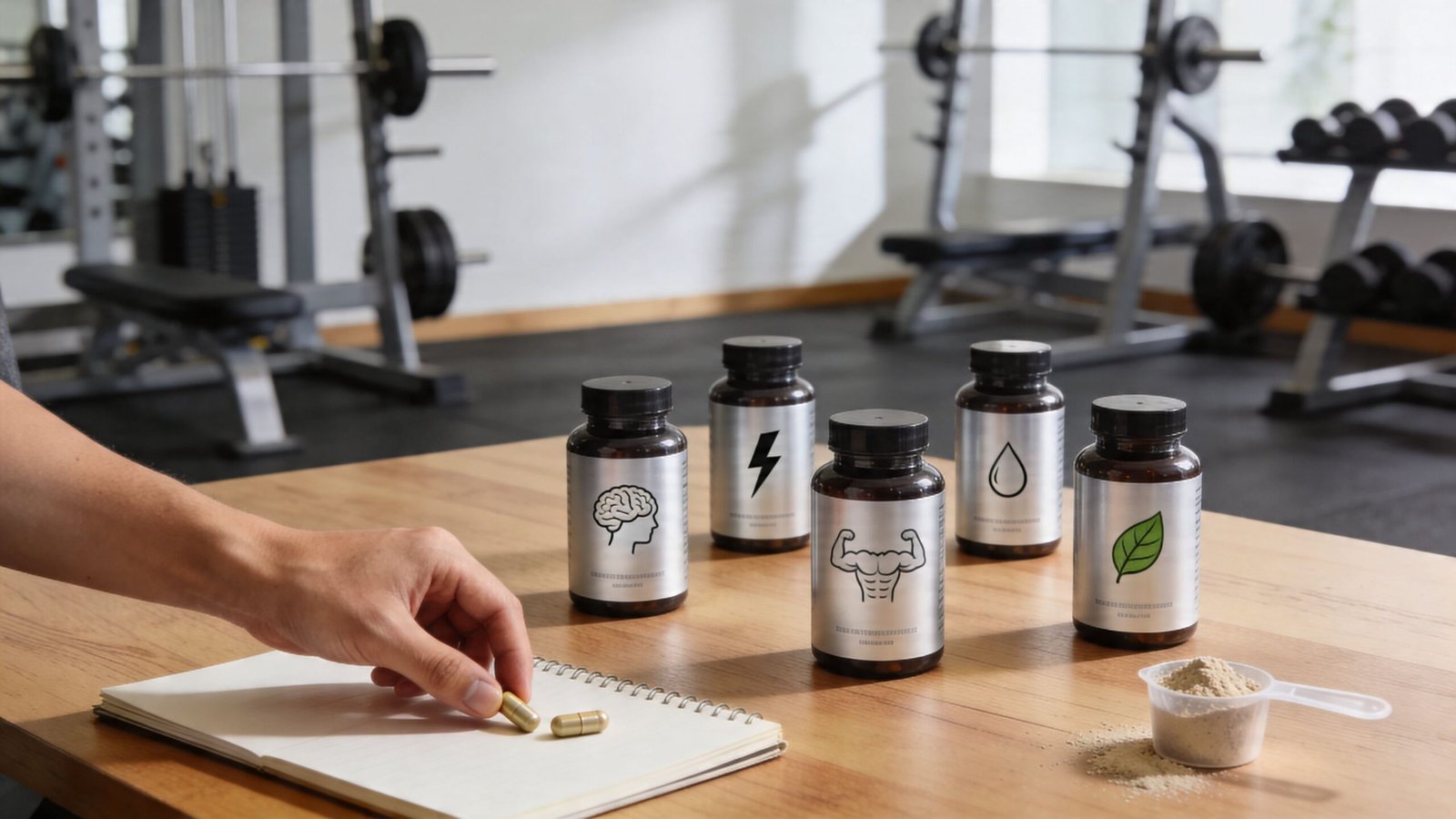
You’re probably familiar with this sequence. You get to the gym with every intention of training hard, but your brain is already jumping tracks. One minute you’re warming up, the next you’re checking your phone, re-racking the wrong plates, or standing between sets wondering why your energy feels flat before the session really starts.
For people with ADHD, that disconnect is frustrating because it doesn’t look like laziness from the inside. It feels like having enough physical capacity, but not enough mental traction. The right supplement plan won’t fix sleep debt, poor programming, or a medication setup that isn’t working. It can help close the gap between wanting to train and managing to lock in long enough to get a good session done.
This guide covers the best nutrition supplements for energy with adhd and gym focus from a practical coaching perspective. The emphasis is on what tends to help most, what usually gets overhyped, where stimulant users need to be careful, and which Amazon products are worth considering.
The ADHD Gym Paradox Why Your Brain Drains Your Body
You can be motivated to train and still underperform because your brain never fully settles into the session. That’s the ADHD gym paradox. Your body may be ready for effort, but your attention, drive, and pacing are inconsistent.
In real life, it often looks like this: strong first exercise, scattered middle, then a steep drop in quality. You skip accessories, forget rest times, lose your place in the workout log, or chase stimulation instead of following the program. Plenty of lifters with ADHD mistake that pattern for low discipline. It usually isn’t.
Why it feels different in the gym
Training asks for the exact skills ADHD can make harder.
- Sustained attention: You have to stay with one task long enough to complete sets with good form.
- Impulse control: You need to resist changing the plan every few minutes.
- Effort regulation: You need enough mental drive to push when the session stops feeling novel.
- Working memory: You have to remember loads, reps, cues, and rest periods.
Those demands hit hard when dopamine and related focus pathways are already inconsistent. The result is a session that feels mentally expensive, even if the workout itself isn’t extreme.
Practical rule: If your warm-up feels fine but your attention collapses once the novelty wears off, you’re dealing with a focus and regulation problem, not just a motivation problem.
What actually helps
The supplements that tend to matter most for this audience usually do one of three jobs. They support attention, smooth out overstimulation, or help reduce that drained, foggy feeling that can show up before or after training.
That’s why the best supplement setup for ADHD and gym focus usually isn’t the most intense pre-workout on Amazon. It’s a small group of supplements that improve consistency. Better consistency beats a temporary buzz every time.
How Supplements Fuel the ADHD Brain for Peak Gym Performance
Think about gym performance as a three-part system. First, your brain has to initiate effort. Second, it has to maintain attention. Third, your body has to keep producing energy without your focus falling apart halfway through. Supplements can support each layer, but only when you match them to the job.

Three pathways that matter most
Neurotransmitter support helps with the “start and stay on task” problem. This is why ingredients that affect dopamine or acetylcholine get attention in ADHD. They can improve the feeling of mental traction, especially when you need to focus on technique, tempo, and exercise order.
Cellular energy support matters because the brain burns a lot of energy during focus-heavy work. If your mental energy crashes early, your workout quality usually follows. This is one reason lifters with ADHD often feel better when they support recovery, sleep quality, and basic nutrient sufficiency before chasing stronger stimulants.
Neural membrane and signaling support is less flashy, but it often produces steadier results. Omega-3s fit here. They don’t feel like a high-stim pre-workout. They’re more like background maintenance for smoother signaling and better cognitive stamina.
Quick picks best supplements for ADHD and gym focus
| Supplement | Primary Benefit | Best For |
|---|---|---|
| Omega-3 fish oil | Steadier attention and cognitive stamina | Lifters who want foundational daily support |
| Magnesium glycinate or taurate | Calm focus and better recovery quality | People who feel wired but mentally tired |
| Citicoline | Mental energy and task focus | Morning training or work plus gym days |
| Caffeine plus L-theanine | Fast pre-workout alertness with less edge | Non-stimulant users or low tolerance users |
| L-tyrosine | Situational focus support under stress | Demanding days when mental fatigue is high |
If you want a broader category view before you buy anything, these nootropic supplements for energy and focus can help you understand where cognitive support overlaps with gym performance.
What doesn’t work well
The weak approach is using random “focus” blends with long ingredient labels and no clear role. Most of them combine too many compounds, hide dosages in proprietary blends, and make it impossible to know what’s helping or what’s causing side effects.
A better approach is boring and effective. Start with one foundational daily supplement, then add one targeted tool for training days if you need it.
Better gym focus with ADHD usually comes from fewer variables, not more capsules.
The Top 4 Foundational Supplements A Detailed Review
The strongest stacks usually start with four core categories. Not everyone needs all four, and not everyone responds the same way, but these are the options I’d look at first before reaching for more exotic products.

Omega-3 fish oil review
If you only wanted one supplement with the most credible base for ADHD support, omega-3s would be near the top. High-EPA fish oil is one of the few options that repeatedly shows up as relevant for attention, impulsivity, and steadier mental performance.
According to this ADHD nutrition review, omega-3 fatty acids, especially high-EPA formulas, are among the most researched nutritional supplements for ADHD, with daily doses of 500 to 1,000 mg EPA combined with 200 to 500 mg DHA linked to improvements in hyperactivity, impulsivity, and attention.
For gym-goers, the appeal is simple. Omega-3s don’t create fake energy. They support more reliable cognitive stamina, which often means less friction starting and finishing training.
Best Amazon product example
Sports Research Triple Strength Omega 3 Fish Oil
This is a practical pick because it’s widely available on Amazon, clearly labeled, and easy to compare against the EPA-heavy target most ADHD-focused buyers should care about.
Pros
- High-EPA friendly: Easier to fit into an ADHD-focused plan than generic low-potency fish oils.
- Useful for daily support: Better suited to steady routines than “feel it instantly” supplements.
- Good fit with gym goals: Supports a calm, more durable type of focus rather than overstimulation.
Cons
- Not a quick hit: You won’t get pre-workout style effects.
- Can cause fish burps: Some users still deal with this even with quality products.
- Requires consistency: This is a daily habit supplement, not a once-in-a-while tool.
Who should consider it
Choose omega-3s if your main issue is inconsistency, distractibility, or that mentally depleted feeling that shows up across the whole day, not just during training. It’s also a smart anchor if you want to avoid piling on more stimulants.
Magnesium review
Magnesium is one of the best options for the ADHD lifter who feels both tired and overstimulated. That combination is common. You’re mentally revved up, physically tense, and not sleeping well enough to recover well.
A useful summary from this ADHD supplement guide notes that magnesium at 200 to 400 mg daily, often as glycinate or taurate, is used to support calm focus, reduce hyperactivity, and improve sleep-related recovery. The same source describes a double-blind RCT of 66 children where vitamin D and magnesium co-supplementation over 8 weeks reduced conduct problems and social difficulties.
That doesn’t mean magnesium is a pre-workout. It means magnesium often improves the conditions that make good workouts possible.
Best Amazon product example
Doctor’s Best High Absorption Magnesium Glycinate Lysinate
This is the kind of product I’d rather see in an ADHD-focused stack than magnesium oxide. Glycinate forms are generally chosen for better day-to-day tolerability and a calmer feel.
Pros
- Helpful for evening use: Good for people whose stimulant wear-off leaves them edgy or restless.
- Supports recovery quality: Better sleep often improves next-day gym focus more than another stimulant product.
- Usually easy to stack: Fits well with fish oil, protein, and basic nutrition.
Cons
- Not exciting: You won’t “feel” this the way you feel caffeine.
- Can upset digestion in some people: Dose matters.
- May be mistimed: Taking it right before training can feel too relaxing for some lifters. Bedtime often works better.
Magnesium is often a recovery supplement first and a focus supplement second. For many people with ADHD, that order is exactly why it works.
Caffeine plus L-theanine review
This is the most practical fast-acting combo on the list for people who want pre-workout alertness without the rough edges of straight caffeine. L-theanine tends to smooth the experience and reduce that scattered, overamped feeling some ADHD lifters get from caffeine alone.
There’s a catch. If you already take stimulant medication, stacking extra stimulants on top can get messy fast. You can end up more alert but less organized, more energized but less precise, and more likely to overshoot your ideal intensity.
Best Amazon product example
Nutricost Caffeine with L-Theanine
This is an easy Amazon option for people who want a simple formula instead of a giant pre-workout blend. It’s also easier to adjust than a full scoop product loaded with extras.
Pros
- Fast effect: Useful when you train early or need a sharper ramp into the session.
- Cleaner than many pre-workouts: Fewer moving parts.
- Good for low-dose experimentation: Easier to test tolerance before using harder-hitting products.
Cons
- Can conflict with stimulant meds: This is the main limitation.
- May worsen anxiety or increase tension: Especially in caffeine-sensitive users.
- Can mask fatigue: You may train harder than your recovery allows if sleep is poor.
Who should be careful
Be especially cautious if you use amphetamine-based or methylphenidate-based medication, train late in the day, or already feel physically tight and mentally sped up. In those cases, magnesium and omega-3s are usually better first moves than stronger stimulation.
If your broader training plan also includes basics like creatine, this guide on how to take creatine for beginners is worth reading so you don’t overcomplicate the stack.
Here’s a deeper explainer if you want to hear another perspective before buying:
L-tyrosine review
L-tyrosine is popular in ADHD and performance circles because it’s a precursor related to catecholamine production, including dopamine. In plain English, people use it when they want a little more mental drive under stress, sleep loss, or demanding training days.
The problem is that L-tyrosine is often oversold. Some people feel more focused on it. Others feel almost nothing. And stimulant users can find it redundant or too activating depending on timing and dose.
Best Amazon product example
NOW Foods L-Tyrosine
NOW is one of the easier Amazon brands to find consistently, and plain L-tyrosine is better than buying a “brain blend” when you’re trying to evaluate what helps.
Pros
- Simple single-ingredient option: Easier to assess response.
- Useful on mentally demanding days: Some lifters report better task initiation and drive.
- Flexible timing: Can be used situationally instead of daily.
Cons
- Response is inconsistent: Not everyone notices much.
- Can be too stimulating for some users: Especially with medication or caffeine.
- Often overrated online: It’s not a substitute for sleep, food, or a stable routine.
Best use case
I see L-tyrosine as a conditional tool, not a foundational daily supplement. It makes more sense when stress is high, sleep was mediocre, and you need a cleaner push into focused work or training. It makes less sense as a first purchase if your basics aren’t already in place.
Best foundational picks by goal
| Goal | Best first pick | Why |
|---|---|---|
| Better all-day focus consistency | Omega-3 | Strongest foundational support |
| Calmer evenings and better next-day training | Magnesium | Helps recovery and regulation |
| Fast pre-workout alertness | Caffeine plus L-theanine | Useful when stimulant load is manageable |
| Situational mental drive | L-tyrosine | More tactical than foundational |
Essential Supporting Nutrients for Energy and Resilience
Once the foundations are covered, a few supporting supplements can make the whole system more resilient. These aren’t the first place I’d start for the best nutrition supplements for energy with adhd and gym focus, but they can add real value when used for a clear reason.

Creatine monohydrate
Creatine belongs in almost every serious gym conversation because it supports training performance and is usually simple to use. For ADHD lifters, I like it as a “reduce friction” supplement. It won’t sharpen attention on its own the way a nootropic might, but it can support harder training and make productive sessions easier to repeat.
Amazon product example: Optimum Nutrition Micronized Creatine Monohydrate
What it does well
- Supports high-quality training: Useful when strength and repeat effort matter.
- Easy to stack: It rarely complicates a supplement routine.
- High value product: Basic creatine is usually more useful than flashy workout blends.
Trade-off
- Doesn’t target ADHD directly: Good support supplement, not a focus-first pick.
B-complex vitamins
B vitamins are cofactors in energy metabolism, and some people do feel better when a basic B-complex closes a nutritional gap. The issue is that many lifters assume B-complex equals energy. It doesn’t work like caffeine. It’s more about supporting the processes behind energy production.
Amazon product example: Nature Made Super B Complex
Where it fits
- Works best for people with inconsistent eating patterns, high stress, or generally poor diet quality.
- Makes more sense as “cover the basics” support than as a standalone ADHD performance tool.
Downside
- If your nutrition is already solid, the difference may be subtle.
Rhodiola rosea
Rhodiola gets attention for stress resilience and mental fatigue. Some lifters like it on work-heavy days when they still need to train later. I’d keep it in the optional category because responses vary a lot, and it’s easier to misread its effect when you’re also using caffeine or ADHD medication.
Amazon product example: NOW Foods Rhodiola
Potential use
A decent option for people who feel worn down mentally but don’t want more direct stimulation.
Potential problem
If your nervous system already runs hot, adding another “energy support” supplement can muddy the waters.
Zinc and iron need a different standard
Many supplement guides often lack precision. Zinc and iron get recommended as if everyone should just add them. That’s not a good practice, especially for active people.
A key point from the earlier referenced guidance is that magnesium can be useful in the 200 to 400 mg daily range and may support calmer focus and gym energy, while one study cited there found that vitamin D and magnesium co-supplementation over 8 weeks reduced conduct problems and social difficulties in children. That’s a targeted nutrient with a reasonable use case. Iron and zinc are different because deficiency status matters far more.
If sleep is poor, you may benefit from practical guidance on choosing the best magnesium supplement for sleep before you start adding more stimulating compounds.
Don’t treat deficiency-sensitive minerals like general wellness candy. They need a reason.
Supporting picks in one glance
- Creatine monohydrate: Best for lifters prioritizing output and consistency in the gym.
- B-complex: Best for people with obvious dietary inconsistency or high stress.
- Rhodiola rosea: Best as an optional stress-support experiment, not a foundation.
- Zinc and iron: Only after testing and only when there’s a clear need.
How to Build Your Supplement Stack and Use It Safely
Individuals often thrive with a small stack they use consistently. The biggest mistake is buying six products at once, changing your routine every day, then having no idea what helped and what didn’t.

Three simple stack templates
Stimulant-free daily focus stack
This is the cleanest place to start if you’re not using ADHD medication or you know you’re sensitive to stimulants.
- Omega-3 fish oil: Daily foundation for steadier focus support.
- Magnesium glycinate at night: Helps recovery and calm.
- Creatine monohydrate: Good add-on if training performance is a major goal.
This stack won’t feel dramatic. That’s a strength, not a weakness.
Pre-workout stack for non-stimulant users
If you train early or need more mental snap before lifting, this setup is often enough.
- Caffeine plus L-theanine: Better than jumping straight to a dense pre-workout blend.
- Creatine monohydrate: Keep it in the daily routine, not just pre-workout.
- Omega-3 elsewhere in the day: Let it do the long-game work.
Medication-aware stack
For stimulant users, less is usually more.
- Start with omega-3
- Use magnesium in the evening
- Be cautious with caffeine and L-tyrosine
- Add only one variable at a time
If your medication already raises alertness, adding more stimulation can make your gym focus feel more intense but less controlled. Some people train better that way. Many don’t.
The testing-first rule
It is essential to note this. Iron and zinc should not be blind additions just because a blog or product label says they support focus.
A strong warning from this discussion on ADHD supplements and testing says, “Taking supplements for ADHD without testing first means guessing which deficiencies you have”. That matters even more for gym-goers, because undiagnosed deficiencies can create energy crashes during training, while unnecessary iron can create avoidable risk.
What to test before supplementing iron or zinc
- Ferritin: Better than guessing based on fatigue alone.
- Zinc status: Especially if you’re considering it for focus or dopamine support.
- RBC magnesium if available: Helpful when symptoms suggest low magnesium despite decent intake.
How to choose better Amazon products
Not every Amazon listing is equal. You want boring quality, not marketing theater.
Look for these:
- Clear labeling: The active ingredient and form should be obvious.
- Single-ingredient products when possible: Easier troubleshooting.
- Reasonable serving size: Avoid products that require huge daily capsule counts unless there’s a good reason.
- Third-party testing language: Especially important for fish oil and stimulant-like formulas.
A simple rollout plan
- Pick one foundational supplement first. Omega-3 or magnesium is usually the better opening move.
- Run it consistently before adding anything else. Keep training, sleep, and meal timing stable.
- Add one targeted tool if needed. Usually caffeine plus L-theanine, or occasionally L-tyrosine.
- Test minerals before using them. This is not optional for iron, and it’s smart for zinc.
- Stop if the stack makes you sharper but less organized. That’s a common sign the stimulation load is too high.
A good ADHD gym stack should make your sessions easier to execute, not harder to control.
Summary and Frequently Asked Questions
The best supplement setup for ADHD and gym focus is usually less aggressive than people expect. The winning approach is to build from foundational support, not chase a huge pre-workout feeling. For most lifters, that means starting with omega-3s or magnesium, tightening sleep and meal consistency, then adding a targeted pre-workout tool only if it solves a clear problem.
The second big takeaway is safety. Iron and zinc are not casual add-ons. Testing matters. Medication interactions matter. The right product on Amazon can still be the wrong product for your nervous system, your timing, or your current recovery status.
Quick summary
| Priority | Best move |
|---|---|
| First purchase | Start with omega-3 or magnesium |
| Best fast-acting option | Caffeine plus L-theanine, if stimulant load allows |
| Best situational add-on | L-tyrosine for select high-demand days |
| Most important safety step | Test before using iron or zinc |
Frequently asked questions
Can I take these with non-stimulant ADHD medication?
Usually, the lower-risk options are the foundational ones like omega-3s and magnesium, but medication-specific decisions still need a clinician’s input. The main issue isn’t just whether something is “natural.” It’s whether the combination changes alertness, blood pressure, sleep, or appetite in a way that hurts your training and recovery.
How long does it take to notice effects?
It depends on the supplement. Some products are acute, while others are cumulative. For example, this review discussing citicoline notes that citicoline at 250 to 500 mg daily supports mental energy and focus, and a 2016 RCT found 500 mg per day improved sustained attention and psychomotor speed after 12 weeks, with effects noticeable in 3 to 14 days. That’s relevant when people compare it to L-tyrosine, since both are used for neurotransmitter-related support, but not in the same way.
Should I cycle these supplements?
Some don’t need cycling in the same way others might. Foundational supplements are often used more consistently, while situational tools are better saved for when you need them. If a supplement stops helping, creates side effects, or makes your focus feel chaotic, it’s time to reassess rather than pile on another product.
What if I feel energized but still can’t focus in the gym?
That usually means you solved arousal, not attention. More stimulation won’t always fix that. In practice, those lifters often do better with less stimulant load, better sleep, steadier meals, and a simpler stack built around regulation instead of intensity.
If you want the short version, start basic, test what matters, and pay attention to whether the stack improves execution. That’s the standard that matters in the gym.
If you want more practical supplement breakdowns, training-friendly product reviews, and no-nonsense advice for building a stack that fits your workouts, visit Energy Supplement Reviews.
