


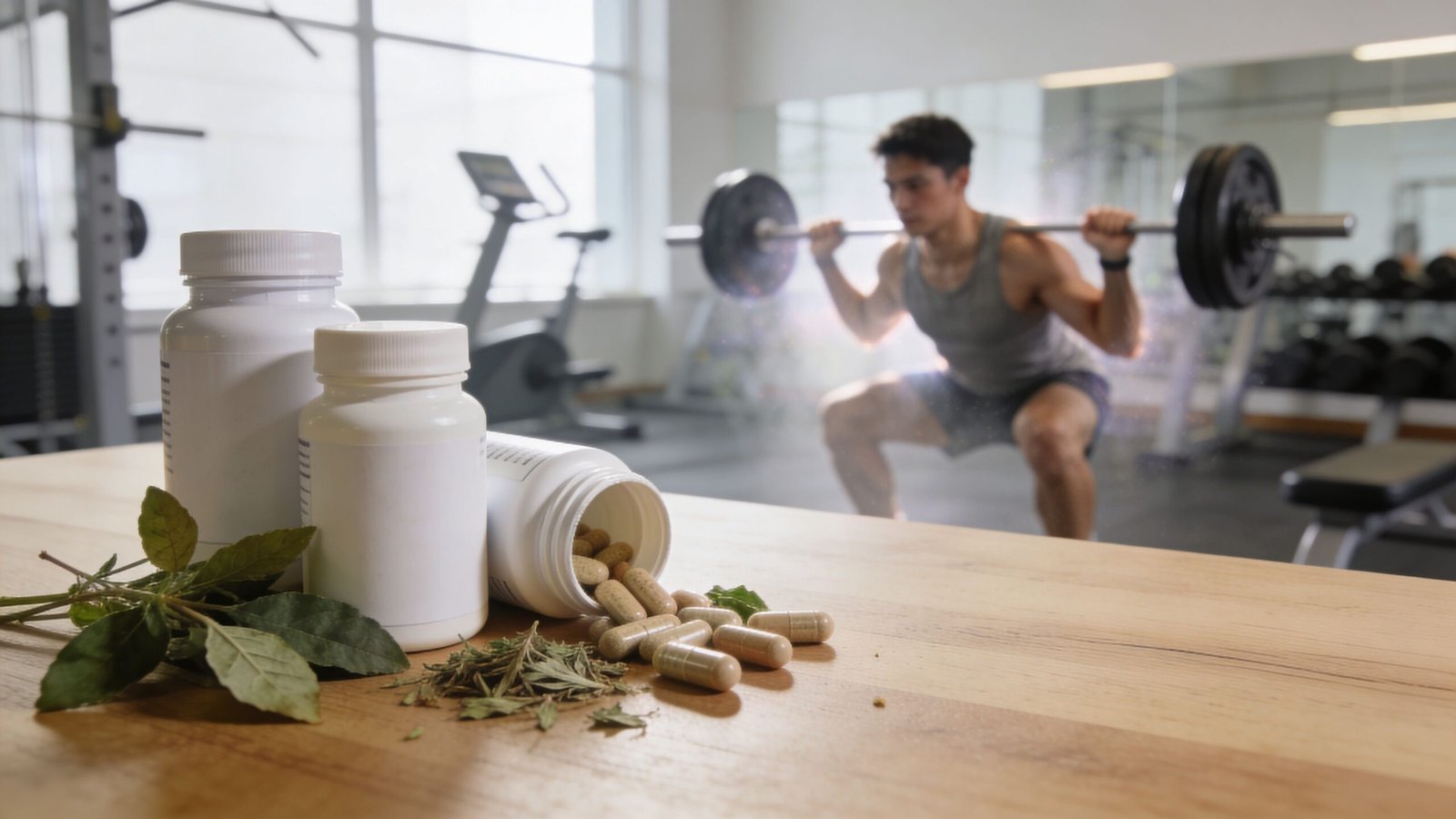
You want to train. Your body says no. Your mind says maybe later.
That mix of low energy and gym anxiety is more common than often realized. You get to the parking lot already tired. You walk in and feel overstimulated by the music, mirrors, and crowd. Then you reach for the strongest pre-workout you can find, hoping it will fix everything, and sometimes it only makes the nerves worse.
That’s the trap. A lot of gym supplements are built to push intensity, not to support calm, steady output. If you deal with both mental tension and physical drag, you need a different approach. You need ingredients that help you feel more focused, less wired, and more capable of finishing the session.
Introduction Conquering Gym Jitters and Fatigue
A typical version of this looks like this. You slept badly, work drained you, and by the time you change into gym clothes your motivation is hanging by a thread. You still want to train, but your chest feels tight, your head feels noisy, and your body feels flat.

I’ve seen the same pattern in beginners, in people returning after a long break, and in experienced lifters under stress. They don’t need more hype. They need a setup that helps them get through the first ten minutes without feeling scattered or depleted.
That’s why this review is focused on the best diet supplements for anxiety and low energy in the gym, not just generic energy boosters. The goal is practical. Which Amazon products are most useful when you want a calmer mind, smoother energy, and fewer workout crashes?
Supplementation is already normal in serious training circles. According to a national survey of approximately 21,000 U.S. college athletes, energy drinks and shots were used by 28.6% of respondents in a finding summarized by the NIH Office of Dietary Supplements fact sheet on exercise and athletic performance. That tells me two things. People are looking for performance help, and many are still leaning on stimulant-heavy options that aren’t always ideal when anxiety is part of the picture.
What this review looks for
Not every calming ingredient belongs before a workout. Not every energy ingredient is worth taking if it leaves you shaky.
So the products below were chosen with a simple lens:
- Calm without sedation: They should support focus or stress control without making training feel sluggish.
- Energy without chaos: They should help output, attention, or fatigue management without turning the session into a jitter-fest.
- Real gym usability: Capsules, powders, and stacks need to fit into normal routines.
- Amazon availability: Every product category discussed reflects what gym-goers commonly shop for there.
Understanding the Link Between Anxiety and Low Energy
Anxiety and low energy often show up together because stress doesn’t just affect your thoughts. It changes how you use your fuel.
Think of your day as having an energy budget. Stress takes a cut before you even touch a dumbbell. If your brain spends the day scanning deadlines, social tension, poor sleep, and overstimulation, you walk into training with less left for performance. That’s why someone can feel mentally restless and physically exhausted at the same time.
Why stress can make you feel flat
When stress stays high, training stops feeling like a clean outlet and starts feeling like one more demand. In practice, that usually looks like:
- Mental overdrive: You can’t settle into the workout.
- Perceived fatigue: The warm-up feels harder than it should.
- Low confidence: Every set feels heavier before you even start.
- Poor pacing: You rush early, then fade.
The gym version of anxiety isn’t always panic. Sometimes it’s subtle. You procrastinate your first set. You overthink whether people are watching. You change exercises mid-session. You scroll between sets because your brain won’t lock in.
Why heavy stimulants often backfire
A lot of people try to solve this with a strong pre-workout. Sometimes that works if the problem is simple sleepiness. But if anxiety is already high, piling on more stimulation can push you in the wrong direction.
Caffeine can sharpen focus for some lifters, but too much can intensify shakiness, urgency, and that “I’m buzzing but not productive” feeling. The FDA recommends a maximum daily caffeine intake of 400 milligrams for safety, and some pre-workout supplements can exceed that in one serving or don’t clearly disclose caffeine content. That’s one reason gym-goers with anxiety often do better with products that balance stimulation instead of chasing the hardest hit.
Calmer energy usually beats bigger energy when consistency is the goal.
What a better approach looks like
The most useful supplements in this niche do one of three things well:
| Support type | What it helps with | Gym benefit |
|---|---|---|
| Nervous system support | Stress, tension, overactivation | Easier start to the session |
| Cellular or muscular energy support | Fatigue and output | Better work capacity |
| Balanced focus support | Alertness without feeling frantic | Cleaner pre-workout performance |
That’s the lens I use in practice. If a product helps you feel more settled, more physically ready, and less likely to crash, it earns a place. If it just blasts the nervous system, it doesn’t.
Our Review Criteria Key Ingredients for Calm Energy
The ingredient label tells you more than the front of the tub ever will. For this category, I don’t care about flashy names. I care whether the formula helps someone train when they feel both anxious and tired.

Ingredients that actually fit this problem
The first ingredient I look for is L-theanine. A 2021 systematic review found that L-theanine combined with caffeine is safe and effective for improving attention and reducing stress, and a review of 13 clinical trials found that Coenzyme Q10 significantly reduced fatigue in study participants, as summarized in this Medical News Today review of supplements for energy and stress support. That’s a strong reason to prioritize formulas that smooth stimulation or support energy production directly.
L-theanine is especially useful when someone wants pre-workout alertness without the edgy side. It doesn’t replace caffeine. It changes the feel of caffeine.
CoQ10 is different. It isn’t a hype ingredient. It’s a slower-burn energy support option that makes more sense for people who feel generally drained and want less dependence on stimulants.
For readers who want broader stimulant-free options, this guide to natural energy supplements without caffeine is a useful companion.
The adaptogen I rate highest
Ashwagandha keeps showing up in this category for a reason. It’s one of the few ingredients that meaningfully sits between stress management and training recovery.
Practical rule: Ashwagandha makes more sense when stress is draining performance. It makes less sense if you want an immediate stimulant effect before a heavy session.
A narrative review noted that reducing fatigue and boosting energy represents a potential health benefit of ashwagandha supplements. In athletic recovery settings, a standardized root extract at a daily intake commonly used in research has also been associated with lower cortisol, improved recovery, and less perceived soreness. That matters when someone’s gym anxiety is tied to overreaching, poor recovery, or constant life stress.
Magnesium, BCAAs, and stack logic
I also look for magnesium, especially in forms marketed for gentler nervous system support, because magnesium supplementation supports anxiety reduction by regulating serotonin and improving brain function. This is less of a “feel it instantly in the gym” ingredient and more of a support tool when the person is wired, under-recovered, or sleeping poorly.
BCAAs can still be useful in this specific niche. Their value isn’t that they calm the brain directly. It’s that they may support recovery and reduce fatigue perception when training volume is high.
Here’s the full filter I use when judging a product:
- Useful mechanism: Does it target stress, focus, energy production, or recovery in a way that matches the problem?
- Reasonable formula design: Are the ingredients compatible, or does the product try to do too many opposite things at once?
- Timing fit: Can you use it pre-workout, post-workout, or daily without fighting the formula?
- Stack potential: Does it pair cleanly with basics like protein or creatine, or is it likely to overlap badly?
Products made the list if they contained one or more of these ingredients in a way that makes practical sense for gym-goers, not just label readers.
A Review of the 7 Best Supplements for Gym Anxiety and Energy
The best Amazon products in this category usually fall into one of three camps. A calm-focus pre-workout, a daily stress-and-energy capsule, or a simple stack component you combine with your existing routine.
Here’s the quick scan version first.
Top 7 Supplements for Gym Anxiety & Energy At a Glance
| Product Name | Key Ingredients | Best For | Price Guide |
|---|---|---|---|
| Nature Made Wellblends Calm & Relax | Ashwagandha, L-theanine, magnesium | Daily stress support with gym carryover | Budget to mid-range |
| NOW L-Theanine | L-theanine | Smoothing caffeine pre-workout | Budget |
| Sports Research CoQ10 | CoQ10 | Daily fatigue support | Mid-range |
| Doctor's Best High Absorption Magnesium Glycinate | Magnesium glycinate | Evening nervous system support | Budget to mid-range |
| Optimum Nutrition Gold Standard Pre-Workout with TeaCrine | Caffeine, L-theanine style pairing depending on version, focus aids | Users who still want a pre-workout feel | Mid-range |
| KSM-66 Ashwagandha capsules by a major Amazon seller | Ashwagandha | Stress-heavy lifters | Mid-range |
| XTEND Original BCAA | BCAAs | Training recovery and fatigue perception support | Mid-range |
If you already know that high-stim pre-workouts make you feel rough, also look at this roundup of pre-workout options without jitters for combat sports athletes. The same logic applies here.
Nature Made Wellblends Calm & Relax
This is the kind of product I like for people whose anxiety starts long before the workout begins. It’s not a classic pre-workout. It’s a daily support supplement that aims to reduce baseline stress so training feels easier to start.
The appeal is simple. Instead of trying to overpower low energy with more stimulation, it supports the stress side of the equation first. For many gym-goers, that’s the missing piece.
Best for: Beginners, people with gym dread, and lifters who feel mentally “on” all day
Pros
- Broad calm-energy logic: The ingredient style fits people dealing with both stress and drag.
- Beginner-friendly format: Easy to slot into a daily routine.
- Good stackability: Usually pairs better with protein, creatine, or a light coffee than a loaded pre-workout does.
Cons
- Not an instant performance hit: You’re unlikely to feel dramatic same-day gym intensity from it.
- May not suit everyone pre-workout: Some users do better taking calming formulas away from training time.
- Can overlap with other nighttime supplements: Check labels if you already use magnesium or other calming ingredients.
NOW L-Theanine
This is one of the cleanest tools in the category. If caffeine helps your performance but often comes with nervousness, L-theanine is the simplest fix to trial first.
I often prefer this over buying a whole new pre-workout. You can keep your coffee or lower-stim product and add a focused ingredient instead of gambling on a giant proprietary blend.
Best for: People who respond well to caffeine but hate the edge
Pros
- Highly practical: Easy to pair with coffee before training.
- Flexible timing: Useful on workdays and training days.
- Focused purpose: Good when your problem is overstimulation, not lack of drive.
Cons
- Doesn’t create energy by itself: It smooths alertness more than it generates power.
- Capsule-only users may need experimentation: Timing matters.
- Limited if fatigue is the main issue: Better for anxious energy than deep exhaustion.**
If caffeine already works for you but feels too sharp, L-theanine is usually the first thing I’d test before replacing your whole stack.
Sports Research CoQ10
CoQ10 isn’t exciting, and that’s exactly why I rate it. It’s for the person who’s tired of feeling dependent on a hard stimulant just to complete an average session.
This is more of a daily fatigue-management ingredient than a gym buzz product. It suits lifters who feel flat across the whole day, not just pre-workout.
Best for: Adults with persistent low energy who want a non-stim daily add-on
Pros
- Matches fatigue-focused needs: Better aligned with energy support than hype.
- Simple stack option: Usually easy to pair with protein, creatine, or a mild pre-workout.
- No jitter problem: Good fit for anxiety-prone users.
Cons
- Not a fast-acting gym sensation: More support tool than acute booster.
- Less useful if your issue is mostly pre-gym nerves: It won’t replace focus support.
- Higher patience required: This is a consistency ingredient.**
Doctor's Best High Absorption Magnesium Glycinate
Magnesium glycinate is rarely the star of a gym stack, but it often helps the overall system work better. If you’re tense, sleeping poorly, and carrying stress into training, this is one of the better support supplements to put in the evening.
I don’t usually frame magnesium as a pre-workout solution. I frame it as a recovery and nervous system support supplement that can make tomorrow’s session easier.
Best for: Evening use, stress-heavy schedules, poor sleep carryover
Pros
- Good support role: Helps the recovery side of the calm-energy equation.
- Often easier to tolerate than harsher forms: Popular among users who want gentle support.
- Pairs well with stimulant reduction strategies: Useful when cutting back from aggressive pre-workouts.
Cons
- Not a direct energy booster: Don’t expect a performance rush.
- Timing matters: Better later in the day for many people.
- Can complicate stacks: Especially if you also use ashwagandha or other calming products.**
Optimum Nutrition Gold Standard Pre-Workout
Some readers still want a real pre-workout feel. That’s fair. Not everyone wants to train on capsules and tea. In that case, the question becomes whether the formula gives enough focus support and whether the stimulant level feels manageable.
This category of product works best for users who can tolerate some stimulation but need a more controlled experience than the strongest tubs on the shelf. It can be a bridge between “coffee does nothing” and “high-stim pre ruined my session.”
Best for: Intermediate users who still want flavor, ritual, and pre-workout motivation
Pros
- Familiar gym experience: Scoop, shake, train.
- Better compliance: Some people stick with powders more consistently than capsules.
- Useful if you need both mental and physical activation: Especially for early morning sessions.
Cons
- Still a stimulant product: If your anxiety spikes easily, this may still be too much.
- Less flexible than single ingredients: Harder to fine-tune.
- Version differences matter: Always read the label before assuming it fits your needs.**
KSM-66 Ashwagandha capsules
A straightforward ashwagandha product is often the best choice for lifters whose performance drops when life stress rises. This is not about feeling “amped.” It’s about feeling less burdened by stress before and after training.
For many people, that’s the difference between consistent training and skipping half the week.
Best for: People whose gym fatigue feels stress-driven
Pros
- Strong category fit: Useful where anxiety and recovery strain overlap.
- Simple daily use: No need for a flavored drink.
- Easy to combine with basics: Protein, creatine, and food-first routines fit well around it.
Cons
- Some users feel drowsy: Not always ideal right before training.
- Medication interactions matter: This is one to review carefully if relevant.
- Not the best stand-alone option for immediate pre-workout energy.
XTEND Original BCAA
BCAAs don’t directly solve gym anxiety, but they can still earn a place when fatigue perception and recovery are dragging your sessions down. This is more of a support product for people who train hard, sweat a lot, and need something easy to sip.
I don’t rank BCAAs above L-theanine or ashwagandha for the specific anxiety-plus-energy problem. But I do think they’re useful in the right context.
Best for: Lifters who want intra-workout support and recovery help
Pros
- Easy gym use: Sip during training.
- Recovery-oriented role: Fits higher volume training blocks.
- Can complement calm-focused supplements: Different purpose, less overlap.
Cons
- Not an anxiety supplement: Doesn’t address the mental side directly.
- Less essential if your diet is already strong: Food still matters most.
- Flavored powder fatigue: Some users get tired of sweet intra-workouts.**
Which type of product should you choose
If you’re stuck between categories, use this quick guide.
- Choose L-theanine if coffee helps but makes you edgy.
- Choose ashwagandha if stress feels like the main reason your training is inconsistent.
- Choose magnesium glycinate if poor recovery, tension, or bad sleep are feeding the problem.
- Choose CoQ10 if your energy feels chronically low and you want a non-stim option.
- Choose a moderate pre-workout if you still want some gym drive but need tighter control over the experience.
- Choose BCAAs if your workouts fade because recovery and fatigue perception are the weak links.
The Verdict Our Top Pick for Overall Performance
The best overall choice for most readers is a simple ashwagandha plus L-theanine approach, and among Amazon-style options that usually means a quality daily ashwagandha product as the foundation, with L-theanine added only if needed around training.

If I had to pick one winner from the list, it would be the KSM-66 Ashwagandha capsule category. It does the best job of matching the underlying problem. The issue for many gym-goers isn’t just lack of stimulation. It’s a stress-loaded system that never feels fully recovered.
That’s where ashwagandha stands out. Ashwagandha has been shown to lower cortisol by 20 to 30% after 8 weeks at a 600 mg daily dose, according to Stanford Lifestyle Medicine’s overview of supplements for athletic recovery. For this category, that matters because cortisol is tied to the stress burden that can leave training feeling mentally heavy and physically flat.
Why this one wins
It wins on versatility. You can use it as a foundation rather than as a one-shot fix. It also stacks better than many pre-workouts because it doesn’t force the whole routine to revolve around a single high-stim drink.
The runner-up depends on your profile:
- Best budget option: NOW L-Theanine
- Best stim-free option: Sports Research CoQ10
- Best for evening support: Doctor's Best Magnesium Glycinate
For readers who want a visual breakdown before deciding, this short explainer helps frame how to think about supplement choices in training.
One caution. If ashwagandha makes you feel too relaxed before training, move it away from your workout window and let L-theanine handle the pre-gym role instead. That split usually works better than forcing one supplement to do everything.
Beyond the Bottle Non-Supplement Strategies for a Better Workout
Supplements help. They don’t replace the basics that make anxious, low-energy training possible.

The fastest gains I see often come from pairing a smart supplement with a calmer pre-gym routine. If your nervous system arrives rushed, your workout usually starts rushed too.
Four habits that work better than hype
- Use box breathing before you walk in: Inhale, hold, exhale, hold in equal counts for a few rounds. This helps settle the “go go go” state before your first set.
- Shorten the first ten minutes: Don’t tell yourself you need a perfect session. Commit to the warm-up and first lift only. Anxiety drops when the entry point feels smaller.
- Eat for steadier training: A light meal or snack before training often does more for low energy than another stimulant scoop. Keep it simple and repeatable.
- Build a pre-gym ritual: Same playlist, same water bottle, same warm-up sequence. Predictability lowers friction.
The best pre-workout for an anxious lifter is often a repeatable routine they trust.
Warm up like you mean it
A dynamic warm-up is underrated here. It raises body temperature, improves movement quality, and gives your brain a transition from daily stress into training mode.
Good warm-ups don’t need to be long. They need to be consistent. If you need extra ideas for food-first and habit-based support, these natural energy boosters for workouts are worth reviewing alongside your supplement plan.
Conclusion Your Path to Confident Training
The best diet supplements for anxiety and low energy in the gym aren’t always the loudest ones. The most useful products tend to support calm focus, stress control, and steady energy, not just stimulation.
Often, this means starting with the actual bottleneck. If caffeine makes you edgy, try L-theanine. If stress is crushing consistency, ashwagandha is the stronger foundation. If you feel generally drained, CoQ10 or a recovery-focused approach may fit better.
Use supplements as tools, not rescue devices. Pair them with a repeatable warm-up, better pacing, and a pre-gym routine that makes training easier to begin. When you address both the mind and the body, workouts feel less like something you survive and more like something you can build on.
Frequently Asked Questions
Can I stack these supplements with my regular pre-workout
Usually yes, but you need to respect overlap. The cleanest stack is often L-theanine with a caffeinated pre-workout or coffee when the goal is smoother focus. Be more careful with broad calm formulas that already include multiple ingredients, since stacking can muddy timing and tolerance.
How long does it take to feel the effects
It depends on the ingredient. L-theanine is typically used for more immediate calm-focus support around training. CoQ10, magnesium, and ashwagandha make more sense as consistency supplements rather than instant gym sensations. That’s why I separate “acute pre-workout tools” from “daily support tools” when building a routine.
What side effects should I watch for
The main issue is interaction and timing. A key unanswered question is supplement interaction. As noted in Dr. Will Cole’s discussion of supplements for stress and anxiety, L-theanine is best taken pre-workout to smooth out energy, ashwagandha can cause drowsiness in some, and stacking ashwagandha with magnesium can lead to GI upset in a minority of users, around 10%. In practice, that means starting simple and avoiding big all-at-once stacks.
What’s the best first supplement to try
If you already use caffeine and just want fewer nerves, start with L-theanine. If your training quality falls apart during stressful periods, start with ashwagandha. If your issue is poor recovery and general tension, magnesium glycinate is often the more logical place to begin.
If you want more practical, no-hype guidance on supplements, recovery, and smarter training, visit Energy Supplement Reviews. It’s a solid resource for comparing workout supplements, simplifying your stack, and finding strategies that fit real-life training.
