

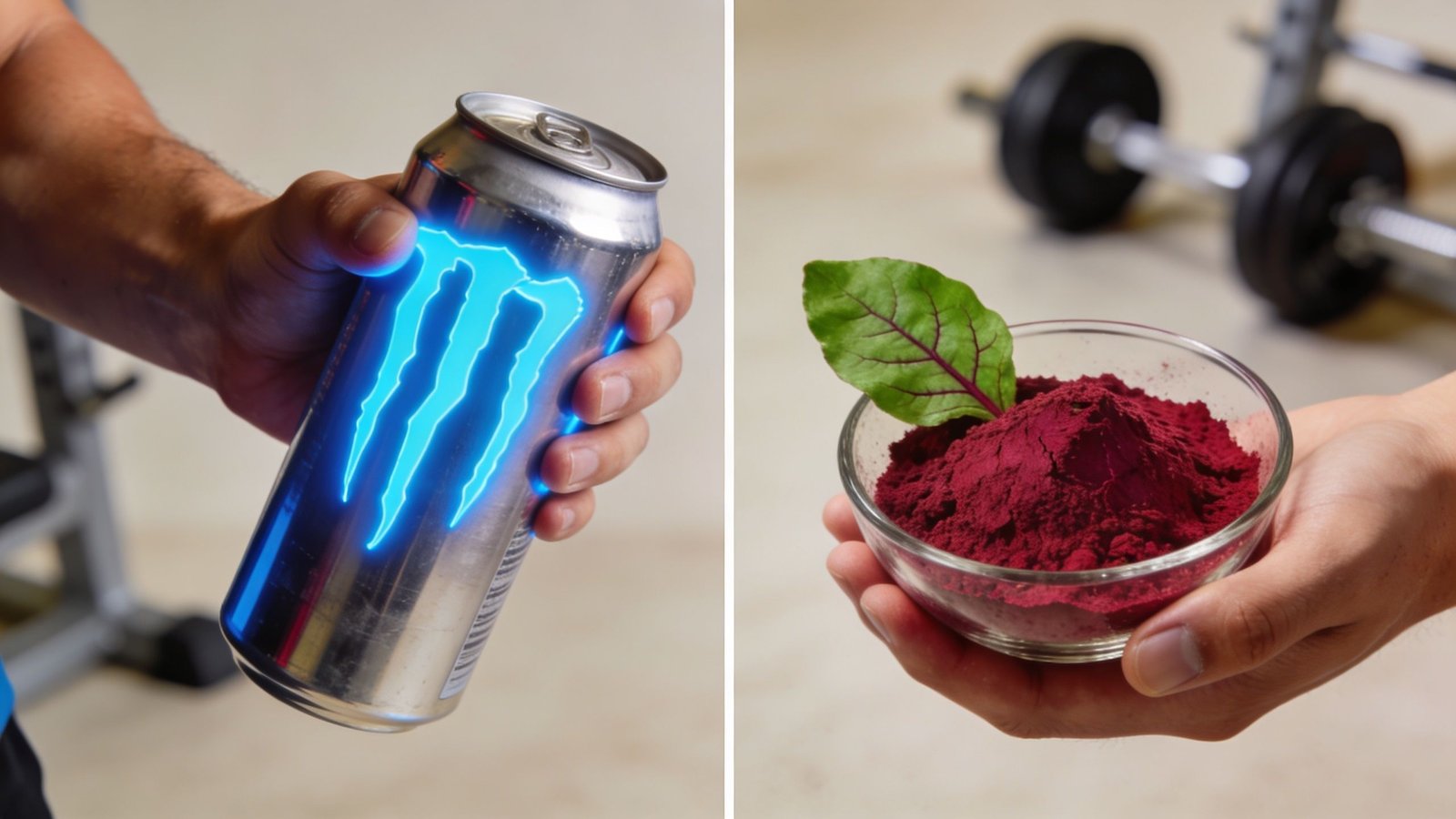
It’s usually the same moment. You finish work, roll out your mat or step up to the bench in your garage, and realize your energy is flat. The fastest option is staring back at you from the fridge or the pantry shelf. A bright can, a scoop of neon powder, a promise of instant intensity.
That’s where a lot of home trainees make a bad trade. They choose a stronger buzz over a safer workout.
The better question isn’t just what gives you energy fastest. It’s what helps you train well without putting unnecessary strain on your heart. If you want the best natural supplements vs energy drinks for heart safe workouts, the answer usually leans away from high-stim cans and toward simpler, more transparent options that support performance without the same cardiovascular baggage.
The Pre-Workout Dilemma Choosing Your Fuel Wisely
Training at home sounds convenient until you have to start. There’s no gym crowd, no coach watching, no commute to force momentum. You have to create your own energy. That’s why energy drinks became such an easy habit for so many people. Crack a can, feel the rush, start moving.
The problem is that the rush can come with a real cost.

According to MedStar Health’s review of workout supplements and heart risk, the USDA recommends a maximum of 400 mg of caffeine per day for adults, yet many popular pre-workout supplements contain more than that in a single serving. The same MedStar review notes that the World Health Organization has flagged energy drink consumption as a major public health issue because energy drinks and pre-workouts often exceed safe caffeine limits and can pose significant cardiovascular risks during workouts.
Why home trainees are especially vulnerable
At home, people often stack stimulants without thinking about it. Coffee in the morning. An energy drink before training. Another caffeinated product later in the day. The total load adds up quickly, and many people don’t notice until they feel jittery, overstimulated, or uncomfortable mid-session.
That doesn’t mean every supplement is risky. It means the category needs sorting.
Some products are built around concentrated stimulation. Others are built around blood flow, hydration, focus, or muscular performance with a much lighter stimulant footprint, or none at all. That difference matters if your goal is sustainable training.
Practical rule: If a product’s main selling point is “extreme energy,” treat it with caution before you treat it as a fitness tool.
The real choice
For many training at home, the smart path looks like this:
- Use food first when possible, especially if you’re training for general fitness.
- Use targeted supplements when they solve a clear problem, such as poor pump, flat endurance, or low focus.
- Avoid chasing intensity from products that rely on heavy caffeine and flashy marketing.
Heart-safe workouts don’t have to feel weak. They just need better fuel.
Energy Drinks vs Natural Supplements The Heart Safe Showdown
The biggest mistake in this debate is treating all pre-workout products as the same. They aren’t. Some are caffeinated shockwaves in a can. Others are closer to performance support.

Here’s the clean comparison.
| Factor | Energy drinks | Natural supplements |
|---|---|---|
| Energy feel | Fast, often sharp | Usually steadier |
| Ingredient style | Often blended, flavored, stimulant-led | Often simpler and more targeted |
| Heart safety profile | Higher concern, especially with heavy stimulant formulas | Usually better when doses and ingredients are straightforward |
| Best use case | Rare convenience use | Planned training support |
| Common downside | Crash, jitters, overstimulation | Slower onset or subtler feel |
Cardiovascular strain
This is the dividing line.
A 2019 randomized trial summarized by The Cardiology Advisor found that energy drinks caused significant elevations in both peripheral and central systolic and diastolic blood pressure compared with placebo, with all p < .001. That’s the kind of finding that matters when someone is about to do intervals, circuits, or heavy lifting.
The same source notes that quality pre-workouts with L-citrulline in the 6 to 8 g range promote vasodilation and improve blood flow without the same hypertensive spikes, and it also cites studies showing a 12 to 16% increase in repetitions to failure during resistance training.
Energy drinks can feel effective because they hit quickly. That doesn’t make them the better workout tool.
Ingredient transparency
Energy drinks often sell experience first and formula second. Loud flavor. big branding. “Insane energy.” That’s not how I’d choose something that affects workout intensity and recovery.
Natural supplements tend to be easier to evaluate because they often center on one function:
- L-citrulline for blood flow and training volume
- Creatine monohydrate for repeated high-output effort
- Beetroot powder for nitric oxide support
- EAAs for training when meals are light or distant
- Green tea extract or moderate caffeine sources for a milder lift
If you want cleaner focus instead of a hard spike, this kind of caffeine and L-theanine comparison for gym energy is often a better line of thinking than defaulting to a canned stimulant drink.
Energy curve and workout feel
Energy drinks usually do one thing well. They announce themselves.
You feel them fast, but that fast surge can also create pacing mistakes. People start their first round too aggressively, rest poorly, and then fade. For home workouts, especially longer strength sessions or steady conditioning, a smoother rise in readiness usually performs better than a dramatic spike.
Natural supplements often work best when the goal is one of these:
Better blood flow
This is where L-citrulline and beetroot make sense. You’re not trying to feel “crazy.” You’re trying to move well, get a better pump, and maintain output.
Better repeat performance
Creatine is a classic because it supports hard efforts across sets. It doesn’t feel flashy, but it supports the kind of performance that actually matters over time.
Better focus without chaos
Moderate caffeine from simpler sources, used carefully, can help. The key is avoiding the pile-on effect that happens with high-stim drinks.
If your pre-workout makes you feel wired before you even warm up, it’s probably doing too much.
Long-term training value
A product earns its place if it helps you train consistently. Not just once. Not just when you’re exhausted. Consistently.
Energy drinks are often poor at this because they teach dependence on stimulation. Natural supplements, especially the single-ingredient or low-stim options, tend to fit better into a routine built around sleep, hydration, regular meals, and smart training volume.
That’s the actual showdown. One side pushes urgency. The other supports performance.
The 7 Best Natural Supplements for Heart Safe Workouts on Amazon 2026
If you want a practical shopping list, these are the seven product types I’d look at first on Amazon. They aren’t all stimulants, and that’s the point. A heart-safer setup usually comes from matching the supplement to the job instead of forcing every workout through a caffeine blast.
For a broader look at supportive options, this guide to heart healthy supplements for safe workout energy is a useful companion.
Quick-View The 7 Best Heart-Safe Workout Supplements
| Supplement Type | Primary Benefit | Stimulant Level | Best For |
|---|---|---|---|
| Low-stim pre-workout powder | Balanced support | Low | People who still want a pre-workout feel |
| Pure L-citrulline powder | Pump and blood flow | None | Strength sessions and circuits |
| Beetroot powder | Endurance support | None | Cardio, conditioning, longer sessions |
| Creatine monohydrate | Repeated power output | None | Strength and muscle building |
| EAA formula | Training support when meals are light | None | Fasted or early sessions |
| Cordyceps mushroom supplement | Gentle energy support | None | People avoiding stimulants |
| Green tea extract supplement | Milder focus and alertness | Moderate | Those who want lighter caffeine support |
The shortlist at a glance
Some readers want a traditional tub they can scoop. Others want one clean ingredient they can understand in five seconds. Both approaches can work.
Here are the seven Amazon-friendly categories I’d prioritize:
- Low-stim pre-workout powder
- Pure L-citrulline
- Beetroot powder
- Creatine monohydrate
- Essential amino acids
- Cordyceps mushroom
- Green tea extract
What makes this list different
I’m not ranking the strongest products. I’m ranking the most useful heart-safer alternatives to the energy drink habit.
That means each option needs to do at least one of these well:
- Support performance without leaning on extreme stimulation
- Fit home training where consistency is needed more than aggression
- Make label reading easier, not harder
The next section gets specific with Amazon product picks, practical pros and cons, and who each one fits best.
Our In-Depth Amazon Product Reviews
The products below are common Amazon picks that match the categories above. I’m focusing on practical use, ingredient logic, and how each one fits into a heart-safer pre-workout approach.

Transparent Labs Stim-Free PreWorkout
This is one of the better fits for people who still want a “real” pre-workout ritual but want to step away from the energy drink cycle. It’s stimulant-free, which matters if you already get caffeine elsewhere or you train later in the day.
The appeal here is simple. You’re trying to support the workout, not detonate your nervous system.
Pros
- Stimulant-free formula makes it easier to avoid the wired feeling that many canned energy drinks create
- Good for late training because it won’t push the same kind of stimulant burden
- Better ritual adherence for people who like mixing a pre-workout drink before training
- Pairs well with coffee or tea if you want to control caffeine separately
Cons
- No instant jolt if that’s what you’re used to
- Can feel subtle at first if you’re coming off heavy-stim products
- Flavor preference matters more with powders you use regularly
Summary
Best for the person who wants structure and performance support without turning every workout into a stimulant event.
BulkSupplements L-Citrulline Powder
If I had to recommend one single ingredient for this topic, pure L-citrulline would be near the top. It’s straightforward, usually easy to dose, and it targets blood flow support rather than buzz.
That makes it one of the cleanest answers to the best natural supplements vs energy drinks for heart safe workouts question.
Pros
- Single-ingredient simplicity makes label reading easy
- Flexible dosing because you control the amount
- Excellent for pump-focused training such as upper-body sessions, circuits, and garage gym lifting
- Easy to stack with creatine or a light caffeine source if needed
Cons
- No flavor excitement unless you mix it with something else
- Not an “energy” supplement in the dramatic sense
- Powder measuring requires care if you want consistency
Summary
Best for lifters who want better training flow and muscular endurance support without the rollercoaster feel of an energy drink.
Snap Supplements Organic Beet Root Powder
Beetroot is a smart choice for people doing longer sessions at home. Think conditioning circuits, bike intervals, rowing, step work, or high-rep full-body training. The effect is usually less dramatic than a stimulant, but that’s often an advantage.
It supports a smoother workout feel rather than a sharp rise and fall.
Pros
- Stim-free endurance support for cardio and mixed-modal training
- Easy to combine with hydration habits
- Good fit for people who are caffeine-sensitive
- Food-adjacent feel compared with highly synthetic products
Cons
- Taste can be earthy
- Not everyone notices it immediately
- Mixability varies by brand and shaker effort
Summary
Best for home trainees who want support for longer sessions and don’t need a hype-heavy pre-workout experience.
A quick visual breakdown can help if you’re comparing categories instead of just brands.
Optimum Nutrition Micronized Creatine Monohydrate
Creatine is the least flashy product on this list and one of the most useful. It doesn’t behave like an energy drink, and that’s exactly why it belongs here. It supports performance over time, especially in strength work and repeated hard efforts.
If someone tells me they need more “pre-workout energy,” but they’re really struggling with output across sets, creatine is often more relevant than caffeine.
Pros
- Well-known single ingredient
- Excellent for strength training at home
- No stimulant load
- Stacks with almost anything else on this list
Cons
- Doesn’t give a noticeable buzz
- Requires consistency
- Not a replacement for poor sleep or poor nutrition
Summary
Best for people who care about measurable training support rather than a dramatic feeling.
NOW Sports EAA Powder
EAAs make sense when your meal timing isn’t ideal. A lot of home trainees squeeze workouts between meetings, parenting, or errands. They train early, or they train too long after lunch. In those cases, an EAA product can be more useful than an energy drink because it supports training without pretending stimulation solves everything.
Pros
- Useful when training fasted or semi-fasted
- Can be easier on the system than a harsh pre-workout
- Helpful during longer sessions where plain water feels insufficient
- Often pleasant to sip during training
Cons
- Less essential if your meals are already on point
- Not a direct substitute for full protein intake
- Taste varies widely across formulas
Summary
Best for people with messy schedules who need a practical bridge into training.
Force Factor Cordyceps Mushroom
Cordyceps sits in the “gentle support” lane. It won’t mimic a canned stimulant blast, and that’s a strength, not a weakness, for many users. This is the kind of product people choose when they’re done chasing intensity and want a calmer setup.
Pros
- No stimulant rush
- Useful for people who want a non-caffeine option
- Simple fit for lower-intensity or steady-state training
- Works well in a broader wellness routine
Cons
- Subtle feel
- Not ideal if you expect a rapid pre-workout kick
- Product quality varies, so label scrutiny matters
Summary
Best for stimulant-avoidant users who value steadiness over hype.
Nature’s Bounty Green Tea Extract
For readers who still want some lift, green tea extract is a more measured place to look than a typical energy drink. The key is still moderation and label awareness. If you already drink coffee, you need to count the total stimulant picture.
Pros
- Milder option than many heavy-stim pre-workouts
- Convenient capsule format
- Good for light focus support before short sessions
- Can suit morning workouts well
Cons
- Still contains stimulant activity
- Not ideal for people highly sensitive to caffeine
- Can overlap poorly with other caffeine sources if you don’t track intake
Summary
Best for people who want cleaner alertness and are willing to keep the dose conservative.
Quick review recap
If you want the simplest buying framework, use this:
- Choose Transparent Labs Stim-Free PreWorkout if you want a full pre-workout experience without the stim burden.
- Choose BulkSupplements L-Citrulline Powder if you want the cleanest performance-focused ingredient.
- Choose Optimum Nutrition Creatine Monohydrate if strength progress is the main goal.
- Choose beetroot or cordyceps if you want a softer, stimulant-free route.
- Choose green tea extract only if you still want caffeine and can keep it controlled.
Building Your Heart Safe Pre-Workout Strategy at Home
Buying the right product matters less than using the right strategy. Individuals typically don’t need more ingredients. They need better matching between the workout, the timing, and their own stimulant tolerance.

A review on workout nutrition and heart-healthy options notes that natural pre-workout options include water, tea, coffee in moderation, and small glasses of 100% juice, while MedStar emphasizes wholesome foods such as fruits, vegetables, lean proteins like chicken, fish, and lentils, plus complex carbs for longer-lasting workout energy.
Match the supplement to the session
A home HIIT workout at 6 a.m. is different from a garage strength session at 6 p.m. Treating both with the same stimulant-heavy product is lazy programming.
Use this decision guide:
- For strength training use creatine as your foundation, and add L-citrulline if you want a better pump or more training flow.
- For circuits or conditioning try beetroot powder or a low-stim pre-workout.
- For yoga, mobility, or lighter sessions you may not need a supplement at all. Water and a light snack are often enough.
- For morning sessions when you want a lift use tea, moderate coffee, or a lighter caffeine source instead of a full energy drink.
- For stimulant-sensitive users look at natural energy supplements without caffeine and build around food, hydration, and stim-free support.
Start with the lowest effective approach. If water, a banana, and a smart single ingredient work, there’s no prize for making the formula more aggressive.
Three practical home setups
The simple strength stack
Half a banana or toast, water, creatine, and optional L-citrulline. This works well when you want steady output without feeling overcooked.
The cardio support stack
Water first. Beetroot powder before the session. A small glass of 100% juice can fit if you need quick carbohydrate support.
The gentle focus stack
Tea or moderate coffee, plus a low-stim or stim-free support product. This is a good fit for people who want alertness without the hard edge.
What usually doesn’t work
The biggest misses are predictable:
- Using stimulants to cover poor sleep
- Taking a high-stim product on an empty stomach and hoping for the best
- Layering coffee, pre-workout, and an energy drink in the same day
- Confusing “feeling intense” with better training quality
A heart-safe approach is less exciting on the label. It’s usually much better in real life.
The Verdict Our Top Pick for Heart Safe Performance in 2026
If I had to choose one overall winner for most readers, it’s BulkSupplements L-Citrulline Powder.
Why that one? Because it solves a real training problem without forcing the stimulant issue. It’s simple, flexible, and useful for a wide range of home workouts. It also avoids the trap that sends many people toward energy drinks in the first place. They think they need “more energy,” when they often really need better blood flow, better pacing, and a cleaner pre-workout setup.
Category winners
Best overall winner
BulkSupplements L-Citrulline Powder
Best for people who want a straightforward, heart-safer performance aid with minimal label drama.
Best full-featured option
Transparent Labs Stim-Free PreWorkout
Best for readers who enjoy the ritual and flavor of a pre-workout but don’t want the stimulant hit that often comes with energy drinks.
Best for strength progress
Optimum Nutrition Micronized Creatine Monohydrate
Best for anyone focused on lifting performance, repeated effort, and long-term value.
Best endurance-friendly pick
Snap Supplements Organic Beet Root Powder
Best for longer home sessions, cardio blocks, and people avoiding stimulants completely.
Final verdict
The winner isn’t the product that feels strongest in the first ten minutes. It’s the one that supports better training without creating a cardiovascular gamble. Generally, that means a targeted natural supplement beats an energy drink every time.
Conclusion Train Smart and Protect Your Heart
The energy drink habit survives because it’s easy, not because it’s the smartest option. For home training, the better path is usually less dramatic. Use whole foods when you can. Use simple supplements when they solve a specific problem. Keep stimulant intake controlled and intentional.
That approach gives you something better than a quick rush. It gives you workouts you can repeat.
The best natural supplements vs energy drinks for heart safe workouts aren’t always the flashiest Amazon picks. They’re the products that support performance, respect your recovery, and don’t ask your heart to absorb the price of a marketing promise.
Read labels carefully. Keep your routine honest. If a product makes you feel off, stop using it. If you have any cardiovascular condition, medication concern, or history of palpitations, talk with a qualified clinician before adding pre-workout products.
Train hard if you want. Just don’t train recklessly.
Frequently Asked Questions About Pre-Workout Safety
Are natural energy drinks safer than regular energy drinks
Sometimes, but the word natural doesn’t automatically make a product heart-safe. If the drink still relies on a heavy stimulant load, the label style doesn’t change the practical concern. I’d judge it by the total caffeine, the ingredient transparency, and how it fits with the rest of your day.
A “natural” can that still hits hard may not be much better than the mainstream version.
Is coffee a better pre-workout than an energy drink
For many adults, yes. Coffee is usually the simpler option because you know what it is, and it doesn’t come wrapped in the same high-stim performance branding. Used in moderation, it can be a reasonable pre-workout tool.
The key issue is dose control. If you’re using coffee, don’t stack it carelessly with capsules, powders, or canned drinks.
What are the best stimulant-free alternatives for home workouts
The most practical stimulant-free options are usually:
- L-citrulline for pump and workout flow
- Creatine monohydrate for strength support
- Beetroot powder for longer sessions
- Cordyceps for people who want a gentler wellness-style option
- Whole food plus water when the session is moderate and your meals are already solid
These are often better choices for evening training or for anyone who gets jittery easily.
Can I use a pre-workout and still keep things heart-safe
Yes, but only if you choose carefully. Look for transparent formulas, avoid extreme stimulant positioning, and don’t assume more is better. A lower-stim or stimulant-free product is often the safer route for general fitness.
Also, pay attention to your total daily caffeine intake from all sources. That’s where many people get into trouble.
If you need to convince yourself that a scoop “isn’t that strong,” it’s worth stepping back and checking the label again.
What signs mean I should stop using a supplement right away
Stop and seek medical advice promptly if you experience symptoms that concern you, especially during or after training. Red flags can include feeling unusually uncomfortable, strong palpitations, chest discomfort, dizziness, faintness, or shortness of breath.
Even without dramatic symptoms, a supplement is the wrong fit if it consistently leaves you feeling overstimulated, shaky, or unable to settle after the workout.
Are whole foods enough for pre-workout energy
Often, yes. If your sleep, hydration, and meals are in decent shape, whole foods can cover a lot. Fruit, complex carbs, and regular protein intake support training far better than many people think. Supplements are best used as support tools, not as a replacement for basic nutrition.
That’s especially true for people training at home for health, fat loss, or general strength.
Which Amazon supplement should a beginner start with
For a true beginner, I’d start with the simplest match to the goal.
- If you want strength support, start with creatine monohydrate.
- If you want pump and workout feel, start with L-citrulline.
- If you want zero stimulants, start with beetroot powder or a stim-free pre-workout.
- If you already rely on caffeine, don’t jump straight to stronger products. Clean up the routine first.
The best first supplement is usually the one you can understand, tolerate, and use consistently.
If you want more practical supplement breakdowns, safer pre-workout comparisons, and home-friendly fitness product reviews, visit Energy Supplement Reviews.
