


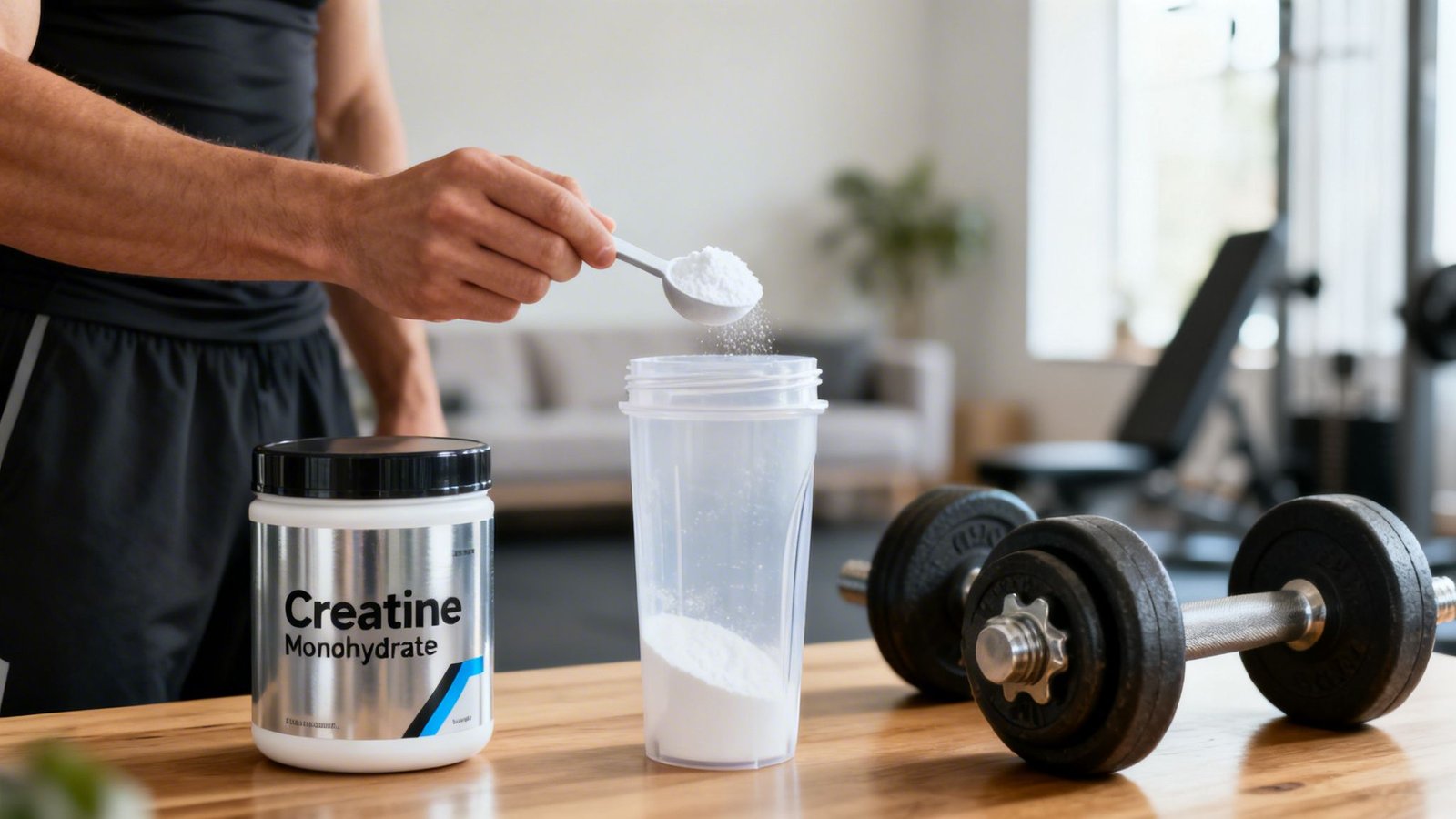
When it comes to using creatine to build serious muscle, the good news is that it's pretty straightforward. You really only have two main ways to get started: a rapid 'loading phase' to get results faster, or a simpler 'daily dose' approach. Both methods will get you to the same place—stronger and bigger—as long as you’re putting in the work.
Your Guide to Using Creatine for Serious Muscle Growth

Creatine is, without a doubt, one of the most proven supplements for anyone looking to boost their strength, power, and muscle mass. But let's be clear: it isn't magic. Think of it more like an amplifier for the effort you're already putting into your training and nutrition.
Here’s how it works. Supplementing with creatine tops off your body's phosphocreatine stores. This is the high-octane fuel your muscles burn for quick, explosive movements. With more of this fuel in the tank, you can squeeze out those last few, growth-stimulating reps or add a little more weight to the bar.
Over time, this ability to consistently perform better is what triggers greater muscle hypertrophy. You do the work; creatine just helps you do it better.
Choosing Your Dosing Strategy
The two tried-and-true methods for starting creatine are the loading phase and the standard maintenance dose. Your choice really just boils down to personal preference, how patient you are, and maybe how your stomach feels about it.
Here's the breakdown:
- The Loading Phase: This is the fast-track approach. You’ll take a higher dose—typically 20 grams per day—for about 5-7 days. Most people split this into four separate 5-gram servings to make it easier. The whole point is to saturate your muscle cells as quickly as possible. After that first week, you just drop down to a daily 3-5 gram maintenance dose.
- The Daily Dose (No-Load) Approach: This is the simple, steady route. You skip the high-dose week and just start taking 3-5 grams every day from the beginning. It takes longer to reach full muscle saturation (usually about 3-4 weeks), but it's dead simple and can be gentler on the stomach for some people.
In the long run, both strategies are equally effective. Loading just gets you to the finish line—full saturation and the performance benefits that come with it—about three weeks sooner. That initial kick can be a huge motivator. If you want to make sure your training is set up to take full advantage of that boost, check out our guide on why you should incorporate weightlifting into your routine.
The most important thing is just being consistent. Whether you load or not, taking creatine daily is what keeps your muscles saturated and fuels your progress. Don't sweat it if you miss a day here and there, but long-term consistency is the real key to seeing results.
To make the choice even clearer, here’s a quick comparison of the two dosing protocols to help you decide which one fits you best.
Creatine Dosing Protocols At a Glance
This table breaks down the two most common methods for starting creatine, so you can pick the one that aligns with your goals and lifestyle.
| Protocol | Daily Dose | Saturation Time | Best For | Potential Side Effects |
|---|---|---|---|---|
| Loading Phase | 20g for 5-7 days, then 3-5g | ~7 days | Those wanting faster results; anyone new to creatine. | Higher chance of temporary stomach upset or bloating. |
| Daily Dose | 3-5g from day one | ~28 days | Those with sensitive stomachs; anyone preferring simplicity. | Minimal; very low risk of GI issues. |
Ultimately, there's no wrong answer here. If you're eager to see what creatine can do, the loading phase is a great way to kick things off. If you prefer to keep things simple and steady, the daily dose will get you to the exact same place. Just pick one and stick with it.
2 Top Creatine Products for Muscle Growth: A 2026 Review
Before we even get into dosing and timing, let's tackle the first big question: which creatine should you actually buy? Walk into any supplement store or browse online, and you're hit with a wall of options—all with flashy labels and promises of being the "next big thing."
Honestly, you can ignore almost all of it. The choice is surprisingly straightforward.
For anyone looking to use creatine to build muscle, creatine monohydrate is the only one you need to consider. It’s not new or exciting, but it’s the original for a reason. It's the most studied sports supplement on the planet, with hundreds of studies backing up its effectiveness and safety. It just works.
Stick with the Gold Standard: Creatine Monohydrate
You’ll see a ton of other forms out there, like creatine hydrochloride (HCL), ethyl ester, or buffered versions, almost always with a higher price tag. They claim better absorption or fewer side effects, but the science simply doesn't back those claims up when it comes to building muscle.
Time and time again, research has shown that no other form of creatine is more effective for muscle and strength gains than good old-fashioned monohydrate. Spending extra on the fancy alternatives is, for most people, just lighting money on fire.
The bottom line? Creatine monohydrate works incredibly well, it's cheap, and it has an unmatched safety record spanning decades. Don't overcomplicate things. Stick with what's proven.
What to Look For on the Label
Once you’ve decided on monohydrate, a couple of small details on the label can make a big difference in your day-to-day experience.
Here’s what I look for:
- Micronized: Keep an eye out for this word. It simply means the powder has been milled into finer particles. This doesn't boost its muscle-building effects, but it dramatically improves how well it dissolves. It’s the difference between a smooth drink and a gritty, sandy sludge at the bottom of your shaker cup.
- Third-Party Testing: A seal from a group like NSF Certified for Sport or Informed-Sport is a major green flag. This means an independent lab has verified that the tub contains exactly what the label says it does and is free of any banned substances. It's your best bet for ensuring quality and purity.
- Purity: A high-quality product should have one ingredient: creatine monohydrate. Steer clear of formulas loaded with fillers, sugars, or "proprietary blends" that don't tell you exactly how much creatine you're getting.
A Review of 2 Great Amazon Options: Budget vs. Premium
To give you a real-world idea of what to grab, here are two excellent products that I often recommend, available right on Amazon.
1. The Smart Budget Pick: Nutricost Creatine Monohydrate (Micronized)
This is the perfect example of a no-nonsense, high-value product. It's exactly what you need, nothing you don't.
Pros:
- Incredibly affordable with a great cost-per-serving.
- Micronized for excellent mixability in water or shakes.
- Pure, single-ingredient formula with no fillers.
Cons:
- Basic packaging.
- Lacks a third-party certification seal like NSF.
Summary: For the vast majority of people, this is the smart buy. Nutricost is a reputable brand delivering a high-quality, effective product that won't strain your wallet.
2. The Certified Premium Choice: Klean Athlete Klean Creatine
This one is for the competitive athlete or anyone who wants the absolute highest level of quality assurance.
Pros:
- NSF Certified for Sport, the gold standard for drug-tested athletes.
- Guarantees top-notch quality, purity, and safety.
- Trusted by professional and collegiate sports teams.
Cons:
- Significantly more expensive per gram.
Summary: If you're a competitive athlete or simply want the peace of mind that comes with the highest level of certification, Klean Athlete is worth the premium price.
How to Dose and Time Your Creatine for the Best Results
Alright, you've got your creatine. Now for the important part: actually using it. How you dose and time your creatine is what separates simply taking a supplement from strategically fueling real muscle growth.
There are two main ways to go about this: the fast-track "loading" method or the slower, simpler "maintenance" approach. Don't overthink it—both roads lead to the same destination of fully saturated muscles. It just depends on how fast you want to get there.
If you're still on the fence about which creatine to buy, this simple chart nails the decision-making process.

It really is that easy: check for purity, stick with proven monohydrate, and you're good to go.
The Loading Phase: The Fastest Way to Full Saturation
The loading phase is popular for one simple reason: it gets you results, fast. The entire point is to quickly top off your muscles' creatine stores. While a normal dose can take a few weeks to a month to do this, loading gets the job done in about a week.
This is a time-tested strategy. You’ll take 20 grams per day for 5-7 days, then drop down to a daily maintenance dose of 3-5 grams. The science backs this up, too. A 2023 meta-analysis on creatine's effects when paired with training confirmed that it leads to small but significant increases in muscle thickness.
Trying to swallow 20 grams at once can be a bit much for your stomach. The smarter way is to split it up.
- Your Plan: Take four separate 5-gram servings throughout your day.
- A Simple Schedule: Think 5g at breakfast, 5g at lunch, 5g after your workout, and a final 5g with dinner.
This approach keeps your digestive system happy and ensures your body absorbs as much of it as possible. After that first week, your muscles will be locked and loaded.
The Maintenance Dose: Your Daily Habit for Long-Term Gains
Whether you start with a loading phase or not, you'll eventually settle into the maintenance phase. This is the simple, long-term part of the plan.
Your only goal here is to keep your muscle creatine stores full. That’s it. A single daily dose of 3-5 grams is all it takes. For just about everyone, a standard 5-gram scoop is the perfect amount.
This daily consistency is what keeps the benefits coming—that extra rep, better endurance, and, over time, more muscle in the mirror. When you take it is far less important than that you take it.
The real key to making creatine work isn't some complicated timing protocol. It's the boring, everyday habit of taking your 5 grams. Make it a non-negotiable, just like brushing your teeth.
Does Creatine Timing Really Matter?
While consistency is king, we can get a little strategic about when you take your creatine to squeeze out every last drop of benefit. The research does suggest a slight edge for one particular time of day.
Taking your creatine post-workout seems to be the optimal window.
Why? It all comes down to what’s happening in your body after a tough training session. Your muscles are like sponges, primed to soak up nutrients. When you take creatine with a post-workout meal or shake that has both carbs and protein, you can give it a helping hand.
The Post-Workout Advantage:
- Better Delivery: Exercise boosts blood flow to your muscles, creating an express lane for nutrients.
- The Insulin Assist: The carbs and protein in your meal trigger an insulin release. Insulin helps "unlock" your muscle cells, shuttling the creatine inside more effectively.
- Recovery and Refueling: Taking creatine with carbs also helps restock the muscle glycogen you just burned, kicking off your recovery sooner.
So, does this mean taking it at any other time is a waste? Not at all. The advantage of post-workout timing is small. Don’t stress if it doesn't fit your life.
The massive benefits of taking it every day will always trump any minor gains from perfect timing. If you work out at night but find it’s easiest to remember your creatine with your morning oatmeal, do that. The most important thing is getting that daily 3-5 gram dose in, day in and day out. That's what keeps your muscles saturated and ready to perform.
Pairing Creatine With Nutrition and Training

It’s easy to think of creatine as a magic powder, but it won’t build muscle while you’re sitting on the couch. The best way to think about it is as an amplifier. It takes the hard work you’re already putting in at the gym and in the kitchen and turns the volume up.
Without a smart training plan and solid nutrition, the benefits of creatine will fizzle out. So, let’s get those two things dialed in.
First up: hydration. Creatine works its magic by pulling more water into your muscle cells. This process, called cell volumization, is a key trigger for muscle growth. But there's a catch—it also increases your body's overall need for water. Skimp on H2O, and you risk dehydration, which can kill your performance and lead to nasty cramps.
As soon as you start taking creatine, make a point to drink more water. There’s no perfect number for everyone, but a good rule of thumb is to add an extra 32-64 ounces (about 1-2 liters) to whatever you’re already drinking daily.
The Power Duo: Creatine and Protein
While water is crucial, the real one-two punch for muscle growth comes from combining creatine with a high-protein diet. Think about it this way: creatine gives you the fuel to squeeze out those extra, growth-stimulating reps. But protein provides the actual building blocks—amino acids—your body needs to repair the damage and build your muscles back bigger and stronger.
Your training creates the demand for growth, and creatine helps you increase that demand. Protein is what allows your body to meet it. If you’re serious about building muscle, you’ll want to eat at least 90 grams of protein per day, though your ideal number will depend on your body weight and how hard you train.
"Creatine is not a magic pill—it only works when combined with consistent strength training, adequate protein, and healthy lifestyle habits."
Try to spread your protein intake throughout the day with high-quality sources like chicken, fish, eggs, and Greek yogurt. If you’re struggling to hit your protein goals, a good powder can make a huge difference. For some help on that front, check out our guide on the best protein powder for beginners.
Fueling Your Workouts for Progressive Overload
At its core, creatine helps your muscles rapidly generate energy for short, intense bursts of effort. For anyone lifting weights, this is huge. It means you can fight off fatigue and grind out an extra rep or two on a heavy set of squats or bench presses when you’d normally have to rack the weight.
This ability to consistently do more work over time is the very definition of progressive overload, and it's the single most important factor for muscle growth. With creatine on your side, it becomes just a little bit easier to add more weight to the bar, squeeze out more reps, or increase your total sets—all of which challenge your muscles to adapt and grow.
This holds true even if you train at home with basic gear. Creatine will help you push for more reps with the dumbbells you have or slow down the movement to increase time under tension. It gives you the extra gear you need to make any workout more effective.
Sample One-Week Dumbbell Workout Split
Here’s a practical example of a dumbbell routine where creatine can really shine. The goal with this plan is to push for that extra rep on each set, driving the progressive overload that leads to real growth.
Day 1: Upper Body Push (Chest, Shoulders, Triceps)
- Dumbbell Bench Press: 3 sets of 8-12 reps
- Dumbbell Overhead Press: 3 sets of 8-12 reps
- Incline Dumbbell Press: 3 sets of 10-15 reps
- Dumbbell Lateral Raises: 3 sets of 12-15 reps
- Triceps Overhead Extension: 3 sets of 10-15 reps
Day 2: Lower Body (Quads, Hamstrings, Glutes)
- Dumbbell Goblet Squats: 3 sets of 10-15 reps
- Dumbbell Romanian Deadlifts: 3 sets of 10-15 reps
- Walking Lunges: 3 sets of 10-12 reps per leg
- Glute Bridges: 3 sets of 15-20 reps
Day 3: Rest
Day 4: Upper Body Pull (Back, Biceps)
- Dumbbell Rows: 3 sets of 8-12 reps per arm
- Pull-Ups (or Dumbbell Pullovers): 3 sets to failure
- Renegade Rows: 3 sets of 8-10 reps per arm
- Dumbbell Bicep Curls: 3 sets of 10-15 reps
- Hammer Curls: 3 sets of 10-15 reps
Day 5: Full Body (Optional)
- Dumbbell Thrusters: 3 sets of 12-15 reps
- Dumbbell Swings: 3 sets of 15-20 reps
- Farmer's Walks: 3 sets for distance or time
Days 6 & 7: Rest
Remember, the name of the game is consistency and effort. Each week, try to add one more rep or a small amount of weight to your lifts. That combination of smart supplementation and dedicated training is how you truly put creatine to work.
A Realistic Timeline for Creatine Results
So, you've started taking creatine and you're staring in the mirror every morning, waiting for the magic to happen. It's totally normal. But it's important to know what to expect and when, because creatine is a long-term play, not an overnight fix.
The very first thing you'll notice happens almost immediately: the number on the scale goes up. Don't panic. It's common to see a jump of 2-4 pounds within that first week, especially if you did a loading phase.
This isn't fat. This is the first clear signal that the creatine is doing its job. That initial weight gain is almost entirely from water being pulled into your muscle cells—a process called cell volumization. Think of it as your muscles getting super-hydrated and primed for performance. It’s a great sign.
From Performance Boosts to Visible Gains
After that initial water weight settles, the real performance benefits start to show up. Within just 1-2 weeks of your muscles being fully saturated, you should feel a real, tangible difference in the gym.
This isn’t just a placebo effect; it’s measurable. That set of squats that usually grinds you to a halt might feel a little smoother. You might suddenly hit that extra rep on your bench press that you've been chasing for weeks. These small wins are the building blocks of real, long-term muscle growth.
The first few weeks are all about what you can do, not necessarily what you can see. Focus on your performance in the gym. That newfound strength and endurance are the leading indicators that visible changes are right around the corner.
Now, for the part you’re really waiting for: the mirror test. Visible changes in muscle size and fullness take a bit more time and consistency. You'll typically start to notice a real difference after about 4-12 weeks of consistent creatine use, assuming your training and nutrition are also on point. Creatine gives you the edge, but you still have to put in the work to build the muscle. For more on optimizing your recovery, check out our guide on the best supplements for workout recovery.
What the Science Says About Long-Term Growth
Creatine's benefits are among the most well-researched in the supplement world, but it's crucial to have a realistic perspective. It gives you a proven advantage, but it’s not going to double your gains overnight.
In fact, some interesting recent research puts the hype in check. One 12-week study found that both the creatine and placebo groups gained an average of 2kg of lean body mass, with no major difference between them. This suggests some of the initial size increase might be more from fluid than actual muscle fiber. However, it's just one study. The overwhelming weight of evidence from larger meta-analyses still confirms that creatine plus resistance training leads to significantly more lean mass than training alone. You can read more about the findings of this recent trial on creatine and muscle gains for another perspective.
The takeaway? The effect is real, but it’s incremental. It's the small but consistent performance boosts that add up to significant gains over months and years.
Your Creatine Results Timeline
To give you a clearer picture, here’s a general timeline for what to expect when you start using creatine to build muscle.
| Timeline | Expected Result | What It Means |
|---|---|---|
| Week 1 | Body weight increases by 2-4 pounds. | This is a good sign! Your muscles are soaking up creatine and water. |
| Weeks 2-4 | Noticeable increase in strength and power. | You're pushing more reps or lifting slightly heavier. The engine is primed. |
| Weeks 4-12 | Visible changes in muscle size and fullness. | Your hard work, amplified by creatine, is paying off with real hypertrophy. |
| Beyond 12 Weeks | Steady, consistent progress. | Creatine continues to support your ability to progressively overload and build muscle over the long haul. |
The name of the game is patience. Trust the process, be consistent with your workouts and nutrition, and let creatine work as a powerful tool to amplify all your hard work.
Conclusion
So, what's the final word on using creatine to pack on muscle? It’s actually pretty simple.
When you're standing in the supplement aisle, don't get paralyzed by choice. Your best bet, backed by decades of research, is good old creatine monohydrate. It’s effective and affordable.
From there, you have two solid ways to get started. You can fast-track the process with a one-week loading phase of 20g per day, or you can just begin with a straightforward maintenance dose of 3-5g daily. Both paths lead to the same destination; one is just a little quicker.
Many people get hung up on timing, but consistency is what truly matters. Yes, taking it post-workout with some carbs and protein can give you a slight absorption advantage, but the real key is simply taking it every single day to keep your muscles fully saturated. Don't skip your rest days.
Remember, creatine is the fuel, but you still have to drive the car. It works by enabling you to train harder and push out those extra, growth-stimulating reps. It’s an amplifier, not a replacement for hard work.
To really see the results you're after, you need to pair your creatine supplementation with a smart training plan and a protein-focused diet. My final advice is this: grab a quality, micronized creatine monohydrate, drink plenty of water, and be patient. Trust the process, put in the work at the gym and in the kitchen, and the results will follow.
Frequently Asked Questions (FAQs)
Even with all the science backing it up, it's totally normal to have some questions before you start. Let's tackle some of the most common myths and concerns I hear about using creatine, so you can feel confident you're doing it right.
Do I Really Need to Cycle Off Creatine?
This is probably one of the most persistent myths out there, but the short answer is no. You don't need to cycle creatine.
Unlike some supplements that might mess with your body's natural hormone levels, creatine isn't one of them. Decades of research have shown that continuous, long-term use of creatine monohydrate is perfectly safe for healthy people. If you ever decide to stop, your body’s own production just ramps back up to normal.
For the best and most consistent results, sticking with it every day is the way to go. It keeps your muscles fully topped off and ready to perform. While some folks might take a break for personal reasons, it's definitely not a requirement for safety or for the supplement to keep working.
Will Creatine Make Me Look Bloated or Puffy?
This concern comes from a misunderstanding of where the water goes. Yes, creatine makes you retain water, but it pulls that water inside your muscle cells (intracellular), not under your skin. This is a good thing!
This process, called cell volumization, is part of what signals your muscles to grow. It’s what gives you that fuller, harder look in your muscles—not a soft, puffy appearance. That initial jump of 2-4 pounds on the scale in your first week is just this intramuscular water. It’s a clear sign the creatine is working.
If you're feeling genuinely bloated, it's often a sign you're not drinking enough water to support the process. In rare cases, it could be a reaction to a low-quality product with impurities. This is why I always recommend sticking with a pure, micronized creatine monohydrate.
I’ve Heard Creatine is Bad for Kidneys and Causes Hair Loss. Is It Safe?
Let’s put this to rest. Creatine is one of the most heavily researched supplements on the planet and has an incredible safety record. The myths about kidney damage have been repeatedly debunked in long-term studies involving healthy individuals.
The hair loss rumor all traces back to a single, small study from 2009. It found an increase in DHT, a hormone linked to male pattern baldness, but its findings have never been replicated. The massive body of evidence we have today shows no direct link between creatine and hair loss.
Of course, if you have a strong family history of baldness, it's something you might think about, but for the vast majority of us, creatine is exceptionally safe at the recommended 3-5 gram daily dose. As with any supplement, it’s always smart to let your doctor know what you're taking.
What Happens If I Miss a Day?
Don't sweat it. Missing one day isn't going to undo your progress.
The whole point of taking creatine is to keep your muscles saturated. A single missed dose won't suddenly empty the tank. Your creatine stores deplete very slowly—it would take several weeks of not taking it at all for your levels to return to baseline.
If you miss a day, just get back on track the next day with your normal dose. There's no need to "double up" or take extra. What really matters is consistency over the long haul, not being perfect every single day.
Can I Still Build Muscle Without Creatine?
Absolutely. Creatine is a fantastic tool, but it is not magic and it’s not a requirement for building a great physique.
The real cornerstones of muscle growth will always be a solid strength training program and a diet with enough protein and calories. Think of it like this: your training provides the stimulus to grow, and protein provides the building blocks. Creatine is just an optional upgrade that helps you get more out of that stimulus.
Plenty of people, including serious athletes, have built incredible bodies without ever touching it. Creatine just gives you a proven, reliable edge to speed up the process.
At Energy Supplement Reviews, we're committed to providing you with evidence-based guides to help you train smarter and achieve your fitness goals. For more in-depth reviews and workout plans, visit https://energysupplementreviews.com.
