


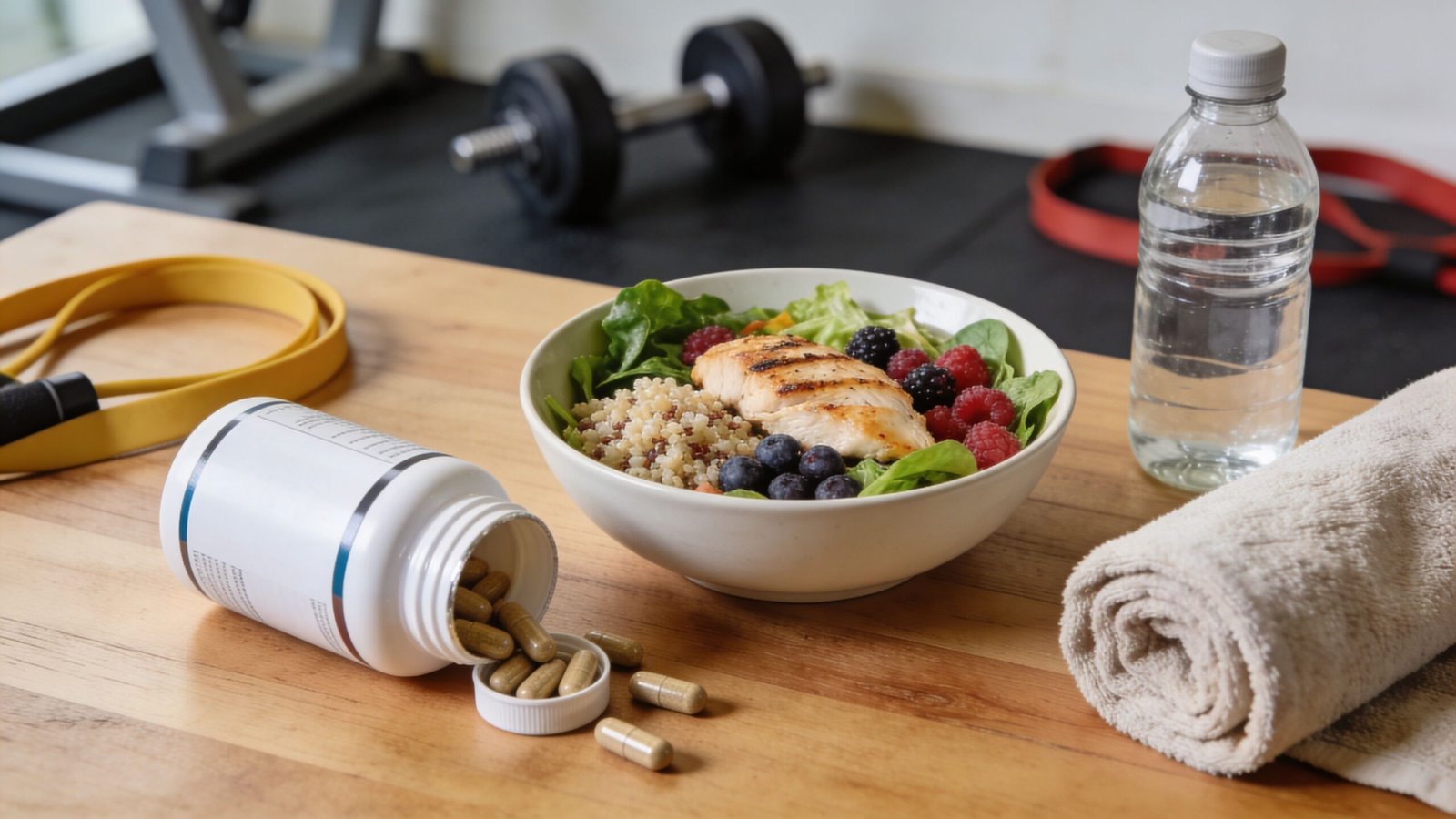
You drag yourself into a workout hoping movement will help. Sometimes it does, for an hour or two. Then the crash hits. Your legs feel heavy, your brain fog ramps up, and the soreness that should feel normal turns into a full-body energy drain that lingers far longer than it should.
That cycle is common in people trying to balance chronic fatigue symptoms with a real desire to stay active. It’s also where generic fitness advice falls apart. Standard recovery guides assume you only need muscle repair. Standard fatigue guides often ignore the fact that you still want to train, lift, walk, or rebuild capacity. Best supplements and nutrition for chronic fatigue and gym recovery sit in the middle of those two problems.
This review takes that middle ground seriously. The focus is practical: Amazon-available supplements, how they fit into daily energy support and post-workout recovery, where they help, and where they disappoint.
The Vicious Cycle of Fatigue and Poor Gym Recovery
You feel too tired to train hard, so the session underdelivers. Then the session still wipes you out, so recovery gets worse anyway. That’s the trap.
For some people, the issue isn’t motivation. It’s that energy production and recovery capacity don’t match the demand of training. You finish a moderate lift, a home circuit, or even a brisk walk, and your body reacts as if you did far more. The next day becomes damage control instead of progress.

Why generic advice often misses the mark
Most supplement content splits into two camps. One side talks about fatigue and mitochondrial support. The other talks about gym recovery, protein, and muscle soreness. A review in PubMed coverage of fatigue-related supplementation gaps highlights that most content treats chronic fatigue and gym recovery separately, even though people dealing with fatigue often need an integrated plan.
That matters because the same person may need to support:
- Daily energy stability so basic training is even possible
- Recovery after exercise so one session doesn’t lead to a multi-day setback
- Pacing and tolerance so progress doesn’t trigger post-exertional malaise
Practical rule: If a supplement only helps you push harder but doesn’t improve how you feel the next day, it’s not a complete recovery strategy for chronic fatigue.
What usually works better
The strongest real-world approach is layered. Start with compounds that support cellular energy, then add recovery support, then fix nutrition and training volume. That’s a different strategy from chasing the strongest pre-workout or the trendiest recovery powder.
In practice, the best results usually come from products that do one of these jobs well:
- Support ATP and mitochondrial function
- Improve recovery capacity
- Help sleep, muscle relaxation, or hydration
- Fill common nutrition gaps that make fatigue worse
Some supplements are useful but overrated. Others are boring and reliable. For this topic, boring and reliable usually wins.
How We Reviewed The Best Supplements for Fatigue and Recovery
A good supplement review for this problem can’t rely on hype, flavor, or flashy labels. It has to weigh evidence, form, tolerability, and practicality. That’s what separated the seven picks below.

What mattered most in the review
I prioritized products using four filters.
Evidence for fatigue or recovery support
Human data mattered most, especially where a supplement had relevance to both chronic fatigue symptoms and exercise recovery.Form and absorbability
CoQ10, magnesium, omega-3s, and B vitamins all vary a lot by form. A cheaper label isn’t a bargain if the form is poorly tolerated or harder to use consistently.Amazon availability and product clarity
Every pick had to be easy to find on Amazon and clearly labeled. Vague proprietary blends didn’t make the cut.Stack compatibility
People dealing with fatigue often don’t tolerate aggressive supplement stacks well. Products scored better if they could fit into a simple routine without creating obvious overlap or stomach issues.
What lost points
Some products didn’t make this list because they looked exciting on paper but had practical drawbacks:
- Overstimulating formulas that may worsen crashes later
- Underdosed blends that sprinkle key ingredients without meaningful amounts
- Messy formulas with too many add-ons that make side effects harder to identify
- Recovery products built only for bodybuilders with no thought for fatigue sensitivity
A supplement can be popular and still be a bad fit for someone who wants steady training without a rebound crash.
The lens used for ranking
This wasn’t a ranking of the strongest gym supplements in general. It was a ranking of the best supplements and nutrition for chronic fatigue and gym recovery for someone who needs both energy support and recovery support at the same time.
That changes the order a lot. A classic muscle-building product might help with performance but still rank lower if it doesn’t address fatigue well. On the other hand, a supplement that slightly improves gym output but meaningfully improves day-to-day energy can become far more valuable.
Our 2026 Review of the 7 Best Recovery and Fatigue Supplements
You finish a workout that should have felt manageable, then spend the rest of the day heavy, foggy, and under-recovered. That is a different problem from ordinary gym soreness, and it changes which supplements make sense.
For this list, the best picks were the ones that could help both sides of the equation. They needed to support day-to-day energy, especially mitochondrial energy production, while also fitting into a recovery plan for someone who still wants to train. That dual lens is why the order here looks different from a standard bodybuilding list.
Verdict Winner: D-Ribose powder
If I had to choose one starting point for the overlap between chronic fatigue symptoms and gym recovery, I would start with D-ribose. It has the clearest practical fit for the person who feels drained by training itself, not just sore afterward.
Top 7 Supplements for Fatigue and Recovery At a Glance
| Supplement | Primary Benefit | Best For | Verdict |
|---|---|---|---|
| D-Ribose | ATP support | Energy crashes and poor workout tolerance | Best overall |
| CoQ10 + NADH | Mitochondrial support | Fatigue with exertion intolerance | Best for steady energy |
| Magnesium glycinate | Relaxation and recovery | Sleep, tension, and poor recovery | Best for evening use |
| Creatine monohydrate | Strength and energy buffering | Lifters and active trainees | Best for training support |
| Omega-3 fish oil | Recovery nutrition support | Joint comfort and general recovery | Best nutrition add-on |
| B-Complex | Nutrient support | Low intake or broad energy support | Best basic coverage |
| Ashwagandha | Stress support | Tension and recovery friction | Best for stress-related fatigue |
If you want a broader comparison of gym-focused options, this guide to best supplements for workout recovery adds useful context beyond the fatigue-specific picks here.
1. Micro Ingredients D-Ribose Powder
D-ribose takes the top spot because it addresses the complaint I hear most from fatigued trainees. Exercise does not just create soreness. It wipes out usable energy.
A 2006 open-label pilot in people with ME/CFS and fibromyalgia reported improvements in self-rated energy, wellbeing, sleep, mental clarity, and pain after D-ribose use. The study was small and uncontrolled, so I would not oversell it. Still, it points in the right direction for someone whose workouts trigger a disproportionate crash.
That distinction matters. Creatine can help with output. Protein helps muscle repair. D-ribose is one of the few options on Amazon that at least lines up with the feeling of "my battery drops too fast."
It is also easy to use in practice. Some people do better with a split dose across the day. Others tolerate it better around training. The trade-off is digestive tolerance. Higher doses can cause bloating or loose stools, so this is a supplement to start low and test.
Pros
- Best match for depleted energy rather than soreness alone
- Flexible powder format for pre-workout, post-workout, or split dosing
- Useful early in a return-to-training phase
- Fits simple stacks with creatine or magnesium
Cons
- Can cause GI issues if the dose is too aggressive
- Does not replace protein or calories
- Response varies a lot between users
Summary
Best for the reader whose main issue is post-exertional flattening, not just normal muscle soreness.
2. Jarrow Formulas QH-Absorb Ubiquinol or a comparable Amazon CoQ10 product
CoQ10 ranks high because it sits close to the physiology that matters in both fatigue management and exercise tolerance. If D-ribose is the more direct "low battery" pick, CoQ10 is the steadier mitochondrial support option.
Earlier in the article, I referenced research on CoQ10 plus NADH in ME/CFS. That pairing is more relevant than CoQ10 alone, which is an important trade-off to understand before buying. Amazon shoppers can usually find CoQ10 more easily than a reliable combined formula, so CoQ10 still earns a place here, but expectations should stay realistic.
Ubiquinol forms are often the better practical choice if absorption is a concern. This is usually not the supplement people feel on day one. In coaching practice, it tends to suit people who want fewer crashes over time, not a noticeable boost after a single capsule.
Pros
- Strong fit for mitochondrial support
- Relevant for fatigue with poor exercise tolerance
- Often well tolerated
- Good daily option for people avoiding stimulants
Cons
- Usually takes patience
- Best evidence often involves pairing with NADH
- Less useful for sleep or muscle tightness
CoQ10 is often a consistency supplement. The goal is lower effort cost over time, not a stimulant-like lift.
Summary
Best for people who want steadier energy support and better tolerance to daily activity.
3. Doctor’s Best High Absorption Magnesium Glycinate
Magnesium glycinate earns its place because recovery does not happen only in the gym. It happens at night, in the nervous system, and in how well the body settles after training.
For the person who feels wired but tired, this can be one of the more practical additions. Glycinate is usually gentler than magnesium oxide or citrate, and evening use often makes the most sense. Better sleep quality and less muscle tension can improve recovery even if magnesium does not directly raise daytime energy.
I would not use this as the lead supplement for someone with obvious exertion-related crashes. I would use it when poor sleep, tension, headaches, or post-workout restlessness are clearly making the fatigue worse.
Pros
- Helpful for evening recovery
- Usually easier on the stomach
- Supports muscle relaxation
- Pairs well with creatine, omega-3s, or CoQ10
Cons
- Not a primary energy supplement
- Effects can be subtle
- Daytime use feels too calming for some people
Summary
Best for people whose fatigue gets worse because recovery at night is poor.
4. Optimum Nutrition Micronized Creatine Monohydrate
Creatine stays in the top seven because it still does its job better than almost anything else in sports nutrition. It supports repeated high-output effort, strength progression, and lean mass retention, which matters for anyone trying to rebuild capacity after a low-energy stretch.
It ranks below D-ribose and CoQ10 here for a simple reason. Creatine helps gym performance and recovery capacity more than it helps chronic fatigue symptoms directly. That does not make it less useful. It just makes it a better fit for the person who is still training regularly and wants more resilience inside those sessions.
The practical upside is hard to beat. It is inexpensive, well studied, easy to dose, and simple to keep in a routine.
Pros
- Excellent for strength and training support
- One of the most established gym supplements
- Works well alongside D-ribose
- Useful during rebuilding phases
Cons
- Not designed for fatigue syndromes
- Some users dislike the water-retention feel
- Does not fix under-eating, poor pacing, or sleep problems
Summary
Best for active readers who are lifting consistently and want stronger training support without a complicated stack.
5. Nordic Naturals Ultimate Omega or a similar high-quality Amazon fish oil
Omega-3s are not exciting, but they are often useful. I look at them as a nutrition support supplement more than a performance supplement.
That distinction matters for this article. Someone dealing with persistent fatigue and delayed gym recovery often has more than one weak point. Daily food quality may be inconsistent. Recovery may feel stiff or inflamed. Protein may be decent while overall diet quality still lags. Fish oil can help cover part of that gap, especially if fatty fish intake is low.
The main buying issue is quality control. Front-label fish oil claims can be misleading, so EPA and DHA amounts matter more than the size of the softgel.
Pros
- Fits a recovery-focused nutrition plan
- Easy to stack with almost anything
- Can cover a common diet gap
- Useful on training and rest days
Cons
- Will not give a noticeable energy lift
- Quality varies widely on Amazon
- Some people dislike fishy burps or large capsules
Summary
Best for readers who need stronger nutrition support behind their recovery.
6. Garden of Life Vitamin B Complex or another clearly labeled B-complex on Amazon
A B-complex can make sense when food intake has been inconsistent, stress is high, or the goal is basic nutritional coverage without building a large stack.
I would keep expectations measured. B-complex products are often marketed like energy pills, and that is not how they generally work. They are more useful as background support, especially if the diet has obvious holes or if overall intake has been low during periods of fatigue.
This category also needs a label check. Some formulas use forms or doses that create nausea, and some overlap heavily with a multivitamin.
Pros
- Covers multiple energy-related nutrients
- Useful if food quality has been inconsistent
- Easy to combine with CoQ10 or omega-3s
- Often affordable
Cons
- Usually does not feel dramatic
- Some formulas are hard to tolerate
- Can overlap with a multivitamin
Summary
Best for rounding out a routine when the nutrition base is shaky.
7. Sports Research Ashwagandha or another standardized Amazon ashwagandha
Ashwagandha is the most situational option on this list. I do not put it first for pure low-energy states, but it can help when fatigue and poor recovery are tangled up with constant stress, poor downshifting, and feeling overstimulated.
That pattern is common in active people who keep pushing through bad recovery. They are tired, but not calm. They are worn down, but cannot switch off. In that case, a standardized ashwagandha product may help the overall recovery environment enough to make sleep, training tolerance, and soreness easier to manage.
It is also one of the more individual supplements here. Some people like it. Some feel flat on it. That is why it sits lower in the ranking.
Pros
- Good fit for stress-heavy recovery problems
- Can pair well with magnesium
- Useful when life stress and training stress pile up
- Widely available on Amazon
Cons
- Not a primary ATP or muscle repair supplement
- Response is more individual than with creatine or magnesium
- Not the best first purchase for every reader
Summary
Best for readers who feel tired, tense, and unable to recover fully.
Which one should you buy first
Start with your main bottleneck, not with the most popular product.
| If your main issue is… | Start with… |
|---|---|
| Feeling flattened after light or moderate exercise | D-ribose |
| Exertion intolerance and poor steady energy | CoQ10 or CoQ10 plus NADH if available |
| Poor sleep and tight recovery | Magnesium glycinate |
| Rebuilding strength and training output | Creatine monohydrate |
| A weak overall nutrition base | Omega-3s or B-complex |
| Stress-heavy recovery issues | Ashwagandha |
Keep the stack simple at first. One or two products is usually enough to learn what helps, what irritates your stomach, and what improves training recovery without making fatigue worse.
Foundational Nutrition Strategies to Fight Fatigue
You finish a workout and expect the usual soreness. Instead, you get the deeper kind of crash. Legs stay heavy for the rest of the day, concentration drops, and the next session feels harder than it should. In that situation, supplements can help, but they work best when your food intake stops digging the hole deeper.

For people balancing chronic fatigue symptoms with regular training, the nutrition target is different from standard gym advice. The job is not only to support muscle repair. It is also to keep daily energy more stable, reduce the odds of an all-day crash after training, and give mitochondria enough raw material to keep up with basic demand.
Eat to steady energy and support recovery
Under-eating is common here, especially in people who are tired, busy, or trying to eat “clean” while training. I see the same pattern often. Breakfast is light or skipped, lunch is random, training happens half-fueled, and the evening ends with cravings, soreness, and a feeling that recovery supplements “aren’t doing much.”
The fix is usually simple, but it has to be consistent. Build meals around four pieces:
- Protein to support muscle repair and keep meals filling
- Carbohydrates to replace used glycogen and reduce the stress cost of training
- Produce to cover potassium, magnesium, folate, vitamin C, and other micronutrients that tend to run low when intake is erratic
- Fluids and sodium to support blood volume, exercise tolerance, and recovery, especially if you sweat heavily
A practical meal beats a perfect meal. Rice, eggs, fruit, and yogurt will do more for recovery than a low-calorie snack plate that leaves you under-fueled an hour later.
Keep post-workout food predictable
The best recovery meal is often the one you can prepare when tired. Decision fatigue is real, and it matters more when fatigue is already part of the picture. A repeatable routine protects you from the common mistake of delaying food until the crash hits.
If you want simple meal ideas, this guide on what to eat after strength training is a useful place to start.
A solid post-workout template looks like this:
- A protein source such as Greek yogurt, eggs, chicken, cottage cheese, tofu, or a protein shake
- An easy carb source such as oats, rice, potatoes, toast, cereal, or fruit
- A moderate amount of fat, enough to make the meal satisfying without turning it heavy
- Fluids soon after training, especially after longer or sweatier sessions
For someone with persistent fatigue, this matters for more than muscle soreness. Post-workout nutrition can reduce the energy dip that shows up two to six hours later and ruins the rest of the day.
Use daily foods to lower the stress load
Recovery does not come only from the hour after training. It comes from what your body can count on across the whole day.
Good baseline habits include:
- Breakfast with protein, even if it is small
- Carbs around training, especially if exercise leaves you drained or shaky
- Omega-3-rich foods such as salmon, sardines, trout, walnuts, or chia
- Magnesium-rich foods such as pumpkin seeds, leafy greens, beans, and nuts
- Regular meal timing instead of long gaps followed by overeating
The article's dual goal is particularly relevant. Gym recovery nutrition usually focuses on protein and calories. Chronic fatigue support often focuses on micronutrients and mitochondrial function. In practice, you need both. A body that is trying to repair muscle while also struggling with low day-to-day energy does better with a steady intake than with extremes.
As noted earlier, some supplement ingredients are aimed at mitochondrial support. Food still sets the baseline they build on. If daily intake is inconsistent, even well-chosen products like CoQ10, magnesium, or creatine tend to feel less impressive.
For a quick visual refresher on recovery meals, this video is worth watching before you overcomplicate the process.
Recovery nutrition works best when it is boring enough to repeat and solid enough to support both energy production and muscle repair.
When to Consult a Clinician About Your Fatigue
Supplements are useful. Guessing isn’t.
If fatigue is persistent, disproportionate to your activity, or getting worse, it’s time to involve a clinician. That’s especially true if you’ve already tightened up sleep, food, hydration, and training volume but still feel drained in a way that doesn’t make sense.
Red flags worth taking seriously
Talk with a clinician if you have fatigue alongside symptoms such as:
- Fatigue that doesn’t improve with rest
- Sudden or severe exhaustion
- Unexplained weight changes
- Fever or other signs of illness
- Shortness of breath, chest symptoms, or dizziness
- Brain fog severe enough to affect work or daily function
These aren’t signs to buy a stronger supplement. They’re signs to rule out an underlying issue.
Testing matters more than most people think
A lot of supplement content skips testing entirely, and that’s a mistake. The GoodRx review on chronic fatigue supplements notes that individualized testing is often overlooked, and that some small studies have linked CoQ10 deficiency to higher fatigue scores in CFS. It also notes a practical issue many generic articles ignore: high doses of D-ribose can cause GI issues.
That’s why bloodwork is worth discussing. Ask your clinician whether it makes sense to review basics such as:
- Complete blood count
- Iron and ferritin
- Vitamin B12
- Vitamin D
- Thyroid markers
If sleep is a major issue too, you may also find this guide on the best magnesium supplement for sleep useful as a supportive next read, though it shouldn’t replace medical evaluation.
Where self-treatment usually goes wrong
The most common mistake is stacking too many products at once. People add a B-complex, CoQ10, D-ribose, magnesium, creatine, caffeine, and an adaptogen in the same week, then can’t tell what’s helping.
The better move is slower and less exciting. Test basics. Add one product at a time. Track energy, soreness, sleep, and next-day function.
Summary The Verdict on The Best Fatigue and Recovery Supplements
The core problem here isn’t just low energy or sore muscles by themselves. It’s the combination. You want to stay active, but training can leave you more depleted than it should. That calls for a plan that supports both cellular energy and recovery capacity.
Across the seven Amazon picks, D-ribose is the clear Verdict Winner. It fits the overlap best. It’s the most direct option for people whose workouts seem to drain them beyond normal soreness, and it has the strongest practical match for energy-depleted training days.
The rest of the list matters too. CoQ10 is a strong second choice for foundational energy support. Magnesium glycinate helps the recovery side. Creatine is excellent for rebuilding output. Omega-3s, B-complex, and ashwagandha fill in common gaps depending on your situation.
The best results usually come from three moves done together:
- Pick one or two smart supplements
- Fix the food and hydration basics
- Get medical input if the fatigue is persistent or unusual
That combination is far more useful than chasing an aggressive stack and hoping for a shortcut.
Frequently Asked Questions
Can I take several of these supplements together
Yes, but keep the stack simple at first. A practical starting combo is one energy-focused product and one recovery-focused product. For example, D-ribose plus magnesium glycinate, or CoQ10 plus omega-3s.
Avoid changing too many variables at once. If your stomach gets irritated, your sleep changes, or your energy feels worse, you need to know which product caused it.
How long does it take to notice a difference
It depends on the supplement and on your baseline. Some products feel more immediate in practice, especially if your issue is low available energy. Others work more gradually and feel like a reduction in strain rather than a surge.
The best way to judge is to track:
- energy before training
- soreness after training
- sleep quality
- next-day function
That tells you more than a single workout ever will.
What side effects should I watch for
The most practical one from this list is GI discomfort with higher doses of D-ribose. Fish oil can cause aftertaste or burps. Magnesium can be relaxing, which is good at night but not always ideal earlier in the day. Adaptogens like ashwagandha can feel helpful for one person and unhelpful for another.
If you’re on medication, have a diagnosed condition, or are highly sensitive to supplements, check with a clinician before stacking products.
What if supplements help a little but I still crash after workouts
That usually means the issue isn’t just supplements. Look at training volume, session intensity, fueling, hydration, and sleep. Many people need to reduce the total stress load before any supplement starts to shine.
If even light sessions cause a disproportionate crash, get medical guidance rather than trying to out-supplement the problem.
If you want more practical, no-hype guidance on supplements, recovery, home training, and everyday performance, visit Energy Supplement Reviews. It’s a useful resource for building a routine that helps you train consistently without wasting money on products that don’t fit your goals.
