


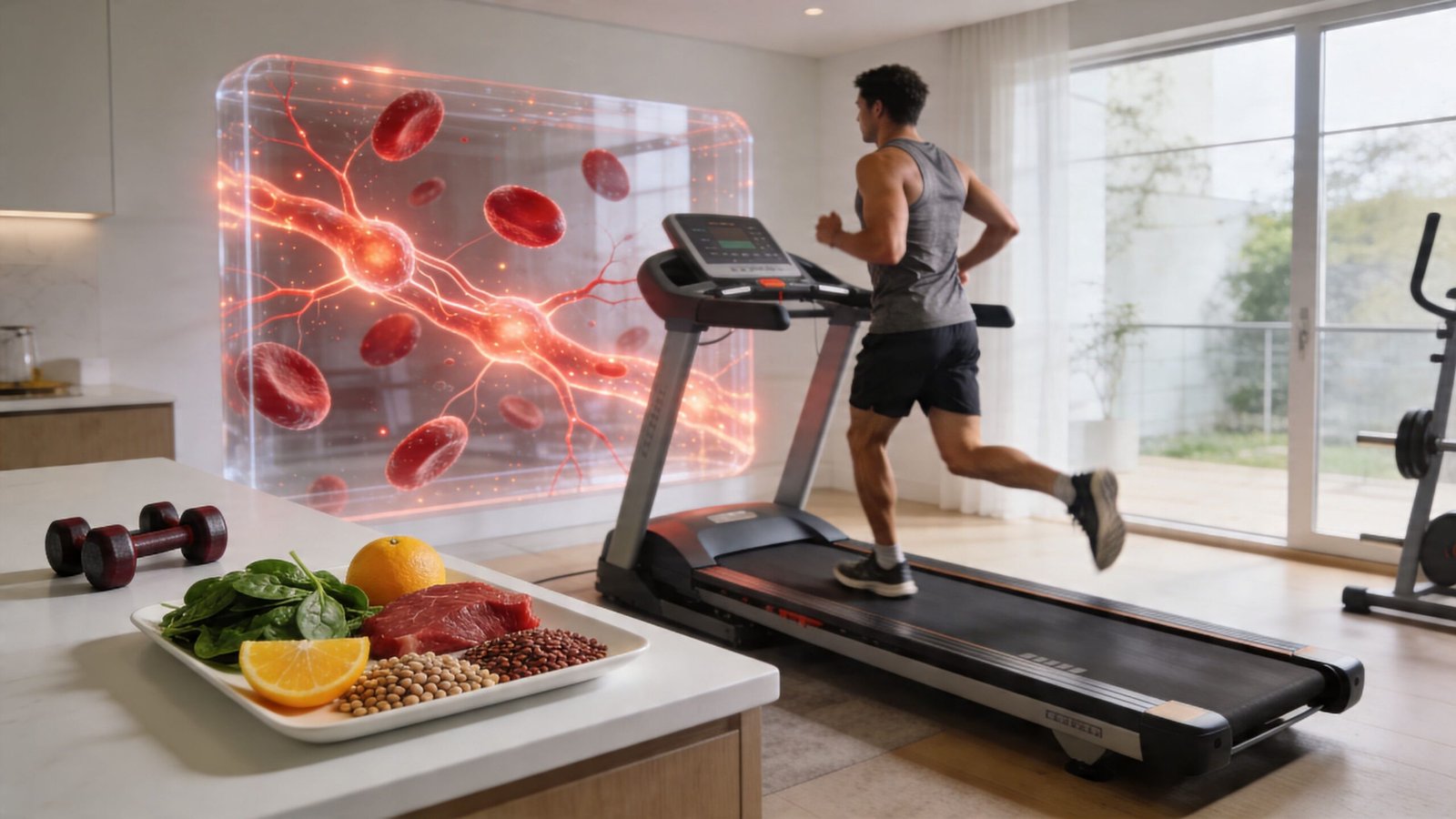
You eat well. You show up for your workouts. You try to sleep enough. But halfway through a simple session, your legs feel heavy, your heart feels like it’s working too hard, and your energy disappears far sooner than it should.
That pattern frustrates a lot of active people, especially home trainees who are doing most things right. They assume they need more motivation, more caffeine, or a harder program. Sometimes the underlying issue is simpler and more physical. Your body may not be moving oxygen well enough to support the work you’re asking it to do.
That’s where anemia enters the picture. It can act like an energy thief. You’re still trying to train, but the engine doesn’t get the oxygen delivery it needs, so effort feels much harder than it should. You might notice breathlessness on stairs, unusual weakness during circuits, or the kind of fatigue that doesn’t match the workout.
Best nutrition support for anemia and working out without fatigue usually isn’t one magic fix. It’s a combination of smart food choices, the right supplements, good timing, and training that helps rather than drains you. That’s especially true if you’re exercising at home and trying to manage energy with limited time and equipment.
Introduction Conquering Workout Fatigue When Your Body Fights Back
A client once described it like this: “I can finish the workout on paper, but my body feels empty before I’m even halfway in.” That’s a useful way to think about exercise with anemia. The plan may be fine, but your body doesn’t have the same reserve.
For active people, that mismatch can be confusing. You might clean up your diet, add a supplement, and still feel flat. Then you start wondering whether you’ve become lazy or out of shape. In many cases, neither is true. Your body may be short on the nutrients needed to build healthy red blood cells, or you may be absorbing iron poorly even though you’re eating iron-rich foods.
What makes this tricky is that workout fatigue from anemia doesn’t always look dramatic at first. It often shows up as slower recovery, weaker intervals, lightheadedness, or a session that feels much harder than your fitness level suggests.
Simple truth: If your oxygen delivery is low, even a moderate workout can feel like a steep hill.
That’s why support has to be practical. You need food strategies that fit real life, supplement options that make sense for your needs, and a workout approach that helps your body rebuild instead of pushing it deeper into the hole.
Some people need iron support. Others may need B12 or folate support. Some are eating the right foods but taking them at the wrong time. That last point gets missed often, and its significance is often underestimated.
Why Anemia Saps Your Workout Energy A Core Concept Review
Think of your blood like a delivery fleet. Hemoglobin is the truck, oxygen is the cargo, and your muscles are the delivery address. When anemia is present, you have fewer trucks on the road, or the trucks aren’t carrying enough cargo. Your muscles still demand oxygen, especially during exercise, but the supply can’t keep up.
That’s why simple exercise can suddenly feel expensive. Your legs burn sooner. Your breathing gets heavier. Recovery drags. In athletes and active people, iron deficiency anemia can cut endurance capacity by up to 30%. The same review notes that aerobic activity can trigger inflammatory responses that reduce hemoglobin concentration and serum iron levels, while weakening red blood cell membranes, which can make workout fatigue worse.

Iron deficiency is the most common fitness roadblock
Iron helps your body make hemoglobin. Without enough iron, oxygen delivery drops. For a trainee, that often means workouts feel harder at lower intensity.
A lot of people hear “anemia” and think only of severe illness. But mild deficiency can still matter if you’re asking your body to perform. Running, cycling, and other endurance-style work can increase stress on iron status, especially if your diet is inconsistent or your recovery isn’t lined up well.
Sports anemia is different from iron deficiency
This confuses many readers. Sports anemia often refers to a dilution effect. Training can expand plasma volume, which makes blood values look lower even when true red blood cell status hasn’t fallen the same way.
That’s why guessing isn’t useful. The symptom can feel similar, but the cause and treatment may not be identical.
B12 and folate matter too
Iron gets most of the attention, but it’s not the whole story. Your body also needs vitamin B12 and folate to support healthy red blood cell formation.
If one of those is low, you can still feel wiped out during training even if you’ve focused hard on iron. This shows up more often in people who eat very little animal food, people with restricted diets, and older adults. When someone says, “I’m taking iron and still feel drained,” this is one of the first things I think about.
Your muscles don’t care why oxygen delivery is low. They only feel that it is.
The practical takeaway
If workouts feel strangely hard, don’t just blame your willpower. Ask a better question. Is your body under-fueled, under-recovered, or under-supplied with the nutrients needed to move oxygen well?
That shift in thinking helps you stop chasing more intensity when what you really need is better support.
7 Best Supplements for Anemia Nutrition Support Review 2026
Supplements don’t replace diagnosis, and they don’t replace food. But they can be useful tools when your intake is low, your needs are higher, or your clinician has confirmed deficiency. The products below are all widely known Amazon supplement options and represent different categories, because not everyone needs the same type of support.
Early in this process, readers usually ask one question: “Do iron supplements help exercise performance?” In one randomized trial of 40 female rowers, those given 50 mg of iron sulfate twice daily for 6 weeks had higher serum ferritin, a slower lactate response, and better exercise fitness than placebo, with the biggest gains in athletes whose starting ferritin was under 20 ng/mL.

1. Solgar Gentle Iron
Best for: People who want an iron supplement that’s often chosen for sensitive stomachs.
Summary: This is a common pick when standard iron tablets feel rough on digestion. If you’ve stopped taking iron in the past because of stomach discomfort, this is the type of formula many shoppers look at first.
Pros
- Gentler format: Often preferred by people who don’t tolerate harsher iron products well.
- Simple formula: Easy to understand if you want a more straightforward iron-only option.
- Widely available on Amazon: Easy to compare sizes and pricing.
Cons
- Still not ideal for everyone: Even gentler iron can bother some people.
- Not a full anemia formula: You may still need vitamin C, B12, or folate depending on your situation.
- Needs timing care: Taking it near inhibitors can undercut its usefulness.
2. MegaFood Blood Builder
Best for: People who prefer a food-based style formula with supportive cofactors.
Summary: This product is popular because it combines iron with nutrients that support blood health. It appeals to readers who want a broader formula rather than iron in isolation.
Pros
- Multi-nutrient approach: Useful if your support plan needs more than iron alone.
- Convenient all-in-one feel: Can simplify a supplement routine.
- Popular with busy trainees: Easy to fit into daily use.
Cons
- May not suit all budgets: Combination formulas often cost more than basic iron.
- Not automatically better for severe deficiency: Product style doesn’t replace medical guidance.
- Dose flexibility can be limited: Separate nutrients offer more customization.**
3. Floradix Iron and Herbs Liquid Supplement
Best for: People who struggle with pills.
Summary: Liquid iron can be easier for some users to take consistently. Compliance matters. The best supplement is often the one you’ll use as directed.
Pros
- Liquid format: Helpful if capsules feel hard to swallow.
- Easy routine fit: Can work well in a morning nutrition habit.
- Often chosen during low-energy phases: Some people do better with a liquid product.
Cons
- Taste is subjective: Some like it, some don’t.
- Storage and measuring can be less convenient: Not as simple as a capsule.
- May stain if spilled: Practical but worth noting.
4. NOW Iron with Vitamin C
Best for: People who want iron plus an absorption helper in the same product.
Summary: Vitamin C helps the body absorb non-heme iron better, so a combo product can reduce guesswork. This can be useful for home trainees who don’t want to build a multi-bottle stack.
Pros
- Built-in vitamin C support: Helpful for absorption strategy.
- Simple setup: Fewer moving parts than buying separate products.
- Easy for beginners: Good starting point if you want a straightforward pair.**
Cons
- Less customizable: You can’t adjust iron and vitamin C separately as easily.
- Not ideal if you already take vitamin C elsewhere: May create overlap.
- Still requires meal timing awareness: The formula doesn’t solve the hepcidin issue on its own.**
If you’re also comparing other non-prescription options for low energy, this guide to supplements for reducing fatigue naturally can help you separate general energy support from true anemia support.
5. Nature Made Vitamin B12
Best for: People who may need support beyond iron.
Summary: B12 won’t fix iron deficiency by itself, but it matters when fatigue is tied to poor red blood cell production for other reasons. This is especially relevant for vegetarians, vegans, and older adults.
Pros
- Targets a different cause of fatigue: Useful when iron isn’t the only issue.
- Easy to add: Usually simple to include in a routine.
- Common Amazon option: Widely available and familiar.
Cons
- Not a substitute for iron if iron is the problem: Wrong tool for the wrong issue won’t help much.
- Testing still matters: Low energy doesn’t automatically mean low B12.
- Can create false confidence: People sometimes assume one B vitamin covers everything.**
A lot of readers benefit from seeing the basics explained visually before they buy anything.
6. Nature Made Folic Acid
Best for: People who need folate support or want to cover a common red blood cell cofactor.
Summary: Folate works in the same broad conversation as B12. It supports healthy blood cell formation, so it deserves attention when fatigue doesn’t line up neatly with iron alone.
Pros
- Useful cofactor: Makes sense in broader blood health support.
- Simple and affordable category: Often easy to find.
- Pairs well with clinician-guided plans: Especially if labs suggest need.
Cons
- Not a standalone fatigue cure: It helps when folate is relevant.
- Can distract from the main issue: If iron deficiency is present, you still need to address that directly.
- Best used with context: Random supplement stacking isn’t a smart strategy.
7. Garden of Life Vitamin Code Raw B12 or a similar B-complex option
Best for: People who want broader B-vitamin support.
Summary: Some trainees feel best using a B12-focused product, while others prefer a B-complex style formula. The value here is coverage, especially if diet quality has been inconsistent.
Pros
- Broader support: Useful when your diet has gaps beyond iron.
- Popular among plant-forward eaters: Often considered by readers avoiding much animal food.
- Flexible category: Lets you choose based on your eating pattern.**
Cons
- Not precise if you need targeted treatment: More isn’t always better.
- Can complicate your routine: Extra bottles, extra decisions.
- May not address the main bottleneck: Absorption timing and true diagnosis still matter.**
How to choose the right supplement type
Use the product category that matches your likely need, not the one with the loudest label.
| Supplement type | Best fit | Main caution |
|---|---|---|
| Gentle iron | Sensitive stomachs | Still needs good timing |
| Liquid iron | Trouble swallowing pills | Taste and convenience vary |
| Iron plus vitamin C | Simple setup | Less customizable |
| B12 | Low animal food intake or suspected deficiency | Doesn’t replace iron |
| Folate | Suspected folate gap | Shouldn’t be random add-on |
| Food-based blood support | People wanting broader formula | Can cost more |
| B-complex | Wider diet gaps | Can be less targeted |
Buying rule: Match the supplement to the deficiency risk, not to the marketing promise.
Building Your Anti-Fatigue Diet Plan
A strong food plan does two jobs. It gives your body raw material for red blood cells, and it avoids blocking the absorption of that material. That second part is where many people get tripped up.
Know the difference between heme and non-heme iron
Heme iron comes from animal foods and is absorbed more easily. Non-heme iron comes from plant foods and fortified foods, but it’s more affected by what you eat with it.
If you eat animal foods, think of lean red meat, poultry, and seafood as your easier iron options. If you eat mostly plants, think beans, lentils, spinach, leafy greens, and fortified cereals, but build the meal carefully so absorption has a better chance.

What helps and what gets in the way
One of the clearest nutrition rules here is pairing. According to this TrainingPeaks review on iron in endurance athletes, adding 100 mg of ascorbic acid can increase non-heme iron absorption by 2 to 4 times. The same source notes that calcium at more than 300 to 600 mg per meal can reduce uptake by 50 to 60%, and tannins in tea can inhibit it by up to 70%.
That means your meal structure matters.
- Helpful pair: Beans with bell peppers, citrus, strawberries, or broccoli.
- Less helpful pair: Iron-rich cereal with a large calcium-heavy meal at the same time.
- Common mistake: Taking iron, then chasing it with coffee or tea.
A simple way to build meals
Try this plate logic:
- Choose one iron source: Lean beef, turkey, lentils, beans, spinach, fortified cereal.
- Add one vitamin C booster: Orange, kiwi, berries, tomatoes, bell peppers.
- Keep inhibitors away from that meal: Save tea, coffee, and large dairy servings for another time.
- Stay hydrated: Good fluid intake helps your whole system work better. If plain water gets boring, this guide on making electrolyte water at home gives practical ideas.
A smart iron meal isn’t just about what’s on the plate. It’s also about what you don’t put next to it.
Sample meal ideas
| Meal idea | Why it works |
|---|---|
| Lean beef with roasted peppers and potatoes | Heme iron plus vitamin C support |
| Lentil bowl with tomatoes and citrus dressing | Non-heme iron with absorption support |
| Fortified cereal with fruit, while saving coffee for later | More favorable iron timing |
| Bean chili with peppers | Practical plant-based option |
The Hepcidin Hack Timing Your Nutrients to Maximize Iron Absorption
Many active people make the same reasonable mistake. They work out, then immediately focus on an iron-rich recovery meal and assume they’ve covered the base. Sometimes that meal lands during the exact window when the body is least ready to absorb iron well.
That obstacle is hepcidin. It’s a hormone that helps regulate iron absorption. After endurance exercise, it can rise and temporarily block iron uptake. The result is frustrating. You may be eating the right foods and still not getting the full benefit.

Why timing changes the outcome
A 2024 review on preventing iron deficiency in athletes notes that hepcidin can peak 3 to 6 hours after an endurance workout, reducing iron uptake by up to 50% if iron-rich meals are eaten during that window. The same review suggests morning iron intake or waiting 30+ minutes post-exercise to improve the odds of better absorption.
That’s the hidden reason some people say, “I’m eating spinach, beans, and fortified foods all the time, but I still feel drained.”
A practical schedule that works better
Try one of these patterns:
- Morning training day option: Take your iron supplement or iron-focused breakfast before training if that fits your stomach and routine.
- Later workout option: Put your iron-focused meal earlier in the day, not in the middle of the post-exercise hepcidin window.
- Plant-based option: Be even more deliberate, because non-heme iron already has more absorption challenges.
Here’s a simple example. If you do a long cardio session late morning, don’t automatically make lunch your biggest iron meal. You may do better putting iron at breakfast, then using lunch for general recovery foods and saving another iron-focused meal for later.
What people often get wrong
They only think about nutrients. They don’t think about nutrient timing.
Food quality matters. Timing decides how much of that quality your body can actually use.
This is one of the most useful upgrades for anyone trying to solve workout fatigue without guessing.
How to Train Smart with Anemia Workout and Recovery Tactics
When energy is low, the answer usually isn’t harder training. It’s better training. Your goal is to create enough stimulus to maintain fitness and support recovery without digging a deeper fatigue hole.
Choose work that helps more than it drains
Long, punishing cardio can be rough when your oxygen delivery is compromised. Strength training and moderate low-impact cardio are often easier to recover from and more productive during this phase.
A 12-week clinical trial found that combining moderate cardio for 20 to 30 minutes, 3 times per week, with 100 to 200 mg of daily iron improved hemoglobin by 15 to 20%, compared with 8 to 10% for iron alone. That’s a strong reminder that total rest isn’t always the best answer. Smart movement can help.
A realistic weekly structure
For many home trainees, this pattern works better than random hard sessions:
- Two or three resistance sessions: Bodyweight squats, rows, presses, bands, and glute work.
- Two moderate cardio sessions: Brisk walking, easy cycling, or similar low-impact work.
- One or two lighter recovery days: Mobility, stretching, or a short walk.
- At least one true easy day: Especially if symptoms are flaring.
If you also want meal ideas around lifting days, this guide on what to eat after strength training can help you keep recovery simple.
Rules that protect your energy
Don’t chase intensity just because the program says so. Use your symptoms as feedback.
- Stop if dizziness shows up: That’s not a push-through signal.
- Shorten the session before you skip movement entirely: A lighter workout can still be useful.
- Keep rest periods generous: Your body may need more time between sets.
- Track patterns: If a certain style of training wipes you out for the rest of the day, that’s data.
The right workout during anemia should leave you feeling worked, not wrecked.
Recovery counts more than usual
This is the phase where good decisions look boring. You may need slower progress, fewer max-effort sessions, and more consistency than excitement. That isn’t backing off forever. It’s giving your body a better chance to rebuild.
Red Flags When to See a Clinician About Fatigue
Fatigue from training is common. Fatigue that feels out of proportion to your effort deserves more respect. If you’re dealing with anemia symptoms, self-diagnosis has limits.
See a clinician promptly if you notice any of these:
- Shortness of breath that feels severe or unusual
- Dizziness or fainting
- Chest pain
- A racing heartbeat at rest or with very light activity
- Pale skin that’s new or more noticeable
- Fatigue that keeps worsening despite eating well and reducing training
- Heavy menstrual bleeding, blood loss, or digestive symptoms alongside fatigue
It’s also worth getting checked if your workouts have changed dramatically and you can’t explain why. Many people wait too long because they assume they’re just stressed or out of shape.
Ask your clinician whether the following labs make sense in your case:
- Complete Blood Count
- Serum ferritin
- Serum iron
- Total iron-binding capacity
- Transferrin saturation
- B12 and folate testing when appropriate
Bring details. Tell them what your workouts feel like now compared with a few months ago, whether stairs feel harder, and whether your fatigue improves with rest or keeps hanging around. That information helps more than saying, “I’m tired.”
Frequently Asked Questions
Common questions and practical answers
| Question | Answer |
|---|---|
| Can I work out if I have anemia? | Often yes, but the style and intensity matter. Many people do better with moderate cardio, walking, cycling, and resistance training rather than long, exhausting sessions. If symptoms are strong, get medical guidance first. |
| What’s the best nutrition support for anemia and working out without fatigue? | The best plan usually combines iron-rich foods, vitamin C pairing, fewer absorption blockers around iron meals, careful supplement choice, and smarter workout pacing. For some people, B12 or folate also matters. |
| I’m plant-based. Can I still support iron well? | Yes, but you need more strategy. Use beans, lentils, leafy greens, and fortified foods, then pair them with vitamin C-rich foods. Be extra careful with coffee, tea, and high-calcium foods around iron-focused meals. Timing matters a lot. |
| Should I take iron right after a workout? | Not always. The timing issue in the hepcidin section matters here. Some people absorb iron better earlier in the day or outside the post-exercise window rather than assuming immediate post-workout is best. |
| How long until I feel better? | That depends on the cause, the severity, your consistency, and whether the treatment matches the actual deficiency. Some people notice early changes in exercise tolerance first, while others need more time. If nothing is changing, talk with a clinician instead of guessing. |
| Are iron supplements hard on the stomach? | They can be for some people. That’s why gentler forms or liquid options can be useful. If a supplement makes you stop taking it, the “best” formula on paper isn’t the best one for you. |
| Do B12 and folate really matter for energy? | Yes, when deficiency is part of the problem. They support healthy red blood cell production, so they matter in the big picture even though iron gets most of the attention. |
| Is sports anemia the same as iron deficiency anemia? | Not exactly. Sports anemia can reflect plasma volume changes from training rather than the same nutrient problem. That’s one reason lab testing matters before you assume you know the cause. |
A final practical note. If you’re doing all the right healthy things and still feel exhausted, don’t treat that as a character flaw. Treat it as information. Your body is asking for a more precise plan.
If you want more practical guidance on training energy, supplement choices, recovery, and simple home-friendly fitness strategies, visit Energy Supplement Reviews. It’s a useful resource for busy readers who want straightforward help without the fluff.
