


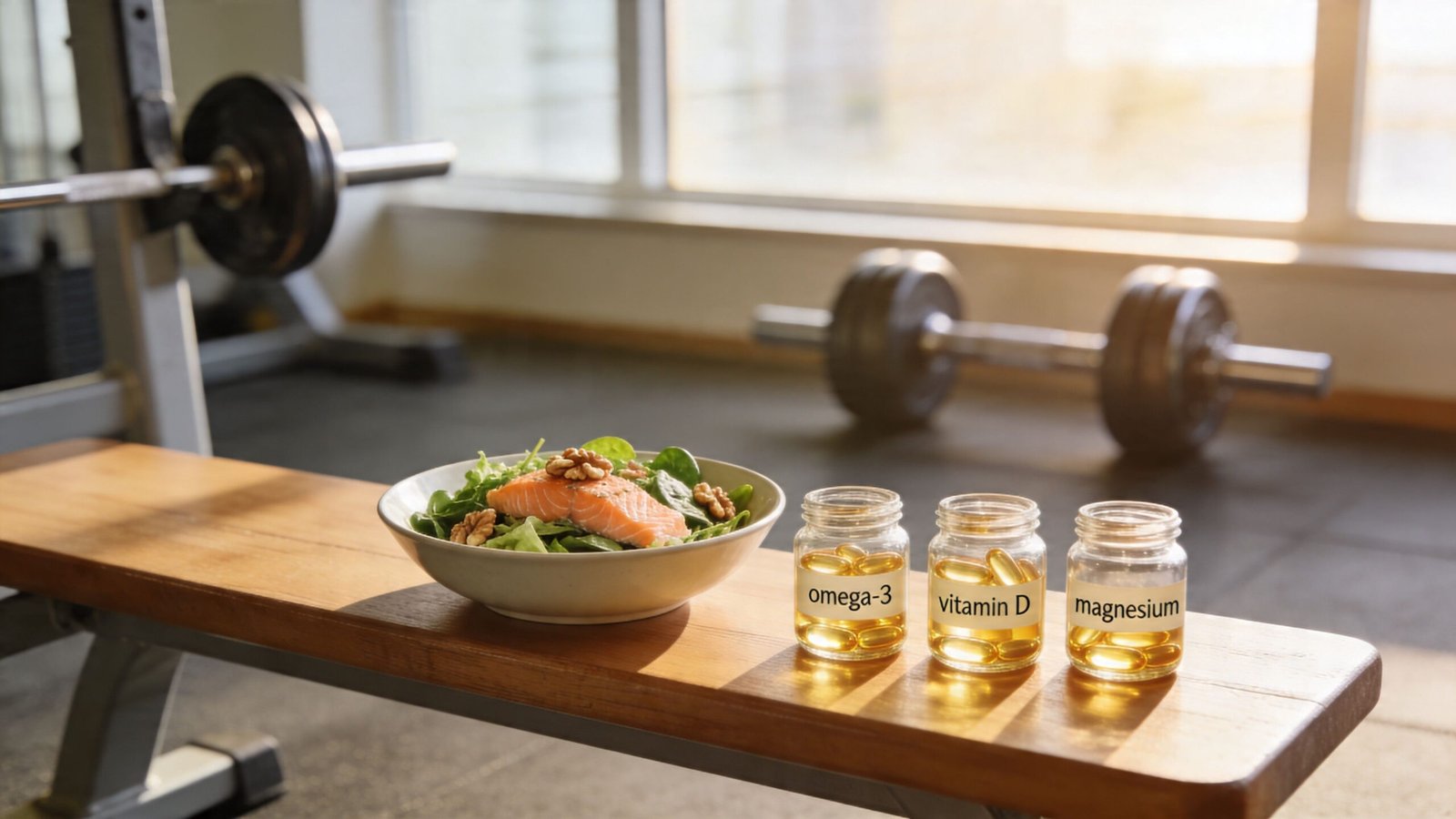
TL;DR: For most active people dealing with low mood, the best starting point is an EPA-focused omega-3 at 1,000 to 2,000 mg combined EPA/DHA daily, because blood omega-3 levels are moderately lower in people with depression and that same intake can also support recovery and joint comfort. If folate metabolism is an issue, L-methylfolate at 7.5 to 15 mg daily may help as an adjunct, and the strongest food foundation is a Mediterranean-style pattern built around fatty fish, lean protein, fruits, vegetables, legumes, nuts, and seeds.
| Supplement | Primary Mood Benefit | Gym Performance Perk | Overall Rating |
|---|---|---|---|
| Omega-3 Fish Oil | Best evidence-backed first pick for depressive symptoms | Supports recovery and joint comfort | 9.5/10 |
| L-Methylfolate | Strong adjunct option when folate metabolism is an issue | May help reduce fatigue-linked inconsistency | 9/10 |
| Vitamin D3 | Useful support, especially when intake or sunlight is low | Helps keep overall routine stable | 8.5/10 |
| Magnesium Glycinate | Better sleep and nervous system support | Helpful for recovery when timed well | 8.5/10 |
| Zinc Picolinate | Supports brain signaling when deficient | Useful for active diets that lack mineral density | 8/10 |
| SAMe | Adjunctive mood support option | May help consistency if tolerated well | 7.5/10 |
| Creatine Monohydrate | Promising pick for mood and brain energy | Excellent gym crossover benefit | 8.5/10 |
Fueling Your Body But Starving Your Mind
A lot of gym-goers know this pattern well. You show up, hit your sets, chase progress, maybe even look better in the mirror, but your mood still drags behind you all day. Motivation feels thin. Recovery feels harder than it should. The workout gets done, but the rest of life still feels heavy.
That disconnect usually isn't a discipline problem. It's often a support problem. Your muscles can be getting enough stimulus while your brain is still running short on the raw materials it needs for mood regulation, stress tolerance, and steady energy.
I see this most often in people who train hard but eat on autopilot. Breakfast is coffee. Lunch is whatever fits between meetings. Dinner is protein, maybe, but not much else. Supplements are often chosen for pumps, pre-workout buzz, or body composition, while mood support gets ignored until things feel serious.
If that sounds familiar, start thinking about your nutrition as part of your mental performance plan, not just your physique plan. Some readers also find it useful to look at broader recovery support, including guides on supplements for reducing fatigue naturally, because low drive and low mood often overlap in real life.
Practical rule: If your training is structured but your meals are chaotic, fix the meals before blaming your mindset.
The best supplements and diet for depression while staying active in the gym won't act like a switch you flip overnight. But they can make your training feel more sustainable, your energy less brittle, and your mood more supported from the ground up.
Understanding the Mind-Muscle-Nutrition Connection
Your brain regulates mood with the same basic inputs that support training performance. Energy availability, protein intake, fatty acids, micronutrients, sleep quality, and total stress all shape how you feel in the gym and outside it.

Your brain needs raw materials
Neurotransmitter production depends on amino acids, fatty acids, B vitamins, minerals, and enough total calories. If intake is inconsistent, mood often becomes inconsistent too. You can still hit your lifts for a while, but focus, patience, and recovery usually start slipping first.
I see this in lifters who are technically eating enough protein but very little else. Chicken, pre-workout, a protein bar, then a big dinner can maintain body weight. It is a weak setup for stable mood, sleep quality, and mental resilience under training stress.
That is one reason active people often start searching for nootropic supplements for energy and focus. Those products can have a place, but they do not replace a diet that actually covers the basics your brain uses every day.
Inflammation affects mood and recovery
Training creates short-term inflammation. That is normal and part of adaptation. The problem is the background load created by poor sleep, under-recovery, highly processed food, excess alcohol, and chronic psychological stress.
For someone managing depressive symptoms while trying to keep gym performance steady, that distinction matters. The goal is not to suppress every inflammatory signal. The goal is to reduce the unnecessary load that leaves joints achy, recovery flat, and mood harder to manage.
This is why some mood-support supplements overlap with sports nutrition so well. Omega-3s are a good example. They are often chosen for depression support, but they also fit a gym routine because they can support recovery and joint comfort. That crossover is a big part of how I rank products in the review section. I do not just care whether a supplement may help mood. I care whether it helps without creating obvious problems for training, appetite, sleep, or session quality.
Blood sugar stability changes the quality of the day
Low mood and low motivation often get blamed on mindset when the issue is erratic fueling. A hard session after too little food can feel productive in the moment, then the rest of the day turns foggy, irritable, and hunger-driven. That pattern is common in people who rely on caffeine early, delay meals, and overeat late.
A better setup is boring, and it works:
- Eat protein across the day: Regular intake supports recovery and provides amino acids involved in brain function.
- Use carbs strategically: Oats, rice, potatoes, fruit, beans, and whole grains usually support steadier energy than ultra-processed snack food.
- Include fats deliberately: Fatty fish, nuts, seeds, avocado, and olive oil improve nutrient density and help meals hold you longer.
- Treat produce as part of recovery: Vegetables and fruit help cover potassium, folate, magnesium, vitamin C, and other gaps common in restrictive gym diets.
Small nutrition errors add up fast when training volume is high and mood is already under pressure.
A physique-focused diet can still be mentally undernourishing. If your meals are built only around macros, mood support usually gets left behind.
The practical takeaway is simple. The best depression-focused supplement stack for an active person works much better when meals are regular, calories are adequate, and recovery habits are not working against it.
The 7 Best Supplements for Depression Review 2026
You’re training four or five days a week, your program is dialed in, and people around you assume the gym means you must be doing fine. Then motivation drops, sleep gets choppy, and your supplement shelf starts filling up with products that promise mood support but say nothing useful about training, recovery, appetite, or medication safety. That is the gap this list is built to solve.
If you want an Amazon-style shortlist, these are the seven supplement categories I’d screen first for an active adult dealing with depressive symptoms. The ranking reflects real-world usefulness, evidence quality, and how each option fits a lifting routine without creating unnecessary friction.
Top 7 Mood-Boosting Supplements for Active Individuals (2026)
| Supplement | Primary Mood Benefit | Gym Performance Perk | Overall Rating |
|---|---|---|---|
| Omega-3s EPA-dominant | Best-supported foundational option | Recovery and joint support | 9.5/10 |
| Vitamin D3 | Helpful adjunct for mood support | Useful in low-sunlight periods | 8.5/10 |
| Magnesium Glycinate | Supports calm and sleep quality | Recovery support when taken away from training | 8.5/10 |
| Zinc Picolinate | Helps when low intake or deficiency is present | Supports brain signaling and routine quality | 8/10 |
| L-Methylfolate | Strong adjunct option | Helps training consistency when mood dips are fatigue-linked | 9/10 |
| SAMe | Useful add-on in some cases | Supports overall routine adherence | 7.5/10 |
| Creatine Monohydrate | Promising mood support plus brain energy role | One of the best gym crossover supplements | 8.5/10 |
1. Nordic Naturals Ultimate Omega on Amazon
For active adults with low mood, EPA-forward fish oil is still the cleanest first-buy category. It has the best overlap between depression support, recovery, and day-to-day practicality.
Earlier evidence in this article already covered why omega-3s matter. The short version is simple. This is one of the few options that makes sense for both sides of the problem. Mood support and gym sustainability.
Why it works for active people
- It helps cover a common dietary gap.
- It fits easily into a recovery-focused routine.
- It pairs well with a food-first plan built around fatty fish.
Best use case
Someone who trains regularly, eats very little salmon, sardines, trout, or mackerel, and wants one supplement that earns its place beyond a mental health claim alone.
Pros
- Best overall starting point: Strong balance of mood relevance and gym usefulness.
- Easy to pair with meals: Works well with a Mediterranean-style diet.
- Helpful during hard training blocks: Often appreciated when joints and recovery feel beat up.
Cons
- Dose discipline matters: More is not automatically better.
- Product quality varies: Purity, freshness, and EPA content matter.
- High-dose use needs caution: Especially if someone also uses blood-thinning medication.
2. Nature Made Vitamin D3 on Amazon
Vitamin D3 is a support piece, not the whole plan. I recommend it more often in people who get little sunlight, train indoors, diet aggressively, or notice their mood slides during darker months.
For gym-goers, the appeal is straightforward. It is easy to take, easy to combine with other basics, and usually does not interfere with training sessions. That makes it a reasonable add-on if deficiency risk is real.
Why it works for active people
It fits almost any training schedule and rarely creates timing problems.
Pros
- Simple to stay consistent with: Low-effort addition to a daily routine.
- Useful adjunct: Makes sense alongside better food quality and regular meals.
- Low hassle: No special workout timing for most users.
Cons
- Weak as a solo move: It will not fix low calories, poor sleep, or chronic stress.
- Works best when personalized: Blood work beats guessing.
- Easy to overestimate: One capsule does not cancel out a poor routine.**
3. Doctor’s Best High Absorption Magnesium Glycinate on Amazon
Magnesium glycinate is a practical recovery supplement with mood upside, especially for people who feel stressed, wired at night, or unable to settle down after evening training. I do not rank it as a primary depression supplement in the same tier as omega-3s or targeted folate support. I do rank it highly for people whose low mood is being worsened by poor sleep and constant tension.
That distinction matters. A supplement can be useful without being the centerpiece.
Take magnesium at night if it helps you relax. Avoid forms that upset your stomach before squats, intervals, or long sessions.
Why it works for active people
Hard training and chronic stress often produce the same pattern. Physical fatigue, mental overstimulation, and poor sleep depth. Magnesium glycinate can help smooth out that pattern.
Pros
- Strong fit for evening routines: Helpful for people who struggle to wind down.
- Recovery-friendly: Better sleep often improves training tolerance and mood.
- Usually gentler form: Glycinate is often easier on the gut than other magnesium types.
Cons
- GI issues still happen in some users: Timing and dose matter.
- Mood support is indirect: Better as part of a full system than a standalone answer.
- Response varies: Some people feel a clear difference, others feel very little.**
4. NOW Foods Zinc Picolinate on Amazon
For zinc, precision beats guesswork. It is useful when intake is low or deficiency is present, but it is not a supplement I tell every lifter to grab blindly.
As noted earlier in the article, zinc has some evidence as an adjunct in depression care, and deficiency should guide the decision. That matters in active people who eat very little red meat, shellfish, legumes, or seeds. A physique diet can look clean on paper and still come up short on minerals.
Why it works for active people
Low-zinc diets are more common than people think, especially during restrictive cutting phases or very repetitive meal plans.
Pros
- Targeted support: More useful when diet quality is narrow or intake is low.
- Relevant to brain function: Worth checking when motivation and mental sharpness are slipping.
- Easy to pair with food upgrades: Shellfish, legumes, pumpkin seeds, and meat all help.
Cons
- Best guided by testing: Blind dosing is not ideal.
- Too much creates problems: Excess zinc can disrupt copper balance.
- Less exciting than trendier products: Basic minerals often get ignored.**
5. MethylPro L-Methylfolate on Amazon
L-methylfolate is one of the stronger targeted options on this list. It is not a casual first supplement for everyone, but it can be a smart adjunct in the right context.
A clinical overview of supplements for depression notes that L-methylfolate is used as an adjunctive option for major depressive disorder, particularly in people with MTHFR-related folate metabolism issues. That makes it more of a clinician-guided tool than a general wellness add-on.
Why it works for active people
Some lifters describe low mood less as sadness and more as mental fatigue, flat drive, and poor follow-through. In that situation, targeted folate support is at least worth a medical conversation, especially if standard basics have already been handled.
Pros
- High upside in the right person: Especially relevant when folate metabolism is impaired.
- Works as an adjunct: It can fit alongside existing treatment.
- Clear clinical use case: More specific than a generic multivitamin approach.
Cons
- Not ideal for casual self-testing: Better discussed with a clinician.
- Useful for a subset, not everyone: This is not the universal first pick.
- Does not replace diet quality: Folate-rich foods still matter.**
6. Nature’s Trove SAMe on Amazon
SAMe belongs in the conversation, but I put it behind omega-3s, solid food intake, sleep support, and targeted folate work for most active people. That ranking is about practicality as much as evidence.
It may help some users with mood support, particularly as an add-on. I stay more careful with SAMe because lifters often stack too many products at once, and this is one of the supplements where medication context matters more.
Why it works for active people
It gives some people a non-stimulant route for mood support, which is useful if caffeine is already too high and anxiety is bleeding into training.
Pros
- Legitimate adjunct option: Reasonable to consider in a broader plan.
- Fits a low-stimulant approach: Useful for people already overusing pre-workout and coffee.
- Can support routine adherence: Helpful if mood dips are disrupting consistency.
Cons
- Not my first recommendation: Other categories are easier to justify early.
- Response is uneven: Some people notice benefit, others do not.
- Needs more medication caution: Discuss before stacking with antidepressants or other mood-related meds.**
7. Optimum Nutrition Micronized Creatine Monohydrate on Amazon
Creatine is the best gym-performance crossover on this list. That alone gives it an advantage over many mood supplements that do nothing for training quality, recovery, or strength retention.
Its mood role is still developing in this article’s source set, so I would not oversell it as a primary depression supplement. I would still rank it highly for active adults because it already deserves a spot in many lifting programs. If it also supports mental energy or resilience for a given person, that is useful upside.
Why it works for active people
It helps on the gym side first. That matters, because adherence is better when a supplement has obvious training value.
Pros
- Excellent performance value: One of the most practical supplements in sports nutrition.
- Reasonable brain-energy angle: Plausible fit for stressed, active adults.
- Simple and affordable: Easy to use consistently.
Cons
- Mood evidence is still less settled here: Stronger for performance than depression claims in this article.
- Will not compensate for a poor routine: Sleep, food, and treatment still matter.
- Timing gets overcomplicated: Daily consistency matters more than perfect scheduling.**
Quick buying summary
If you want the short version:
- Best overall: Omega-3 fish oil
- Best adjunct with a targeted clinical angle: L-methylfolate
- Best for sleep-stressed lifters: Magnesium glycinate
- Best mineral to check if diet is weak: Zinc
- Best broad support option: Vitamin D3
- Best secondary adjunct: SAMe
- Best gym crossover pick: Creatine monohydrate
The Verdict Our Top Overall Supplement Pick
The best overall pick is an EPA-dominant omega-3 fish oil.

This is the supplement I’d start with generally because it gives the best overlap between mood support and gym practicality. It’s one of the few options on this list that directly makes sense for both sides of the problem. Low mood and active recovery.
It also fits how real people live. You can build around it with food. You can keep using it whether your current goal is fat loss, strength, muscle gain, or just getting through a stressful season without losing your training rhythm. That makes it more useful than a niche product that only fits one scenario.
There’s also less friction here than with some of the more specialized options. L-methylfolate may be excellent in the right person, but it’s more targeted. SAMe can be useful, but I wouldn’t call it the most practical first move. Magnesium is valuable, but it supports the system more indirectly.
Coach’s take: Start with the supplement that helps your mood and your recovery at the same time. That's usually omega-3.
The only caveat is dose discipline. Standard use makes sense. Excessive use doesn't. If you're lifting seriously, you want support, not a supplement plan that interferes with adaptation. Used intelligently, omega-3 is the clearest first buy on this list.
Building Your Anti-Depressive Diet Plan for the Gym
The best supplements and diet for depression while staying active in the gym start with food. Supplements can fill gaps or provide targeted support, but they work best when your meals already support mood, energy, and recovery.

Build meals around the Mediterranean pattern
The review evidence provided supports a diet rich in lean proteins, fruits, vegetables, nuts, legumes, and seeds, while avoiding junk food because healthful eating correlates with lower depression risk. For active people, I’d make that practical, not trendy.
A strong plate usually looks like this:
- Protein first: Salmon, chicken, Greek yogurt, eggs, lentils, beans, or tofu.
- Color next: Spinach, berries, peppers, carrots, tomatoes, broccoli, mixed greens.
- Smart carbs: Potatoes, oats, rice, fruit, beans, or whole grains.
- Useful fats: Olive oil, walnuts, flaxseeds, chia, avocado, fatty fish.
If you want one food category to prioritize more aggressively, make it fatty fish. That gives you a direct food source of EPA and DHA instead of relying entirely on capsules.
Time meals around your training
Pre-workout meals don't need to be fancy. They need to be digestible and steady. Think protein plus a carb source that doesn't wreck your stomach. Greek yogurt and fruit works. Chicken and rice works. Oats with protein works.
Post-workout, keep the same logic. You want protein for repair, carbs to restore energy, and a meal that doesn't send you into a junk-food spiral later in the day. The goal isn't perfection. The goal is reducing the number of bad decisions made when you're tired and hungry.
A useful visual on meal structure and consistency is below.
A simple grocery framework
Use this shopping list as your baseline:
- Fatty fish: Salmon, sardines, mackerel
- Lean protein: Chicken, turkey, eggs, Greek yogurt
- Legumes: Lentils, black beans, chickpeas
- Seeds and nuts: Walnuts, pumpkin seeds, flaxseeds
- Produce: Spinach, berries, citrus, broccoli, peppers
- Carb staples: Oats, rice, potatoes, quinoa, fruit
Eat in a way that makes your next workout easier and your next afternoon more stable. That's the standard.
Smart Supplement Strategy Safety and Stacking
The biggest mistake I see isn't under-supplementing. It's stacking too many things with no thought for training timing, digestion, or trade-offs.

More isn't better
A contrarian finding summarized by the Mayo Clinic supplement discussion suggests that high-dose omega-3s above 2 g per day may reduce strength gains by blunting hypertrophy signals, which is exactly the kind of detail most generic depression guides miss.
That doesn't make omega-3 a bad choice. It means dose selection matters more when you're also chasing performance. If your main goal is mood support while keeping training adaptations moving, an EPA-focused approach without drifting into excessive intake is the smarter play.
Use timing to reduce side effects
Here’s the practical stack I’d consider for many active adults:
- Omega-3 with meals: Better tolerated and easier to remember.
- Magnesium at night: A good option if daytime use causes GI discomfort or makes training feel off. Readers comparing forms may also want a dedicated guide on the best magnesium supplement for sleep.
- Vitamin D with a meal containing fat: Keeps the routine simple.
- Zinc away from random mega-dosing: More is not the plan here.
- Creatine daily at a convenient time: Pick consistency over ritual.
Watch the blind spots
A few practical cautions matter:
- Medication interactions: L-methylfolate and SAMe should be discussed with your clinician if you’re already taking antidepressants or other psychiatric medication.
- Mineral balance: Zinc can be helpful, but long-term excess can work against you.
- GI tolerance: Magnesium form and timing matter more than label hype.
- Training phase: During high-volume lifting blocks, don't assume anti-inflammatory stacking should be pushed as high as possible.
The right stack supports your program. The wrong stack creates side effects, confusion, or flat training.
Conclusion Your Path to a Stronger Mind and Body
If your workouts are consistent but your mood still feels unreliable, don't assume you just need more willpower. The better move is usually to tighten the foundation. Eat more nutrient-dense food. Use supplements with a clear purpose. Time them in a way that respects both your digestion and your training.
For most active people, that means starting with an omega-3, improving daily meal quality, and using supportive options like magnesium, vitamin D, zinc, or L-methylfolate based on your actual needs. Creatine is also a smart crossover supplement if you want one product that clearly belongs in a gym routine and may also help on the mental side.
This is not a replacement for medical care. If you have significant depressive symptoms, worsening mood, sleep disruption, or you're already taking antidepressants, bring this plan to your doctor, psychiatrist, or registered dietitian and discuss it with them. A good clinician can help you decide what fits your health history, medication profile, training load, and lab work.
The goal isn't to pick the most supplements. It's to build a routine that helps you train, recover, and feel more like yourself again.
Frequently Asked Questions
How long does it take to feel a difference from these supplements?
It depends on the supplement, your diet, your consistency, and whether you're correcting a real deficiency or just experimenting. Some people notice recovery, sleep, or energy changes sooner than mood changes. Think in terms of steady use and pattern improvement, not overnight effects.
Can I take these supplements with antidepressants?
Sometimes yes, sometimes not without supervision. L-methylfolate is specifically discussed in the provided evidence as an adjunct to antidepressants, and zinc was also described as an adjunct in some contexts, but that doesn't mean every stack is automatically safe for every person. Talk to your prescribing clinician before adding anything.
Which supplement is the best first buy?
For most active people, omega-3 is the best first step because it supports both mood and recovery. If you suspect a more specific issue, such as folate metabolism problems, a clinician may steer you toward L-methylfolate instead.
Are there supplements I should avoid for depression?
Avoid anything sold like a miracle cure. Be cautious with stimulant-heavy products that promise motivation, euphoria, or intense focus, especially if they disrupt sleep or increase anxiety. Also avoid random high-dose stacking just because individual ingredients sound helpful in isolation.
What matters more, food or supplements?
Food. Supplements work better when they're filling a gap in an already solid routine. If your meals are mostly processed food, inconsistent protein, and low fruit and vegetable intake, supplements won't do enough on their own.
If you want more practical, gym-focused guidance on supplements, recovery, and training routines that fit real life, visit Energy Supplement Reviews.
