

You’re training consistently. You’re sleeping enough, at least on paper. You’ve cleaned up your pre-workout meal, your caffeine is already doing overtime, and yet your sessions still feel flat. Warm-ups feel harder than they should. Your heart rate climbs fast. Strength drops earlier in the workout. You leave the gym feeling wrung out instead of productively tired.
That pattern often gets mislabeled as poor conditioning, overtraining, or “just stress.” Sometimes it is. But in practice, one of the most overlooked causes is low iron or low vitamin B12, especially when fatigue shows up alongside poor endurance, breathlessness, sluggish recovery, or that heavy-legged feeling that makes normal training feel harder than it used to.
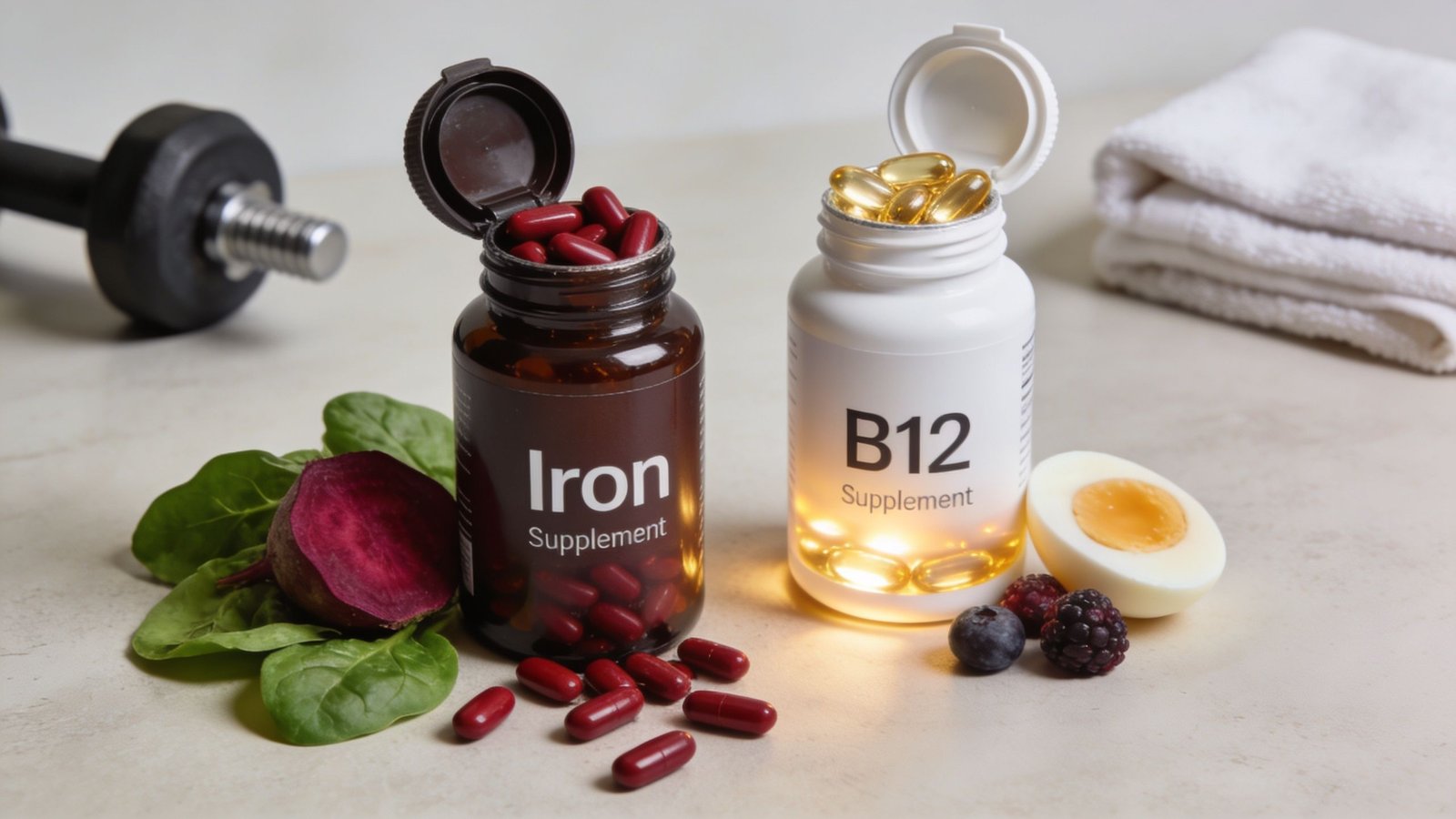
Selecting the optimal iron or B12 for anemia and boosting gym energy is important. The right supplement can help. The wrong one can waste your money, irritate your stomach, or miss the underlying problem entirely.
This guide takes the practical route. First, it helps you tell iron-related fatigue from B12-related fatigue in a gym setting. Then it reviews 7 Amazon supplements that fit different needs, including gentle iron, heme iron, liquid iron, methyl B12, and combo formulas. If you’re also looking at non-mineral options for training fatigue, this guide to natural energy boosters for workouts pairs well with the supplement strategy here.
Introduction Why Your Gym Energy Is Crashing

Many individuals don’t think “possible deficiency” when gym energy tanks. They think they need a stronger pre-workout, more carbs, or a deload week. Those can help, but they don’t fix a shortage of the nutrients your body uses to move oxygen and build healthy red blood cells.
Low iron and low B12 don’t always look dramatic at first. They often show up as persistent fatigue, slower conditioning gains, reduced work capacity, and sessions that feel strangely harder than your program says they should. That’s why athletes and regular gym-goers miss them so often.
The practical question isn’t whether iron or B12 is “better” in the abstract. It’s which one fits your situation. If your issue is poor iron status, B12 won’t solve it. If your issue is B12 deficiency, random iron pills may do nothing except upset your stomach.
Bottom line: If fatigue keeps showing up despite reasonable training, food, and sleep, it’s worth treating nutrient status like a performance variable, not just a health checkbox.
Understanding Anemia and Its Impact on Gym Performance
Anemia reduces your body’s ability to deliver oxygen and maintain energy production. In the gym, that can show up as early fatigue, worse endurance, poor repeat effort performance, and slower recovery between sets. The exact mechanism depends on whether the issue is iron or B12.
How iron-related anemia hurts performance
Iron is central to hemoglobin and oxygen transport. When iron status drops, your muscles don’t get what they need as efficiently, and your sessions can start feeling disproportionately hard. This is one reason athletes can feel “out of shape” even when their programming is solid.
The important point for gym users is that performance can decline before full anemia develops. In athletes, iron deficiency without anemia affects up to 52% of female athletes, and iron supplementation in deficient individuals can improve VO2max by 5 to 10%. A 2023 review of 25 randomized controlled trials involving over 1,200 athletes found that the biggest performance gains happened in those with lower ferritin, with VO2peak improving by an average of 4.6% and time-to-exhaustion increasing by up to 17% during high-intensity endurance tests, according to this 2023 athlete iron review on PMC.
That matters even if your main goal is lifting, not distance work. Better oxygen delivery supports warm-ups, volume work, circuits, supersets, and your ability to recover inside the session.
How B12-related anemia feels different
Vitamin B12 deficiency causes a different type of anemia. Instead of mainly being an iron supply problem, it disrupts healthy red blood cell formation and can also affect nerve function. In a gym context, that can mean fatigue plus a mental and neurological edge to the problem. Some people notice brain fog, low drive, or tingling alongside the physical exhaustion.
That’s why B12 deficiency can feel less like “I’m gassed” and more like “I’m flat, foggy, and off.” If that sounds familiar, it’s worth looking beyond general fatigue.
For a broader performance-focused look at fatigue and nutrient support, this guide on nutrition support for anemia and working out without fatigue is useful.
Why gym-goers often miss the warning signs
A lot of people normalize symptoms they shouldn’t. They assume heavy periods, plant-based eating, dieting, high training volume, or getting older explains why energy is lower. Those factors do matter, but they can also raise the odds of low iron or low B12.
Use this simple checklist if your gym output has slipped:
- Exertion feels inflated: Easy cardio, warm-up sets, or normal circuits feel harder than they used to.
- Recovery inside the workout is weaker: You need longer between sets and still don’t feel ready.
- Progress stalls despite consistency: You’re showing up, but endurance and repeat performance aren’t moving.
- Fatigue spills into daily life: You’re not just tired in the gym. You feel drained outside it too.
Don’t guess from symptoms alone. Symptoms point you in a direction. Labs tell you what you’re actually dealing with.
Iron vs B12 A Head-to-Head Comparison for Athletes
The fastest way to choose the best iron or B12 for anemia and boosting gym energy is to stop treating them like interchangeable “energy vitamins.” They solve different problems.
| Category | Iron | Vitamin B12 |
|---|---|---|
| Main job | Supports oxygen transport and exercise energy production | Supports red blood cell formation and nerve function |
| Common gym pattern | Breathless workouts, lower endurance, heavy legs, poor repeat effort | Flat energy, fatigue plus brain fog, occasional tingling or neurological symptoms |
| Higher-risk groups | Female athletes, endurance trainees, plant-based eaters, people with low ferritin | Older adults, vegans, vegetarians, people with absorption issues |
| Best food angle | Heme iron absorbs better than non-heme | Mostly found in animal foods or fortified products |
| Supplement forms worth looking at | Bisglycinate, heme iron, liquid iron | Methylcobalamin, cyanocobalamin, sublingual tablets, sprays |

Key role in the body
Iron is the oxygen-delivery mineral. If it’s low, hard training often feels harder first. That’s why low iron tends to show up during exertion. You notice it when climbing stairs, finishing sets, or trying to maintain pace in circuits.
B12 is more of a red-blood-cell-and-nerve-function issue. Low B12 can still wreck training energy, but it often has a broader “system slowdown” feel. Some people describe it as low spark rather than just low stamina.
Telltale symptoms
Symptoms overlap, but they don’t overlap perfectly.
Iron deficiency often fits this pattern:
- Workout fatigue first: Training output drops before you feel obviously sick.
- Breathlessness with effort: Conditioning feels worse than your actual fitness level.
- Heavy legs and weak endurance: Volume work and longer sessions become a grind.
B12 deficiency often adds these clues:
- Brain fog: You’re physically tired and mentally dull.
- Tingling or numbness: Neurological symptoms make B12 more likely.
- Low motivation with fatigue: The whole system feels underpowered, not just your cardio.
Crucial lab tests to ask for
If you suspect iron, ask your clinician about ferritin and a basic anemia workup. Ferritin matters because low iron status can affect performance before classic anemia is obvious.
If you suspect B12, ask about vitamin B12 testing and whether folate or related markers make sense in your case. This is especially relevant if you eat little or no animal food, use medications that affect absorption, or have persistent neurological symptoms.
Bring gym-specific symptoms to the appointment. “I get winded unusually fast and can’t sustain my usual volume” is more useful than just saying “I’m tired.”
Best dietary sources
Athletes often make avoidable mistakes concerning iron absorption. Iron from food is not equally absorbed across sources. Heme iron from red meat, poultry, and fish absorbs at 15 to 35%, while non-heme iron from plant foods like spinach and lentils absorbs at 2 to 20%, based on this guide to iron and B12 testing and supplementation.
That doesn’t mean plant-based athletes can’t do well. It means they need better strategy.
- Pair non-heme iron with vitamin C: Citrus and peppers can improve absorption.
- Keep tea, coffee, and calcium away from iron-rich meals or supplements: The same source recommends avoiding them within 1 to 2 hours.
- Use the right supplement form if food alone isn’t enough: Heme iron tends to be highly bioavailable, while iron bisglycinate is often the gentler non-heme supplement choice.
B12 is simpler from a food perspective. It’s mainly found in animal foods or fortified products. If you’re vegan, vegetarian, or eating very little animal food, B12 deserves more attention early, not after fatigue is already affecting your training.
7 Best Iron and B12 Supplements for Anemia Review 2026
The products below are popular Amazon options that fit different needs. I’m not treating any supplement as a substitute for testing. The point is to match the form to the likely problem, your stomach tolerance, and your training reality.

1. Solgar Gentle Iron 25 mg Veg Capsules
This is one of the safer starting points for people who suspect low iron and don’t want the stomach drama that often comes with harsher forms. It uses iron bisglycinate, which is the form I usually prefer for gym users who need consistency.
Why it works well in practice: it tends to be easy to stay on. Adherence matters more than a theoretically strong iron supplement you stop taking after a week.
Pros
- Uses iron bisglycinate: Often a better fit for sensitive stomachs
- Moderate dose: Easier starting point than aggressive iron products
- Simple formula: Good for people who want fewer extras
Cons
- Not ideal for people who specifically want heme iron
- May be too conservative for people following a clinician-led repletion plan
Best for: First-line iron support, sensitive stomachs, and athletes who want a straightforward bisglycinate capsule.
2. NOW Supplements Iron 18 mg Double Strength
This is another Amazon staple. The main appeal is simplicity and a lower-dose approach for people who are trying to support iron status without going straight to heavy dosing.
For gym users, this can suit someone who has mild concerns, wants a cautious trial after labs, or stacks iron into a broader nutrition plan.
Pros
- Lower elemental dose: Often easier to tolerate
- Well-known brand: Easy to find and reorder
- Simple daily use: Fits people who don’t want complicated schedules
Cons
- Lower potency may feel too light for some users
- Doesn’t stand out on form the way top bisglycinate options do
Best for: Conservative users and people who prefer a lighter iron capsule.
3. Three Arrows Simply Heme Iron
This one fills a different role. Some people do better with heme iron, especially if non-heme iron causes stomach issues or hasn’t felt effective for them. Heme iron can be a smart option for gym-goers who want a highly bioavailable route and tolerate animal-derived supplements.
The trade-off is obvious. It won’t fit vegans or strict vegetarians.
Pros
- Heme iron format: Strong fit for bioavailability-focused users
- Often gentler for people who dislike standard iron pills
- Good option when plant-based iron support hasn’t worked well
Cons
- Not vegan or vegetarian
- More niche than a standard bisglycinate product
Best for: People who tolerate animal-derived supplements and want a more bioavailable iron route.
4. Floradix Iron plus Herbs Liquid Supplement
Some athletes hate iron capsules. Others get less stomach friction with liquid products. Floradix remains one of the most recognized liquid iron options on Amazon for that reason.
It’s useful for people who struggle with pills, dislike swallowing capsules before work, or want a format they can split more flexibly. The downside is convenience. Liquids are fussier than capsules.
Pros
- Liquid format: Good for people who dislike pills
- Can feel easier to take consistently
- Popular option for users who want something gentler than traditional tablets
Cons
- Less convenient for travel
- Taste matters more with liquids, and not everyone likes it
Best for: Pill-averse users and those who prefer liquid supplementation.
A quick B12 note matters here. According to Harvard Health’s energy vitamin overview, vitamin B12 deficiency contributes to 6% prevalence of anemia in adults over 60 in the US, and B12-related anemia impacts 1.5 to 2% of populations in developed markets, rising to 20% in vegans and vegetarians. That’s one reason I don’t default everyone with fatigue into the iron category.
Here’s a short video primer if you want a visual refresher before choosing a product.
5. Jarrow Formulas Methyl B-12
When B12 is the main issue, I usually like a methylcobalamin option with easy delivery. Jarrow’s methyl B12 is a common Amazon choice because it’s simple, sublingual, and built for people who want a direct B12 product without extra iron.
For gym users, the appeal is convenience. You don’t need to build a whole stack around it.
Pros
- Methylcobalamin form: Popular with users who want active-form B12
- Sublingual format: Convenient for people who prefer not to swallow capsules
- Focused formula: Useful when you want B12 only
Cons
- Doesn’t address iron if iron is the underlying problem
- Flavor and dissolve time are personal preference issues
Best for: B12-focused support, especially for plant-based eaters and users who prefer sublingual tablets.
6. Nature Made Vitamin B12 Softgels
This is a more basic B12 pick. It’s often the right move for people who want a mainstream, uncomplicated product and don’t need a premium format.
The softgel style can suit users who dislike chalky sublingual tablets. It’s not flashy, but that’s the point.
Pros
- Straightforward formula: Good for users who want a no-fuss B12 supplement
- Easy to find on Amazon
- Simple fit for long-term routine use
Cons
- Less specialized than a methyl sublingual product
- Not the most targeted choice for people focused on absorption preferences
Best for: Everyday B12 support with a simple routine.
7. Garden of Life Vitamin Code Raw B-12
This one works for people who prefer a more premium B12 experience and often want extra dietary compatibility. It tends to attract users who care about ingredient style as much as the nutrient itself.
I wouldn’t call it necessary for everyone. But if you know you’ll stay more consistent with a product that feels cleaner or better aligned with your overall supplement setup, that matters.
Pros
- Strong choice for ingredient-conscious buyers
- Good fit for users who already buy premium wellness products
- Useful for people who want a B12 product that feels more complete
Cons
- Usually pricier than simpler B12 products
- May be more supplement than some people need
Best for: Premium-focused users who want a cleaner-label B12 option.
Quick summary of the 7 reviewed products
| Product | Type | Best use case | Main drawback |
|---|---|---|---|
| Solgar Gentle Iron | Iron bisglycinate | Sensitive stomach, first-line iron support | Not heme iron |
| NOW Iron | Iron capsule | Conservative daily support | Less standout on form |
| Three Arrows Simply Heme Iron | Heme iron | Bioavailability-focused users | Not vegetarian |
| Floradix Liquid Iron | Liquid iron | Pill-averse users | Less convenient |
| Jarrow Methyl B-12 | Sublingual methyl B12 | B12-focused support | Won’t help iron deficiency |
| Nature Made B12 | B12 softgel | Basic daily B12 use | Less specialized |
| Garden of Life Vitamin Code Raw B-12 | Premium B12 | Ingredient-conscious users | Higher cost |
The best supplement is the one that matches the deficiency, the delivery format you’ll actually use, and the side-effect profile you can live with.
The Verdict Our Top Picks for Boosting Gym Energy
Best Overall Iron Supplement Winner: Solgar Gentle Iron 25 mg
This is the most balanced iron choice for most gym users. The bisglycinate form is the main reason. Iron only helps if you keep taking it, and gentler forms usually win on consistency. For someone dealing with exertional fatigue, low ferritin, or an iron-related drop in work capacity, this is the product I’d start with most often after confirming need.
Best Overall B12 Supplement Winner: Jarrow Formulas Methyl B-12
This is the cleaner B12 pick for athletes who need a direct, convenient product. The sublingual format is easy to use, and the methylcobalamin angle appeals to people who want a more targeted B12 option without bundling in iron they may not need.
Best by situation
- Best for sensitive stomachs: Solgar Gentle Iron
- Best heme iron option: Three Arrows Simply Heme Iron
- Best liquid iron: Floradix
- Best simple B12: Nature Made Vitamin B12
- Best premium B12: Garden of Life Vitamin Code Raw B-12
If you want one practical takeaway, it’s this. Choose iron when labs and symptoms point toward oxygen-delivery problems. Choose B12 when the fatigue picture includes red blood cell issues, brain fog, or plant-based intake concerns. Don’t buy based on hype. Buy based on fit.
How to Supplement Safely and Boost Absorption
The biggest mistake people make is buying iron because they’re tired. The second biggest is taking it in a way that limits absorption or makes side effects more likely.

Test before you commit
Iron is not a casual supplement. Absorption depends heavily on whether you need it. People with iron-deficiency anemia can absorb about 90% of supplemental iron, while those without deficiency may absorb only 10%, according to the AANMC review on correcting iron deficiency and performance.
That explains why one person feels a clear benefit and another gets nothing but constipation. Baseline status changes the response.
Choose a form you can tolerate
If you’ve had bad experiences with iron in the past, the form matters a lot. The same AANMC review notes that ferrous bisglycinate chelate demonstrates 2.6 times safer absorption compared with ferrous sulfate, with fewer gastrointestinal issues.
In plain terms, that usually means less chance of stomach irritation disrupting your week and your training.
What tends to work better:
- Bisglycinate iron: Strong first choice if stomach tolerance matters
- Heme iron: Useful if you want a highly bioavailable animal-derived form
- Liquid iron: Better for people who struggle with capsules
What often works worse:
- Random high-dose iron without testing: More side effects, less clarity
- Taking iron next to calcium, coffee, or tea: Poorer absorption
- Switching products too fast: You can’t tell what’s helping
Use food timing strategically
Iron doesn’t work in isolation. Carbohydrate intake and total energy intake influence the training environment around iron use. If you’re under-fueling hard, you make progress harder than it needs to be.
A practical strategy looks like this:
- Take iron away from known blockers if possible.
- Pair non-heme iron with vitamin C-rich foods to support uptake.
- Don’t train hard while chronically under-eating and expect nutrient recovery to go smoothly.
- Use B12 intentionally if your diet or symptoms suggest it, especially in plant-based patterns.
Practical rule: If iron keeps upsetting your stomach, don’t assume iron is impossible for you. Change the form before you abandon the plan.
If fatigue is broader than just suspected anemia, this guide to supplements for reducing fatigue naturally can help you build the rest of the puzzle.
Don’t ignore the iron, B12, and carb connection
B12 and iron often work like teammates, not competitors. If one is low, performance suffers. If both are low, the training hit is usually worse. Carbohydrate intake also matters because low energy availability can make recovery and work capacity more fragile.
That’s why the best iron or B12 for anemia and boosting gym energy isn’t just a product decision. It’s also a plan decision. You need the right nutrient, in the right form, with enough food support to let training adaptations happen.
Conclusion Your Action Plan for More Energy
Persistent gym fatigue isn’t normal, and it isn’t something you should always try to out-caffeinate. If sessions feel harder than they should, start by asking whether iron or B12 status could be part of the problem.
The right move is simple. Test first. Match the supplement to the deficiency. Choose a form you’ll tolerate. For most iron users, a gentle bisglycinate product is the practical first choice. For B12, a straightforward sublingual or softgel product usually makes the most sense.
Keep the bigger picture in view too. As noted in an earlier section, carbohydrate intake and overall energy intake influence iron-related recovery and work capacity. Supplements work better when the rest of your nutrition supports training.
Handle this like you’d handle programming. Diagnose the bottleneck, apply the right fix, and give it time to work.
Frequently Asked Questions
Can I take iron and B12 at the same time
Yes, many people can, especially when both nutrients are relevant. The more important issue is whether you need both. If your fatigue is driven by low iron, B12 alone won’t do the job. If B12 is the main problem, extra iron may not add anything useful. Labs make this much easier to sort out.
How long does it take to feel better on iron or B12
That depends on the cause, how low your levels are, your absorption, and how consistently you take the supplement. Some people notice energy changes earlier than performance changes. In practice, gym output often improves gradually rather than all at once.
Should plant-based athletes choose iron or B12 first
Plant-based athletes need to take both seriously. Iron deserves attention because non-heme iron is less efficiently absorbed than heme iron. B12 also deserves attention because intake is harder to cover consistently without animal foods or fortified products. If you’re plant-based and fatigued, testing both is the smart move.
What’s the best iron form for stomach sensitivity
For many people, iron bisglycinate is the better starting point because it’s often easier to tolerate. Some users also do well with heme iron or liquid iron. If one iron product bothers your stomach, that doesn’t mean every iron product will.
If you want more straight-talking supplement reviews, workout nutrition guidance, and practical recovery advice, visit Energy Supplement Reviews. It’s a useful resource for building a smarter training routine without wasting time on hype.
