

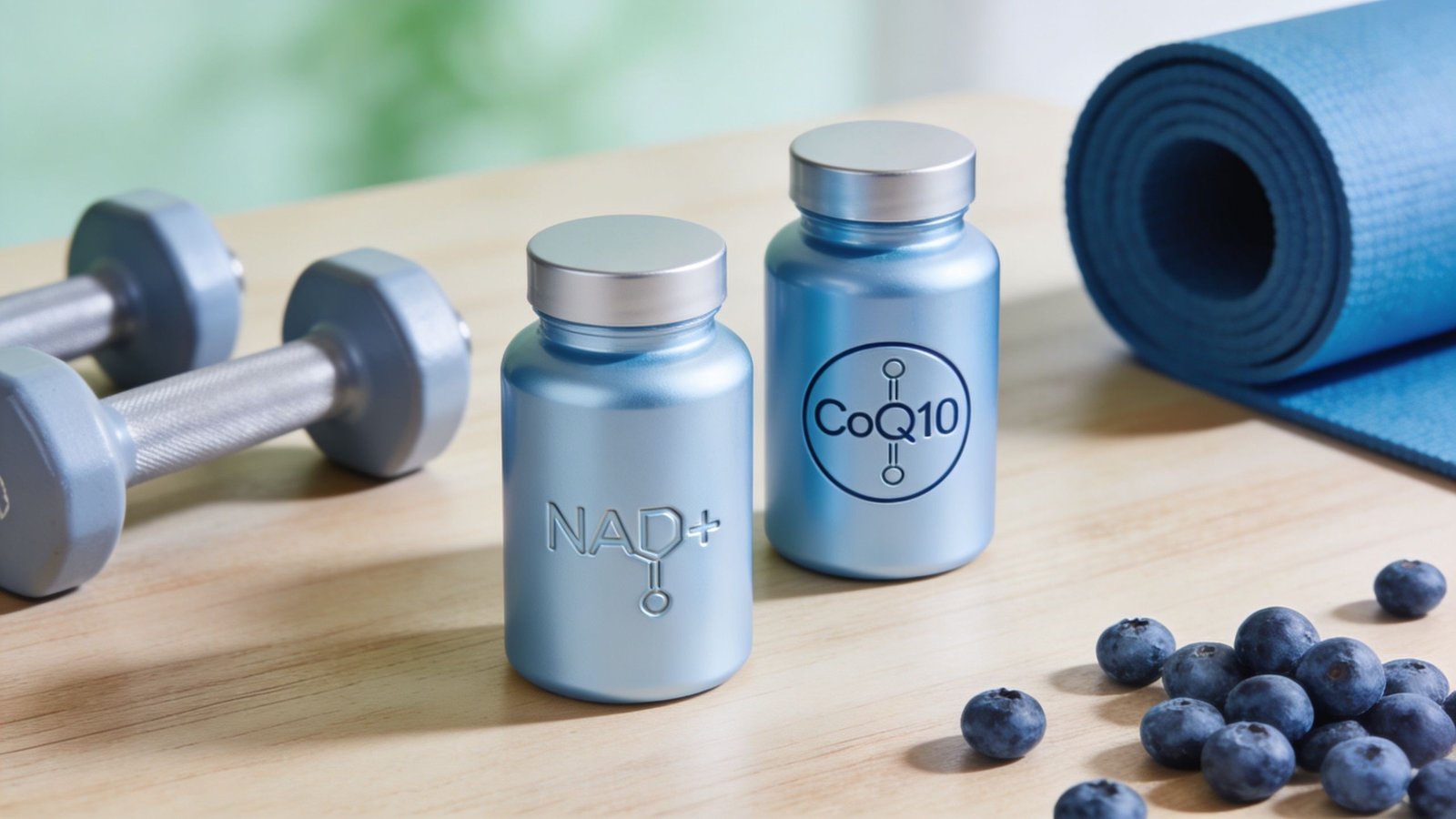
You train consistently. You hit your protein target most days. You sleep reasonably well. But your energy still feels flat, your legs stay heavy longer than they should, and the workout you expected to crush turns into a grind halfway through. That’s usually the point where people start looking past pre-workouts and caffeine and asking a better question. What if the problem is happening deeper, at the level where cells make energy?
That’s where NAD+ boosters and CoQ10 enter the conversation. They aren’t the same tool, and they don’t solve fatigue in the same way. One tends to make more sense when you feel generally drained, mentally dull, or stress-worn. The other often fits better when your issue is physical output, mitochondrial support, and recovery from hard training.
For home trainees and busy gym-goers, that distinction matters. Buying the wrong category can leave you with an expensive bottle that doesn’t match your real problem. Buying the right one can tighten the gap between effort and recovery.
This review focuses on 7 best Amazon supplements for people searching for the best NAD+ or CoQ10 for fatigue and gym recovery energy, with practical trade-offs, product-by-product pros and cons, and clear guidance on who should take what.
Introduction Conquering Fatigue and Maximizing Recovery
A common pattern shows up in serious trainees. Training stays consistent, meals are mostly dialed in, and yet recovery keeps lagging. Morning workouts feel harder than they should. The second half of the week becomes a test of willpower. You’re not injured, but you’re not bouncing back either.
That kind of fatigue often isn’t just about motivation. It can reflect how well your cells are producing and managing energy. When that engine runs inefficiently, the signs appear fast in training. You feel it as slower recovery, lower output, and a body that seems a step behind your effort.

If that sounds familiar, it helps to look at recovery support beyond the usual basics. Readers who want a broader fatigue-recovery framework can also look at this guide on supplements and nutrition for chronic fatigue and gym recovery.
Why these two categories matter
NAD+ boosters support the body’s ability to maintain NAD+, a coenzyme tied to cellular energy metabolism and repair. In supplement form, that usually means taking a precursor such as NR or NMN.
CoQ10 works more directly inside the mitochondria, especially in the electron transport chain where ATP production happens. It also serves as an antioxidant, which matters when hard training raises oxidative stress.
Practical rule: If your fatigue feels broad, stress-linked, or mentally draining, start by evaluating an NAD+ formula. If your issue is more about physical wear, heavy-leg workouts, and recovery drag, CoQ10 often makes more sense.
What this review covers
This article looks at seven Amazon products that fit real-world use cases:
- NR-based NAD+ support for all-day energy
- NMN-focused options for people who want a more aggressive NAD+ strategy
- CoQ10 and ubiquinol products for mitochondrial and recovery support
- Combination formulas for people who want one bottle instead of a stack
Each pick includes a practical review, pros and cons, and a bottom-line recommendation based on who should buy it.
NAD+ Boosters vs CoQ10 A Quick Comparison
You finish a late workday, force yourself into a home workout, and notice two different problems. Your head feels flat before the first set, but your legs also stay heavy for a day or two after training. That split matters, because NAD+ boosters and CoQ10 do different jobs.
NAD+ boosters support the upstream side of energy production and cellular repair. CoQ10 works closer to the mitochondria where ATP is produced, and it also helps control oxidative stress from training. In practice, NAD+ products often fit the person whose fatigue feels systemic. CoQ10 usually fits the trainee who can get through the session but pays for it with slower recovery.

Quick comparison table
| Category | NAD+ boosters | CoQ10 |
|---|---|---|
| Main role | Supports cellular energy metabolism and repair pathways | Supports mitochondrial ATP production and antioxidant defense |
| Best fit | People with broad fatigue, stress-heavy schedules, mental drag | People with physical fatigue, heavy training blocks, slower muscle recovery |
| Common forms | NR, NMN | Ubiquinone, ubiquinol |
| Typical feel | More systemic energy support | More workout and recovery-oriented support |
| Who often prefers it | Busy professionals, older lifters, women dealing with stress-linked energy dips | Strength trainees, endurance trainees, people focused on stamina and recovery |
| Can you stack them | Yes | Yes |
For readers comparing broader energy strategies, this guide to rapid ATP support supplements for speed training adds useful context on where direct ATP support may fit.
Where NAD+ boosters usually fit better
NAD+ boosters are usually the better first test if fatigue shows up before training starts. That includes the lifter who feels mentally dull by afternoon, the parent training at night after a stressful day, and the at-home trainee whose motivation drops with general energy rather than muscle soreness.
The practical trade-off is speed versus breadth. Many users describe NAD+ support as broader and steadier, but less noticeable acutely than a recovery-focused product. I usually place it earlier in the plan for people dealing with stress-linked energy dips, disrupted sleep, or age-related changes in day-to-day energy.
Women also report this pattern often, especially when recovery feels tied to sleep disruption, calorie restriction, or high life stress rather than hard training volume alone.
Where CoQ10 usually fits better
CoQ10 makes more sense when the problem is physical output and recovery drag. If the workout itself feels harder than it should, your legs stay dead after intervals, or repeated sessions leave you flat, CoQ10 is the more direct mitochondrial support option.
Form matters here. Ubiquinol is often chosen by older adults and buyers who want a premium form, while ubiquinone is common in lower-cost products. That does not make ubiquinone useless. It means absorption strategy and budget both matter.
A useful point that many comparison guides skip is stack design. CoQ10 does not have to be used alone. In a 2015 clinical trial, a combination of CoQ10 and NADH improved fatigue-related outcomes, which supports a practical approach many coaches already use. Start with the product that matches the main bottleneck, then add the second category if both mental energy and physical recovery are underperforming.
The best choice depends less on hype and more on the type of fatigue you feel most often.
A simple decision shortcut
- Choose NAD+ first if your energy crash feels global, stress-linked, or mentally heavy.
- Choose CoQ10 first if your training leaves you physically flat and recovery feels slow.
- Choose both if you want broader cellular support plus more direct mitochondrial recovery help.
- Adjust by context if needed. Older trainees often respond well to CoQ10, while busy women managing training plus high stress often do better when NAD+ support is part of the base plan.
How We Reviewed the Best NAD+ and CoQ10 Supplements
Amazon has too many lookalike supplements and too many labels that say “mitochondrial support” without saying much else. So the shortlist had to come from practical criteria, not marketing language.
What actually mattered in ranking these products
The first filter was ingredient form. For NAD+ products, that meant looking at whether the formula used NR, NMN, NADH, or a blend. For CoQ10, it meant separating standard ubiquinone products from ubiquinol, which many experienced buyers prefer when they want a more premium form.
The second filter was formula logic. A clean single-ingredient product can be a strength if you already know what you want. A blended product can be better if the supporting ingredients make sense for energy or recovery.
What we down-weighted
We did not give extra credit to vague phrases like “anti-aging powerhouse” or “doctor formulated” if the label didn’t show anything useful. We also down-ranked products that looked padded with trendy add-ons but gave no clear reason those extras belonged in a fatigue and gym recovery formula.
The practical review standard
Each product below was judged on five points:
- Form choice: Whether the ingredient type matches the job it’s supposed to do
- Absorption logic: Softgels, ubiquinol forms, or other delivery choices that make practical sense
- Label clarity: Whether buyers can understand the formula without digging through marketing copy
- Amazon fit: Availability, convenience, and whether it’s easy to reorder as part of a routine
- Use-case strength: Who it’s best for, instead of pretending one bottle fits everyone
The best supplement isn’t the one with the loudest label. It’s the one whose form, dose style, and formula match your specific fatigue pattern.
7 Best NAD+ and CoQ10 Supplements on Amazon Review 2026
You finish a hard lower-body session, sleep enough, hit your protein target, and still wake up flat. In practice, that usually points to one of two problems. You either need better whole-body energy support across the week, or you need more targeted mitochondrial support for training recovery.
That distinction matters more than brand hype. The products below were ranked by how well they match real fatigue patterns in home trainees, how sensible the form is, and how easy they are to use consistently from Amazon.
For readers building a wider stack around training stress, sleep, and soreness, these supplements for post-workout recovery and energy can help round out the plan.
1. Tru Niagen Pro
Tru Niagen Pro is still the cleanest NAD+ starter in this lineup. If someone asks me for one Amazon-friendly NAD+ product with the clearest research position and the lowest chance of label confusion, this is usually the first name I give.
As noted earlier, the case for this product rests on nicotinamide riboside, or NR. That makes it a better fit for people with broad, all-day fatigue than for lifters who only feel wrecked after training. It also suits older trainees, shift workers, and people whose recovery problem includes mental drain, poor motivation, and lower training consistency.
Best for: Broad fatigue, older trainees, mentally drained lifters, and buyers who want the clearest NR option.
Pros
- Clear ingredient strategy: NR is there for one reason, to support NAD+ production without cluttering the formula.
- Better fit for systemic fatigue: Useful when energy is low in work, training, and day-to-day life.
- Good stack foundation: Easy to pair with magnesium, creatine, protein, or a separate CoQ10 product.
- Practical for women and men: Women dealing with low energy during high-stress phases often do well with a steady NR base. Men in heavier training blocks often combine it with CoQ10 for better physical recovery coverage.
Cons
- Premium pricing: You pay for the research reputation and brand position.
- Slower payoff than stimulants: This is a consistency supplement, not a pre-workout substitute.
- Less specific for sore, heavy legs: If the main complaint is muscular fatigue after training, CoQ10 often makes more sense first.**
2. Life Extension NAD+ Cell Regenerator
Life Extension NAD+ Cell Regenerator fits the buyer who wants an NR product from a familiar supplement company and does not need a flashy formula. I like this category of product for cautious first-time users who want to test whether NAD+ support helps before spending top dollar.
Its strength is simplicity. You know what job it is trying to do. That matters on Amazon, where too many “NAD” listings mix trendy ingredients without a clear reason.
Best for: People who want a straightforward NAD+ precursor product without flashy extras.
Pros
- Clean entry into the NAD+ category: Good for buyers who want to start with the basics.
- Recognizable brand: Easier to trust than thinly branded marketplace listings.
- Useful for low-complexity routines: Works well if you already take several staples and do not want another kitchen-sink formula.
Cons
- Weaker standout case than Tru Niagen Pro: The positioning is solid, but less defined.
- Better for general energy than gym-specific bounce-back: Recovery support is more indirect.
- Usually needs pairing: Many trainees will still want CoQ10, creatine, or electrolytes alongside it.
3. Renue By Science NMN
Renue By Science NMN is the pick for buyers who already know they want NMN rather than NR. I would not call it the safest first purchase for every reader, but it can be a smart choice for experienced users who pay attention to how they perform, recover, and tolerate different ingredients.
The trade-off is simple. NMN attracts performance-focused buyers, but it also brings more confusion because product quality and positioning can vary a lot across brands. That makes brand selection more important here than in some basic CoQ10 categories.
Best for: Performance-focused users who want an NMN-centered product rather than NR.
Pros
- Direct fit for NMN buyers: Good for people who have already decided on this pathway.
- Works well in a two-part stack: NMN for broader cellular energy, CoQ10 for the physical side of recovery.
- Appeals to experienced trainees: Better for people who track results and make small adjustments.
Cons
- Not my first pick for beginners: NR is usually easier to understand and compare.
- Category noise is high: NMN listings can be harder to vet on Amazon.
- Needs clearer expectations: It is still a support tool, not an overnight energy fix.
4. Qunol Ubiquinol
Qunol Ubiquinol is one of the strongest practical picks here for lifters whose fatigue feels mechanical. Heavy legs. Slow recovery between sessions. A drop in output late in the week. That profile often responds better to CoQ10 than to starting with NAD+ alone.
Ubiquinol also tends to make more sense for older trainees and for people who want a premium CoQ10 form without building a complicated stack. In men pushing higher training volume, I often like it paired with an NAD+ booster. In women who already manage sleep and nutrition well but still feel physically flat, this can be the more obvious first move.
Best for: Gym-goers with heavy-leg fatigue, slower recovery, or a strong preference for CoQ10 over NAD+ products.
Pros
- Strong use-case match: Better aligned with muscular energy and workout recovery than most NAD+ products.
- Ubiquinol form: A better fit for buyers intentionally shopping the premium CoQ10 side of the category.
- Easy to combine: Stacks cleanly with NR, NMN, creatine, and omega-3s.
- Good for age-related recovery decline: Often a better first step when training soreness lingers longer than it used to.
Cons
- Narrower scope than NAD+ support: It does not address broader low-energy patterns as well.
- Less useful for stress-heavy fatigue: Physical recovery can improve while mental drain remains.
- Higher cost than basic CoQ10: The form is better positioned, but you usually pay for it.
5. Sports Research CoQ10
Sports Research CoQ10 sits in the middle of this list for a reason. It is not the premium pick, and it is not the bargain-basement one either. It works for the buyer who wants daily mitochondrial support without overthinking the category.
This is the kind of bottle I would suggest to a consistent home trainee doing three to five sessions per week who wants recovery support but does not need a specialized formula.
Best for: Regular exercisers who want straightforward CoQ10 support at a more approachable price point.
Pros
- Simple daily option: Easy to add without changing the rest of your routine.
- Solid for maintenance: Better for steady support than for chasing dramatic changes.
- More accessible price than premium ubiquinol products
- Pairs well with NAD+ supplements: Useful if your base stack already covers broader energy support.
Cons
- Less advanced than ubiquinol-first products
- May feel ordinary for experienced supplement users
- Not the strongest fit for people with clearly worsening recovery
6. NOW CoQ10
NOW CoQ10 earns its place because cost matters. Plenty of readers do not need the best-looking label or the most premium form on day one. They need a low-risk way to test whether CoQ10 improves post-workout energy, muscle freshness, or week-to-week recovery.
That is where this product makes sense. It is practical, easy to reorder, and usually the right kind of first experiment before moving up to ubiquinol if the response is good.
Best for: Shoppers who want a lower-cost CoQ10 entry point before moving to a more premium formula.
Pros
- Budget-friendly starting point
- Easy Amazon availability
- Straightforward formula: Good for buyers who prefer single-focus products
- Useful test case: Helps you decide whether CoQ10 belongs in your long-term routine
Cons
- Not the premium end of the category
- Absorption features are less compelling than higher-tier options
- May feel too basic for buyers who already know CoQ10 works for them
7. Jarrow Formulas QH-Absorb Ubiquinol
Jarrow Formulas QH-Absorb Ubiquinol is the more serious CoQ10 pick for buyers who want quality without adding extra ingredients they do not need. It is a strong fit for older athletes, high-compliance trainees, and anyone who already knows recovery is the limiting factor.
I would rank it especially well for people in hard training blocks, and for women and men over 40 who notice that one missed recovery day now costs them two or three.
Best for: Buyers who want a premium ubiquinol option for recovery support and mitochondrial focus.
Pros
- Ubiquinol format: Good match for buyers who want the premium CoQ10 form.
- Targeted toward physical recovery: Better suited to demanding training phases.
- Easy to combine with NAD+ products: Strong option in a two-part energy stack.
- More refined than entry-level CoQ10 picks
Cons
- Higher price than standard CoQ10
- Does not cover every type of fatigue on its own
- More product than some casual users need
Quick summary table
| Product | Main type | Best for | Main drawback |
|---|---|---|---|
| Tru Niagen Pro | NR | Broad fatigue and all-day energy support | Premium cost |
| Life Extension NAD+ Cell Regenerator | NR | Clean NAD+ support for beginners | Less workout-specific |
| Renue By Science NMN | NMN | Performance-focused users | Less beginner-friendly |
| Qunol Ubiquinol | CoQ10 | Physical fatigue and recovery | Narrower than NAD+ support |
| Sports Research CoQ10 | CoQ10 | Daily recovery support | More basic than premium picks |
| NOW CoQ10 | CoQ10 | Budget buyers | Less advanced form |
| Jarrow QH-Absorb Ubiquinol | CoQ10 | Premium recovery stack users | Higher price |
Product review summary
Tru Niagen Pro remains the strongest NAD+ pick here for broad, persistent low energy. Qunol Ubiquinol and Jarrow QH-Absorb Ubiquinol make more sense when recovery is the obvious problem, especially for older trainees or anyone coming off a hard training block.
The useful way to read this list is by protocol, not by hype. Start with NAD+ support if your fatigue is global, mental, and persistent. Start with CoQ10 if your issue shows up in your legs, your output, and your recovery between sessions. Combine them when both patterns are present.
The Verdict Our Top Picks for Energy and Recovery
The best product depends on the kind of fatigue you’re trying to fix. Some people need broader cellular energy support. Others need a more direct recovery tool that helps them feel less beaten up after training.

Best overall winner
Tru Niagen Pro wins best overall.
It gets that spot because it has the clearest evidence position in the list, the most defined NAD+ support role, and the broadest usefulness for readers whose fatigue isn’t limited to post-workout soreness. If your energy is low across work, training, and daily life, this is the most complete starting point.
Best for intense training and recovery
Qunol Ubiquinol gets the nod for harder training blocks.
When someone tells me their issue is not brain fog but heavy legs, poor bounce-back, and workouts that leave them flat for too long, I lean toward CoQ10 before anything else. This pick makes the most sense for that physical recovery profile.
Best budget-friendly option
NOW CoQ10 is the best budget pick.
It won’t be the most advanced product in the group, but it’s a practical way to test whether CoQ10 improves your training recovery before spending more on a premium ubiquinol formula.
One useful visual overview of the bigger NAD+ conversation is below.
Best for a two-part stack
If you want a stack rather than a single product, the strongest practical pairing from this review is:
- Tru Niagen Pro for broader NAD+ support
- A ubiquinol product such as Qunol or Jarrow for mitochondrial recovery support
That combination covers more ground than choosing one category blindly.
How to Choose The Right Supplement For Your Goals
The right pick depends on the pattern of fatigue, not the label on the bottle. Someone who feels mentally drained by midday usually needs a different strategy than someone whose legs stay heavy long after training ends.

If your fatigue is broad and stress-linked
Start with an NAD+ booster if low energy shows up across the full day, not just after hard sessions. This pattern often includes mental drag, weak motivation, poor resilience to stress, and the tired-but-alert feeling that shows up in people balancing training with work, parenting, or inconsistent sleep.
For women, the decision can be more nuanced than standard supplement roundups suggest. A review at Pink Stork on NAD vs CoQ10 for women 30+ highlights a point many guides miss. Hormonal changes, sleep disruption, and stress load can shift the fatigue pattern enough that NAD+ support may make more sense than starting with CoQ10. The same review also discusses morning dosing and performance data on NMN, which is useful if your goal is better day-long energy plus training capacity.
Best fit
- Women over 30 dealing with stress-linked fatigue
- Busy adults who train before work or late in the evening
- People whose low energy extends beyond soreness and muscle recovery
If your fatigue is mostly physical
CoQ10 is the better first move when the problem is output and bounce-back. This is the trainee who can show up, warm up, and get through the session, but power fades too soon and recovery lags into the next workout.
I see this more often in three groups. Lifters in high-volume blocks. Endurance athletes stacking repeated sessions. Older trainees who still want to train hard but notice recovery quality slipping before motivation does.
If focus is fine but your body feels slow to recharge, CoQ10 is usually the smarter first purchase.
If you want the widest coverage, use a stack with a clear purpose
A simple two-part stack often makes more sense than forcing NAD+ and CoQ10 into a one-winner debate. NAD+ support fits the brain-energy-stress side of the equation. CoQ10 fits the mitochondrial output and recovery side. At-home trainees dealing with both kinds of fatigue often do better when they address both.
One stack stands out from a practical coaching perspective. Pair an NR or NMN product with a ubiquinol CoQ10 product. That gives you broader cellular energy support while also covering the physical recovery side that matters during harder training weeks. Women with stress-heavy fatigue and men pushing volume both can benefit here, but the reason differs. Women often report better day-long steadiness, while men in demanding blocks more often notice improved training durability and less post-session flatness.
There is also some clinical support for a CoQ10 plus NADH combination, as noted earlier. The study population was chronic fatigue syndrome, not gym athletes, so I would treat that as mechanistic support rather than direct sports evidence.
A practical selection guide
Use this framework:
- Choose an NR product if you want the most established NAD+ entry point for broad energy support.
- Choose NMN if performance is a bigger priority and you already understand the NAD+ category.
- Choose CoQ10 or ubiquinol if your main issue is muscular fatigue, slower recovery, or reduced training output.
- Choose a stack if both daily energy and gym recovery are lagging.
Common mistakes that waste money
The first mistake is buying by trend instead of fatigue pattern. A popular NAD+ product will not solve a recovery problem that is mainly muscular.
The second is expecting stimulant-like effects. These supplements are better judged over weeks than hours.
Timing also matters. NAD+ products tend to fit better earlier in the day for people who are sensitive to late-day energy support. CoQ10 is usually easier to place around breakfast or lunch, especially if the formula absorbs better with a meal.
Keep the stack simple. One NAD+ product and one CoQ10 product is enough to judge whether the combination helps. More capsules do not guarantee better results.
Conclusion Fuel Your Fitness Journey from Within
The search for the best NAD+ or CoQ10 for fatigue and gym recovery energy usually starts because effort and recovery no longer match. You’re training hard enough. What’s missing is support at the cellular level where energy is made and managed.
NAD+ boosters fit best when fatigue feels broad, stress-linked, or mentally draining. CoQ10 fits best when your problem is physical output, mitochondrial support, and slow post-workout recovery. For some people, the smartest move is not choosing sides. It’s using both categories strategically.
The biggest mistake is treating every fatigue problem like the same problem. It isn’t. Match the supplement to the pattern. If you want the strongest all-around NAD+ pick from this review, start with Tru Niagen Pro. If recovery is the main issue, start with a ubiquinol CoQ10 product such as Qunol or Jarrow.
A good supplement won’t replace training, food, or sleep. But the right one can help those basics work better.
Frequently Asked Questions
Can I take an NAD+ booster and CoQ10 at the same time?
Yes, often with good reason. They act on different parts of the energy system, so combining them can make sense for lifters dealing with both flat daily energy and poor training recovery.
The clearest support for pairing comes from research on CoQ10 plus NADH in people with fatigue. In practice, I treat that as supportive, not definitive, because NADH is not the same as NR or NMN, and fatigue studies are not the same as resistance training studies. Still, the direction is useful. A simple at-home protocol is NAD+ support in the morning, then CoQ10 with breakfast or lunch if that meal contains fat.
For home trainees, the best use case is specific. Pair them if you have low drive before training, slow recovery after training, and your sleep and calories are already in decent shape.
How long does it take to notice a difference?
Plan on weeks, not days.
CoQ10 can feel faster for some people, especially if the issue is workout stamina or a heavy-legged, underpowered feeling. NAD+ boosters usually reward consistent use. A fair trial is about a month for CoQ10 and closer to one to two months for an NAD+ product before deciding whether it deserves a place in your routine.
The mistake is changing three variables at once. Keep your training plan, caffeine intake, and sleep routine steady enough that you can tell what the supplement is doing.
Should women over 30 lean toward NAD+ or CoQ10?
It depends on the fatigue pattern, not just age.
Women dealing with stress-heavy fatigue, poor resilience, and that wired-but-drained feeling often do better starting with NAD+ support. Women whose main complaint is lower training output, slower muscular recovery, or more pronounced fatigue after sessions may respond better to CoQ10 first. That distinction matters more than marketing claims.
A practical split works well here. Start with NAD+ if the problem shows up all day. Start with CoQ10 if the problem shows up most during training and the next morning. If both patterns are present, a combined stack is reasonable.
Is CoQ10 enough by itself for gym recovery?
Often, yes.
If your main problem is physical recovery, reduced output, or feeling like your engine is missing a gear, CoQ10 is a sensible first step. Ubiquinol usually makes more sense for older adults, heavier training blocks, and anyone who has not done well with standard ubiquinone. If recovery improves but overall energy, focus, or stress tolerance still lag, that is usually the point where adding an NAD+ booster is worth considering.
That is the bigger theme of this review. The better choice is not always NAD+ or CoQ10. For many at-home trainees, the better answer is the right sequence, dose, and stack for the fatigue pattern you experience.
If you want more practical breakdowns on recovery supplements, training-friendly stacks, and no-hype product reviews, visit Energy Supplement Reviews. It’s a useful resource for busy lifters and home trainees who want smarter guidance on what supports performance and recovery.
