

You drag yourself through work, errands, and the usual life friction, then stare at your training plan knowing exercise would probably help, if you had enough gas left to do it well. That’s the trap. You need energy to train, but you’re also training because you want more energy.
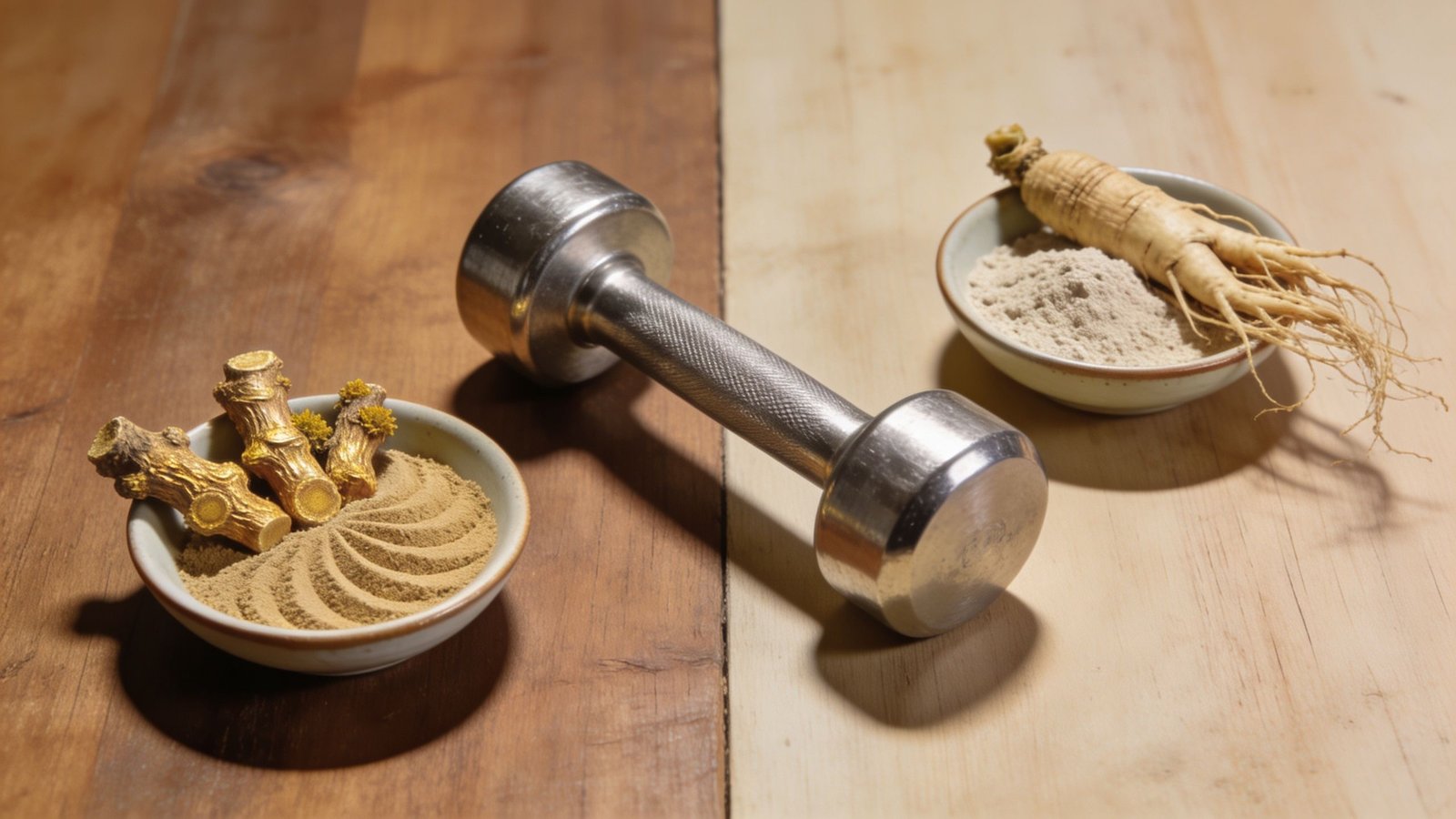
For people stuck in that cycle, Rhodiola rosea and Panax ginseng are two of the few adaptogens worth discussing seriously. Not because they’re miracle fixes, and not because every “energy” supplement deserves attention, but because both have a plausible role when fatigue and performance collide. One tends to fit the person who still wants better training output. The other often fits the person who feels worn down before the warm-up even starts.
If you’ve been searching for the best rhodiola or ginseng for chronic fatigue and gym stamina, the core question isn’t which herb is “stronger.” It’s which one matches the problem you currently have right now.
The Fatigue and Fitness Paradox
Some readers are dealing with low-grade daily exhaustion. Others feel flat, foggy, and under-recovered even when they sleep enough. A lot of them still want to train. They want to lift, do cardio, rebuild conditioning, and feel athletic again. But the body doesn’t always cooperate.

That’s the paradox. If you push too hard, fatigue often gets worse. If you back off too much, stamina drops, motivation falls, and deconditioning starts to feed the problem. In coaching practice, this is one of the most common supplement questions I see from home trainees and gym regulars alike. They’re not asking for a buzz. They want enough stability to function during the day and enough reserve to train without feeling wrecked afterward.
Adaptogens can help in that middle zone, but only if expectations are realistic. These herbs don’t replace sleep, calories, pacing, or a properly managed program. What they can do is support stress tolerance, reduce fatigue for some users, and in the case of rhodiola, potentially improve exercise-related performance markers.
If your fatigue picture is broader than training alone, it also helps to compare these options against other natural energy supplements for chronic fatigue syndrome. Adaptogens work best when they’re part of a wider recovery strategy, not the whole strategy by themselves.
The right supplement won’t rescue a bad training week. It can make a good plan easier to execute.
Rhodiola vs Ginseng The Scientific Showdown
When people compare rhodiola and ginseng, they usually flatten them into one category called “energy herbs.” That’s too simplistic. Both are adaptogens, but they don’t shine in the same situations.
Where rhodiola has the edge
The strongest case for Rhodiola rosea is workout tolerance and fatigue under stress. A Frontiers review reported that rhodiola showed significant efficacy for endurance performance enhancement. Across 11 studies, VO2max improved with an effect size of 0.32 (p < 0.01), time to exhaustion improved with an effect size of 0.38 across 7 studies (p < 0.05), and time trial performance improved with an effect size of −0.40 across 5 studies (p < 0.05). The same review also noted that doses above 600 mg/day produced greater VO2max improvements, and trained individuals showed more pronounced early reductions in creatine kinase after exercise in some settings, according to the Frontiers Nutrition review on rhodiola and endurance performance.
A separate review summarized 16 studies with more than 350 participants and found consistent improvements in lifting power, heart-rate efficiency during exercise, and aerobic power with 100 to 600 mg daily for 4 to 6 weeks, with stronger effects in sub-elite or untrained groups, as described in the Innerbody rhodiola review.
In practice, that makes rhodiola the more logical pick for someone who says, “I’m tired, but my biggest frustration is feeling gassed in training.”

Where ginseng makes more sense
Panax ginseng is a better fit when the core problem is broader, heavier fatigue rather than a lack of acute performance. A meta-analysis found statistically significant efficacy for fatigue reduction with an effect size of 0.34 (95% CI = 0.16 to 0.52, n = 4), but no significant association with physical performance enhancement, where the effect size was −0.01 (95% CI = −0.29 to 0.27, n = 8) in the PMC review of ginseng and fatigue or physical performance.
That distinction matters. Ginseng may help the person who feels chronically drained, run down, or mentally flat. It’s less convincing if you expect it to act like a direct pre-workout performance booster.
Rhodiola vs. Ginseng At a Glance
| Feature | Rhodiola Rosea | Panax Ginseng |
|---|---|---|
| Best fit | Workout tolerance, endurance support, stress-loaded training blocks | Chronic fatigue support, recovery focus, all-day resilience |
| Evidence pattern | Stronger support for acute exercise-related markers | Stronger support for fatigue reduction than for direct performance |
| Typical practical use | Often used before training or earlier in the day | Often used consistently across weeks for steadier support |
| Mechanistic emphasis | HPA axis regulation and mitochondrial ATP support | Antioxidant, anti-inflammatory, metabolic and recovery support |
| What it usually doesn’t do well | It isn’t a replacement for calories, sleep, or intelligent programming | It usually isn’t the best choice for a sharp same-day training lift |
The practical takeaway
If your week is dominated by hard sessions, poor stress tolerance, and feeling underpowered in the gym, rhodiola usually deserves first look. If your bigger issue is that you feel depleted before the day even begins, ginseng is often the better starting point.
Practical rule: Match the herb to the bottleneck. Don’t use a recovery-focused adaptogen when what you really need is better training tolerance, and don’t expect a performance-oriented herb to solve deep all-day fatigue by itself.
How to Choose the Right Adaptogen for Your Goals
Picking between rhodiola and ginseng gets easier when you stop asking which one is “best” and start asking what kind of tired you are.

Choose rhodiola if training is the priority
Rhodiola fits people who can still train, but don’t feel efficient doing it. They start sessions sluggish, hit the wall too early, or feel that their stress load is killing workout quality more than their motivation is. If your goal is to improve gym stamina, make hard sessions feel more manageable, or reduce that “flat but wired” training state, rhodiola is usually the cleaner match.
It also makes more sense for the person who wants a supplement with a more obvious link to endurance-related outcomes and workout tolerance.
Choose ginseng if daily fatigue is the bigger problem
Ginseng is a better fit when life itself feels draining. You may still care about the gym, but the larger issue is your baseline energy, your general resilience, and how wiped out you feel between sessions. If workouts suffer mainly because you never feel restored, ginseng deserves more attention.
That’s why I often think of ginseng as a support herb for the training week, not just the workout itself.
Consider a combination if you have the dual-use problem
The dual-use case is the one most articles miss. Some people need support for chronic fatigue in daily life and also want better acute gym stamina. The problem is that supplement guides rarely separate those goals in a practical way.
One reason for the confusion is that dosage discussions are often vague. As noted in Healthline’s overview of herbs for energy, a 2017 study used 400 mg of Rhodiola rosea extract daily for 12 weeks to improve burnout symptoms, while separate studies reference 200 mg per day of ginseng for beneficial effects, yet no content clarifies whether the same dose works for gym stamina or if athletes need different protocols.
If you relate to that, this is a better framework:
- Use rhodiola first if your training quality is falling faster than your general daily function.
- Use ginseng first if your baseline fatigue is so high that consistent training is the bigger challenge.
- Consider a low-dose combo only after you know how each herb affects you on its own.
For readers comparing non-stimulant options more broadly, it also helps to review other natural energy supplements without caffeine, especially if caffeine already worsens anxiety, sleep, or crashes.
A simple self-check
Ask yourself these three questions:
What fails first, my day or my workout?
If workouts fail first, lean rhodiola. If the whole day fails first, lean ginseng.Do I need something fast-leaning or steady-leaning?
Rhodiola is often chosen for a more immediate training role. Ginseng tends to make more sense when used consistently.Do stimulants already make me feel worse?
If yes, start conservatively with either herb and avoid stacking it blindly with aggressive pre-workouts.
The 7 Best Rhodiola & Ginseng Supplements on Amazon for 2026
Below are seven Amazon products worth considering if you’re trying to solve both sides of the problem: chronic fatigue in daily life and stamina in training. I’m focusing on formulas that clearly identify the herb used, the extract form, or the standardization details when available. That matters more than flashy “energy” marketing.
1. Thorne Rhodiola
Best for: Clean rhodiola option for readers prioritizing workout tolerance and stress-loaded training weeks.
Thorne is one of the safer first picks when you want a straightforward rhodiola product from a brand with a strong reputation for conservative formulation. This is the kind of supplement I’d point to for someone who doesn’t want a kitchen-sink blend and would rather test rhodiola by itself.
Pros
- Brand reputation: Thorne is widely known for quality control and simple formulas.
- Single-ingredient focus: Easier to evaluate your response when rhodiola isn’t buried in a complex blend.
- Good fit for testing tolerance: Useful for readers who want to assess whether rhodiola helps their gym stamina before adding anything else.
Cons
- Usually pricier: You often pay more per serving than with mass-market options.
- May feel too subtle for some users: Especially if someone expects a stimulant-like kick.
- Not ideal if chronic fatigue is your main issue: It’s better aligned with performance support than all-day fatigue management.
Summary: Strong pick if your main complaint is poor workout resilience rather than broad, heavy fatigue.
2. NOW Foods Rhodiola
Best for: Budget-conscious buyers who still want a recognizable rhodiola product.
NOW Foods tends to sit in the sweet spot between affordability and decent label transparency. For many readers, it’s the practical Amazon choice when they want to try rhodiola without spending premium-brand money.
Pros
- Better value: Often easier on the budget for a first trial.
- Widely available on Amazon: Convenient for repeat ordering.
- Simple use case: A reasonable starting point for morning use or pre-training experimentation.
Cons
- Less premium feel than top-tier brands: Some buyers prefer stricter specialty-brand positioning.
- Capsule potency may not fit everyone’s routine: You may need to adjust serving strategy based on your tolerance.
- Not a shortcut around poor recovery habits: If sleep and food intake are off, results will usually disappoint.
Summary: Good starter rhodiola for buyers who want practicality over premium packaging.
3. Gaia Herbs Rhodiola Rosea
Best for: Readers who want a more herbalist-style brand approach and a dedicated rhodiola product.
Gaia Herbs appeals to shoppers who care about plant-based sourcing and traditional herbal identity, but still want something easy to buy on Amazon. It’s a solid middle-ground choice if you dislike “hardcore sports supplement” branding.
Pros
- Strong herb-focused branding: Appeals to readers who want a classic botanical supplement.
- Single-herb formula: Keeps the trial clean and easier to assess.
- Useful for stress-heavy periods: Better suited to people whose training drops when life stress rises.
Cons
- Can cost more than value brands: Not always the cheapest route for long-term use.
- May not satisfy users who want a stronger gym feel: Rhodiola isn’t a pre-workout replacement.
- Bottle economics may be weaker: Depending on serving size and price.
Summary: A thoughtful rhodiola pick for readers who value a traditional herb-first approach.
4. Nature’s Way Korean Ginseng
Best for: Readers whose main issue is underlying fatigue, not acute workout output.
If I were picking a classic Amazon ginseng option for general energy support, Korean ginseng from an established mainstream brand is one of the easiest places to start. This type of product is less about “today’s PR” and more about getting through the week with less drag.
Pros
- Clear chronic-fatigue use case: Better aligned with broad energy support than with gym-session intensity.
- Mainstream availability: Easy to find and reorder.
- Familiar brand for cautious buyers: Useful for people who don’t want an obscure supplement label.
Cons
- Won’t act like a pre-workout: Many buyers choose ginseng for the wrong reason.
- Benefits may feel gradual: This isn’t usually the herb for immediate workout impact.
- Can be disappointing if expectations are off: Especially for people chasing explosive performance.
Summary: Better for someone trying to support daily resilience and consistency than someone chasing a same-day training boost.
5. NOW Foods Panax Ginseng
Best for: Budget-friendly ginseng support for all-day fatigue and recovery-focused use.
This is the practical counterpart to premium ginseng options. It makes sense for readers who respond well to Panax ginseng and want an affordable bottle for steady use over time.
Pros
- Accessible pricing: Easier for long-term experimentation.
- Straightforward positioning: Good for users who want Panax ginseng without extra filler ingredients.
- Useful during demanding life periods: Especially when training quality falls because baseline fatigue is high.
Cons
- Less exciting for gym-focused buyers: It usually won’t feel dramatic in the moment.
- Can be too broad a tool for narrow goals: If your issue is specifically pre-workout stamina, rhodiola may fit better.
- Response is individual: Some users do better with one ginseng form than another.
Summary: A sensible buy for readers who need a fatigue-support supplement they can stay consistent with.
6. Double Wood Rhodiola Rosea
Best for: Readers who want a modern, minimalist supplement brand and a direct rhodiola trial.
Double Wood has become a recognizable Amazon name for single-ingredient nootropics and botanicals. For rhodiola users, that usually means a fairly clean way to test whether the herb helps stress tolerance and workout readiness.
Pros
- Minimalist product style: Appeals to buyers who want uncomplicated labeling.
- Single-ingredient testing: Easier to tell whether rhodiola itself works for you.
- Good fit for performance-first users: Particularly if you train despite a busy, stressful schedule.
Cons
- Brand preference is subjective: Some readers still prefer older legacy supplement brands.
- May overlap heavily with other rhodiola options: The deciding factor can come down to price and trust.
- Not the best first choice for severe all-day fatigue: Better for the person who still has some training capacity.
Summary: Worth considering if you want a direct rhodiola experiment without a blended formula.
7. Zhou Genius Mushrooms with Rhodiola or a combo-style adaptogen blend on Amazon
Best for: Readers who want broader adaptogenic support rather than a pure rhodiola or pure ginseng test.
Amazon is full of blended adaptogen products that combine rhodiola, ginseng, mushrooms, or other support ingredients. A combo formula can make sense for the dual-use reader who wants support for both daily function and training stress. The trade-off is that blends are harder to troubleshoot.
Pros
- Broader coverage: May suit people dealing with stress, fatigue, and training strain at the same time.
- Convenient all-in-one approach: Fewer bottles on the shelf.
- Potentially useful for combo users: Especially after you already know you tolerate adaptogens well.
Cons
- Harder to isolate what works: If you feel better or worse, the cause isn’t obvious.
- Label quality varies widely on Amazon: You need to inspect active ingredients carefully.
- Often less precise: Blends can underdose the ingredient you want.
Summary: Best for experienced supplement users, not beginners. If you’re new to adaptogens, start with a single-herb product first.
Quick product summary
| Product | Best for | Main drawback |
|---|---|---|
| Thorne Rhodiola | Premium single-herb rhodiola | Higher price |
| NOW Foods Rhodiola | Budget rhodiola trial | Less premium positioning |
| Gaia Herbs Rhodiola Rosea | Herbalist-style rhodiola pick | Cost can be higher |
| Nature’s Way Korean Ginseng | Daily fatigue support | Not a strong acute gym aid |
| NOW Foods Panax Ginseng | Affordable long-term fatigue support | Subtle workout effect |
| Double Wood Rhodiola Rosea | Minimalist rhodiola trial | Overlaps with similar options |
| Combo adaptogen blend | Dual-use support | Harder to assess and dose |
If you’ve never used either herb before, the smartest Amazon buy is usually the one that lets you test one variable at a time.
Our Verdict The Best Adaptogen for Fatigue and Stamina
If I had to choose one overall winner for the best rhodiola or ginseng for chronic fatigue and gym stamina, I’d give the nod to Thorne Rhodiola for most active readers.
Why that one? Because the harder problem for many gym-minded buyers isn’t just feeling tired. It’s feeling too stressed, too flat, and too underpowered to train well. Rhodiola matches that use case better than ginseng, and a clean single-ingredient product from a trusted brand makes the trial far more useful.

Category winners
- Best overall winner: Thorne Rhodiola
- Best for pre-workout stamina: Double Wood Rhodiola Rosea
- Best for all-day fatigue support: Nature’s Way Korean Ginseng
- Best budget option: NOW Foods Rhodiola
- Best for cautious beginners: NOW Foods Panax Ginseng
- Best if you want a traditional herb-first feel: Gaia Herbs Rhodiola Rosea
The key trade-off
Rhodiola is the better athlete’s adaptogen. Ginseng is often the better fatigue manager. That doesn’t mean rhodiola can’t help someone with burnout-style fatigue, and it doesn’t mean ginseng is useless for active people. It means your first purchase should reflect the bottleneck you want to solve first.
If you feel tired but still train, start with rhodiola. If you feel so drained that training consistency is the primary issue, start with ginseng.
Maximizing Results A Practical Implementation Guide
The right bottle matters less than the way you use it. Most disappointing adaptogen experiences come from one of three mistakes: taking too much too fast, expecting stimulant-like effects, or using a blended product before you know your response to the main herb.
Start with one target, not two
Pick the priority before you pick the dose.
- If your priority is gym stamina: Start with rhodiola earlier in the day or before training.
- If your priority is all-day fatigue: Start with ginseng and judge it over consistent daily use.
- If both matter equally: Test one herb for a full trial period before adding the second.
Because “feeling better” is too vague, you need a measurable target such as easier warm-ups, fewer dead-feeling sessions, less afternoon crash, or better recovery between training days.
Use the practical dosing ranges already supported in the evidence base
For rhodiola, the practical guidance in the reviewed material points toward standardized extracts around 3 to 5% rosavins and 1 to 2% salidroside at 200 to 400 mg/day, often taken 30 to 60 minutes pre-training or in two divided doses, with cycling of 8 to 12 weeks on and 2 to 4 weeks off, according to the Innerbody rhodiola dosing and usage summary.
For ginseng, reviewed practical guidance supports standardized Panax ginseng root extract around 4 to 7% total ginsenosides at 200 to 600 mg/day, with effects on energy and recovery generally requiring 4 to 8 weeks of consistent use, as noted in the Cereflex comparative guide to rhodiola and other adaptogens.
Time it like a coach, not like a gambler
Rhodiola is usually more useful when timing matters. Ginseng is usually more useful when consistency matters.
A practical approach looks like this:
- Morning trial: Start your first few uses on non-critical days so you can judge alertness, stomach comfort, and sleep effects.
- Training-day test: If rhodiola suits you, try it before a normal training session rather than your hardest session of the month.
- Recovery tracking: With ginseng, monitor your weekly pattern, not your first workout.
Coach’s note: If a supplement only feels useful when everything else is already perfect, it’s a weak tool for your real life.
Read labels like they matter
A good adaptogen label should answer basic questions quickly:
- What species is it? Rhodiola rosea and Panax ginseng should be named clearly.
- Is it standardized? Look for rosavins and salidroside in rhodiola, or ginsenosides in ginseng.
- Is it a blend or a standalone? Standalone products are easier to evaluate.
- How many capsules equal one serving? This changes convenience and cost.
- Does the formula stack stimulants? If it includes caffeine-heavy extras, it may muddy the effect.
Don’t sabotage the trial
Common mistakes that make a good product look bad:
- Changing too many variables at once: New pre-workout, new training block, new sleep schedule, and a new adaptogen is a useless experiment.
- Using it to outrun under-recovery: These herbs support resilience. They don’t erase poor sleep and low calories.
- Ignoring blood pressure, medication, or sensitivity issues: If you have a medical condition, use medications, or react strongly to stimulating compounds, check with a clinician before starting.
A Smarter Approach to Energy Management
The best rhodiola or ginseng for chronic fatigue and gym stamina depends on what’s limiting you most. Rhodiola usually fits better when training quality, endurance, and stress-loaded workouts are the pain point. Ginseng usually fits better when broad fatigue, recovery, and daily function are the bigger problem.
That’s why the smartest approach isn’t to chase the strongest-sounding herb. It’s to choose the one that matches your current bottleneck, use a clean Amazon product, and track whether your life and training improve.
If fatigue is tied to broader health issues, it may also help to compare these herbs with other support options like iron or B-12 for anemia and boosting gym energy. The right supplement strategy gets much better once you stop treating every low-energy problem as the same problem.
Frequently Asked Questions
Can I take rhodiola and ginseng together?
Yes, some people do. The combination can make sense when you want support for both workout tolerance and broader fatigue resilience. Still, it’s better to test each one alone first. That way, if you feel better, worse, overstimulated, or unchanged, you’ll know which herb is responsible.
How long does it take to notice a difference?
Rhodiola is often used when people want a more noticeable training-related effect, so some users judge it fairly quickly. Ginseng is usually better assessed over a longer stretch of consistent use. In either case, don’t evaluate an adaptogen like a strong pre-workout. The useful question is whether your days and sessions become more manageable over time.
Which is better for gym stamina?
Rhodiola is the better bet if your main concern is feeling less drained during training or holding output better across a session. Ginseng may still help if poor recovery and chronic fatigue are what’s hurting your performance, but it isn’t the stronger pick for acute endurance-related support.
Which is better for chronic fatigue?
Ginseng usually makes more sense when the problem is broad, ongoing fatigue that affects the whole day. Rhodiola can still be useful, especially when stress and burnout are part of the picture, but if your baseline energy is the main issue, ginseng is often the more logical first trial.
Do I need to cycle off these supplements?
Cycling is commonly recommended for rhodiola, especially when you use it regularly. It can also be a smart strategy with ginseng if you’re taking it continuously for long periods. A short break helps you check whether the supplement is still helping and may reduce the chance that your routine becomes stale or hard to assess.
Are there people who should be careful with these herbs?
Yes. Anyone who has a medical condition, takes prescription medications, monitors blood pressure or blood sugar closely, or tends to react strongly to stimulating supplements should speak with a healthcare professional first. That matters even more if you’re already using caffeine-heavy pre-workouts or multiple adaptogens at once.
If you want more practical supplement breakdowns, fitness-focused product roundups, and realistic advice for training with limited energy, visit Energy Supplement Reviews. It’s a solid resource for readers who want clear recommendations without the usual hype.
